

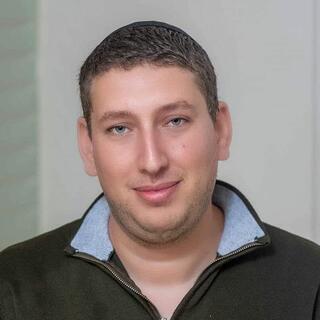
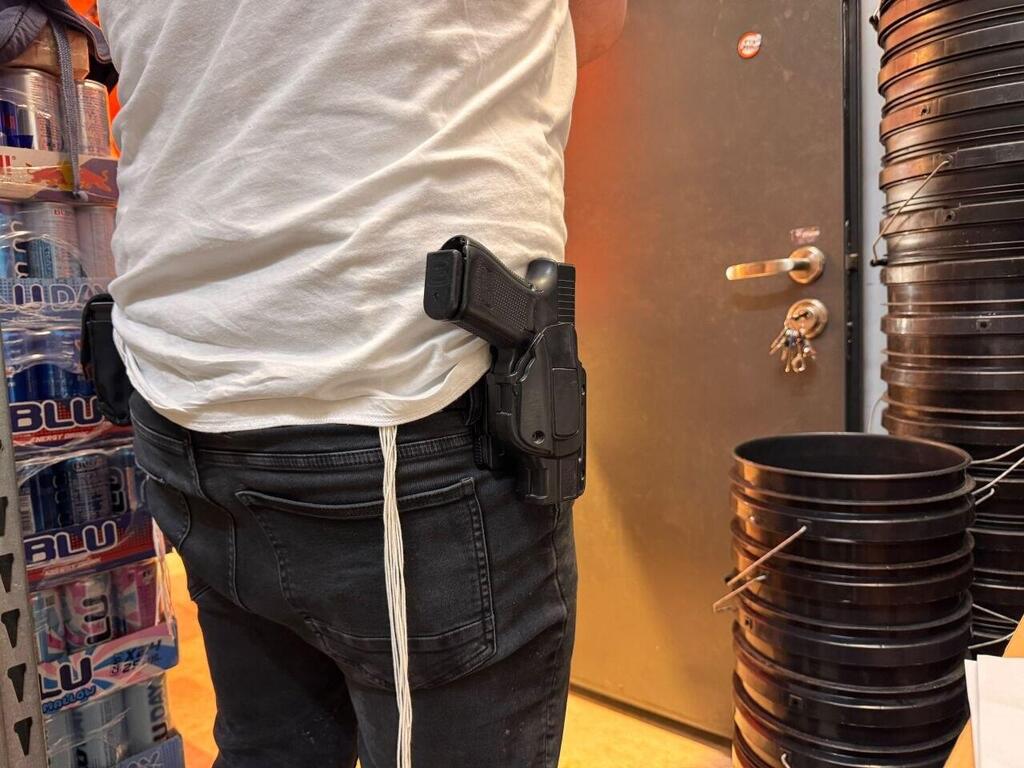
It is becoming an increasingly familiar sight on the streets of Israel’s ultra-Orthodox cities: young men walking with handguns strapped to their belts.
Some carry two-way radios, a sign that they volunteer with emergency organizations such as ZAKA or United Hatzalah. Others have chosen to arm themselves over the past year out of concern for their personal security.
Now, ynet's parent newspaper Yedioth Ahronoth has learned that neighborhoods in Beit Shemesh, a city west of Jerusalem with a large ultra-Orthodox population, have also been designated as areas whose residents may qualify for personal firearm licenses.
The change is part of a much broader transformation in civilian gun ownership in Israel, driven by an expansion of eligibility rules promoted by National Security Minister Itamar Ben-Gvir. The shift has brought guns into communities where many residents, particularly ultra-Orthodox men, have never served in the military and therefore lack the weapons training that many other Israelis receive during compulsory service.
Some gun owners within the community say they are well aware of the concerns.
Ben-Gvir has eased firearm licensing rules and expanded the list of eligible areas to include numerous ultra-Orthodox communities. According to the National Security Ministry, the changes have led to an increase of several hundred percent in the number of young ultra-Orthodox Israelis carrying firearms in their cities.
Beit Shemesh illustrates how carefully those boundaries are being drawn.
Authorities conducted a review of the city aimed at excluding neighborhoods with concentrations of ultra-Orthodox extremists while allowing residents of areas populated by more mainstream ultra-Orthodox Jews, religious Zionists, traditional Jews and secular Israelis to qualify for licenses.
Among the neighborhoods excluded from the eligibility map are Heftziba and Ramat Beit Shemesh Bet. The latter is home to members of extremist ultra-Orthodox groups, including activists who vandalized the home of Supreme Court Justice Noam Sohlberg in June.
The numbers illustrate the scale of Israel’s gun licensing expansion. In 2021, only six communities were designated as eligible areas. By 2025, that figure had risen to 80. Since the beginning of 2026, another 126 communities have received the designation, marking a dramatic increase in the number of Israelis potentially eligible for licenses.
Since the broader expansion began, about 300,000 civilians have received personal firearm licenses, while more than 200 communities have been declared eligible areas.
The change has also reached a growing number of cities with large ultra-Orthodox populations. Among the communities approved are Kiryat Sefer, Netivot, Ashdod, Harish, Kiryat Gat, Beitar Illit and Modi’in Illit.
Israel does not have an unrestricted right to private gun ownership. Civilians generally must meet government eligibility criteria and obtain a license before legally acquiring and carrying a handgun. Geographic eligibility — living or working in an area designated by the government — is one route to obtaining such a license.
Another easing of the rules, introduced earlier, expanded eligibility for volunteers with emergency and rescue organizations, including groups with a strong presence in the ultra-Orthodox community such as ZAKA, whose volunteers frequently respond to scenes of terrorist attacks, accidents and disasters, and United Hatzalah, a volunteer emergency medical service.
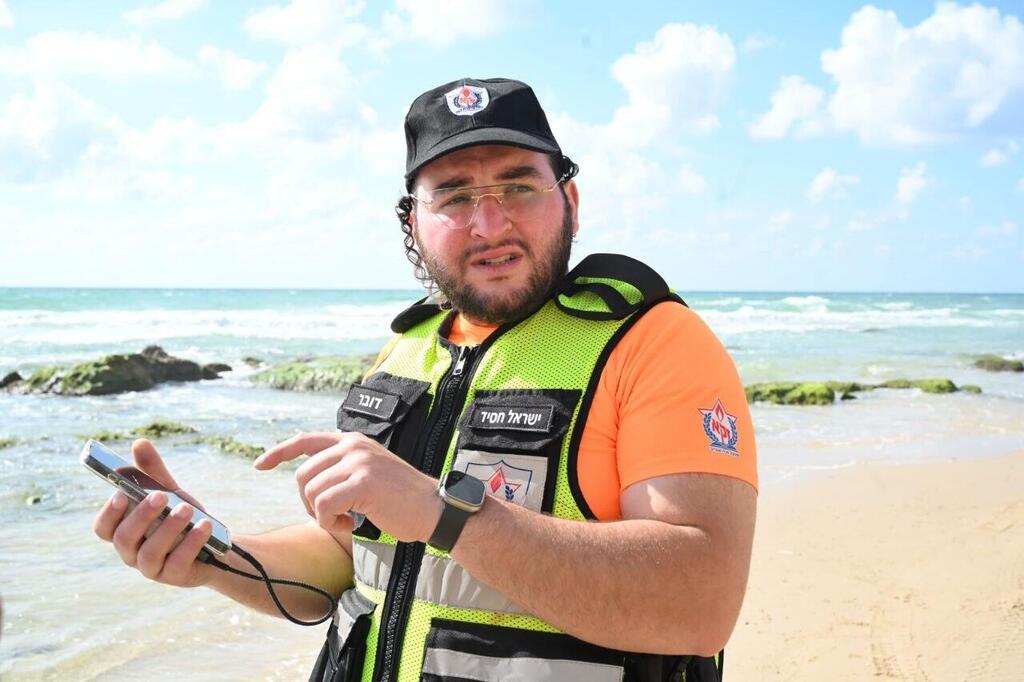
ZAKA spokesperson Israel Hassid
Israel Hassid, a ZAKA spokesperson, is among those who decided to carry a gun.
“I go out to difficult and sensitive scenes, and I decided I wanted to be safer and equip myself with a firearm,” Hassid said. “There is a great deal of interest in this in the community I belong to.”
But Hassid is acutely aware of the risks of introducing more firearms into a community where many people have neither carried weapons nor served in an institution such as the military that provides training in handling and securing them.
“A gun is not a game,” he said. “Young people can say, ‘Come on, there’s a gun, let’s take it,’ but these are dangerous, brutal tools. A firearm poses a mortal danger to the person carrying it, not only to the people around them.”
Every time he straps on his gun, Hassid said, he is conscious of what it can do.
“When I put it on, I know I am carrying something that in a second can cause a very serious incident,” he said. “It is an enormous responsibility.”
Still, he says the growing presence of armed civilians has changed the sense of security within the ultra-Orthodox community.
“In our community, there are a lot of people with guns now, and they feel more protected,” Hassid said. “When someone walks into a synagogue on Shabbat carrying a gun, you can see that the people there are calmer.”
The change is not limited to ultra-Orthodox men.
A., a woman who lives in an ultra-Orthodox area near Jerusalem and asked to be identified only by her initial, said the security situation in Israel persuaded her that she needed a firearm.
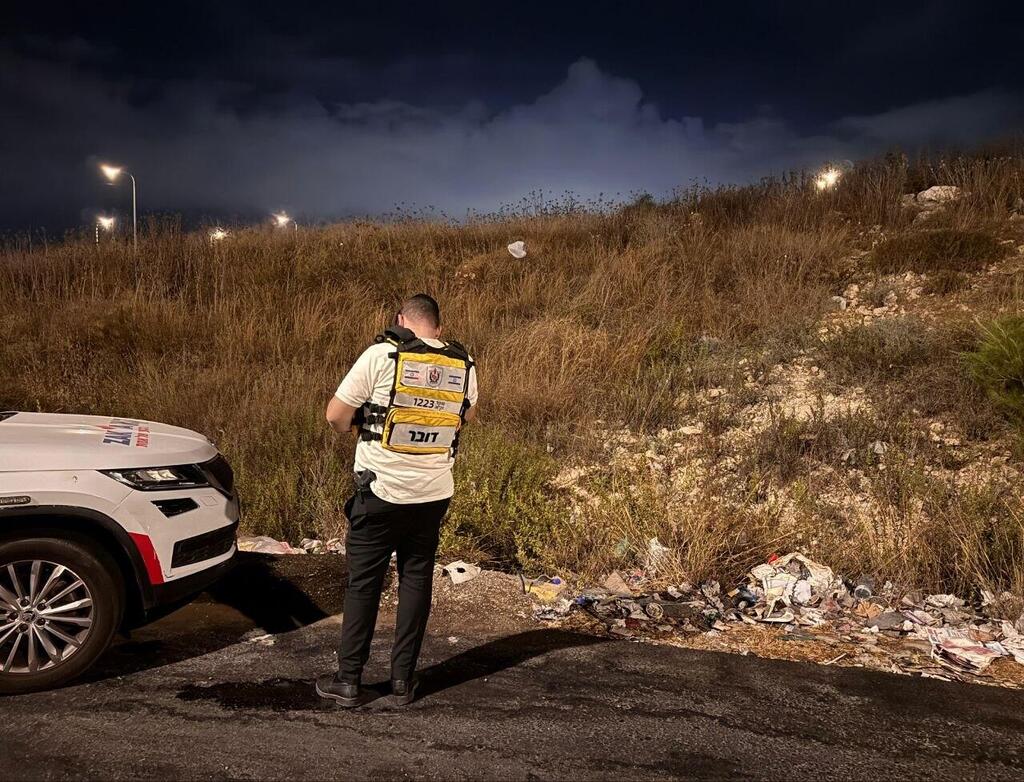
Hassid in the field
“I realized that there was an enormous need for it because of the situation in the country,” she said. “I decided to carry a gun. There are people in my family who enlisted in the military, so there isn’t blanket opposition to it. On the contrary, I understand that it is important, especially at a time like this.”
She, too, acknowledges the risks.
“This is a disadvantaged community with less awareness of how dangerous this weapon is, so it requires extra responsibility and supervision,” she said. “You have to understand that it is a dangerous tool and that you don’t just carry it casually.”
Her goal, she said, is protection rather than visibility.
“Any attacker who needs to be neutralized will meet my handgun,” she said. “But no one else will ever see that I have a weapon.”
A. also undergoes firearms training, which she considers inseparable from responsible gun ownership.
“That is part of the responsibility I was talking about,” she said. “We have a group of women who go together for training, and we arrange a day at the shooting range without men. For me, that is an integral part of being able to carry a weapon responsibly.”
The women-only training also reflects the norms of parts of Israel’s ultra-Orthodox community, where strict religious standards often call for separation between men and women in certain social and communal settings.
For Ben-Gvir, the growing number of armed civilians is a central element of his approach to public security.
“We will continue to expand the firearms reform, add more cities, communities and neighborhoods to the eligibility list, and ensure that as many citizens as possible can defend themselves and the State of Israel,” he said.
The result is a striking cultural shift in parts of ultra-Orthodox Israel. In communities where many men traditionally avoided military service and firearms were once relatively uncommon, a handgun on a young man’s belt — or concealed beneath a woman’s clothing — is becoming less unusual.