



For generations, Israel has occupied a central place in Jewish identity around the world. But feeling connected to Israel and deciding to pack up a life, leave behind a career, family and community, and make aliyah are two very different things.
That gap, between connection and action, was at the center of a conversation with Maj. Gen. (res.) Doron Almog, chairman of the Jewish Agency for Israel, during Ynet Global’s Global Aliyah Live Summit.
Jewish Agency chief: October 7 and antisemitism are reshaping the decision to make aliyah


According to Almog, two developments have dramatically changed the conversation since 2023: the October 7 attack and the rise in antisemitism around the world. He said those forces have caused Jews in countries including Australia, Britain, France, South Africa and the United States to reconsider where they want to build their future.
But Almog stressed that aliyah should not be understood only as an escape from antisemitism.make aliyah. Let’s come and build a new life.” The shift is already visible, he said, in a sharp increase in the number of people opening aaliyah files and contacting the Jewish Agency. Its global call center in Jerusalem operates around the clock in five languages, fielding questions that range from employment and finances to where in Israel a family should settle and what life will cost.
But Almog stressed that Aliyah should not be understood only as an escape from antisemitism.
Renewed sense of Jewish identity and belonging
For many Jews, he said, the more powerful force is a renewed sense of Jewish identity and belonging. Even as Israel faces war and internal political divisions, he argued, Jews abroad have watched Israeli society demonstrate an extraordinary level of solidarity during moments of crisis.
Israel, Almog said, is a paradox: deeply divided in political debate, yet capable of coming together when confronted by a common threat. That solidarity, he believes, has become part of Israel’s appeal to Jews looking from abroad.
“They feel this sense of belonging,” he said. “They want to be part.”
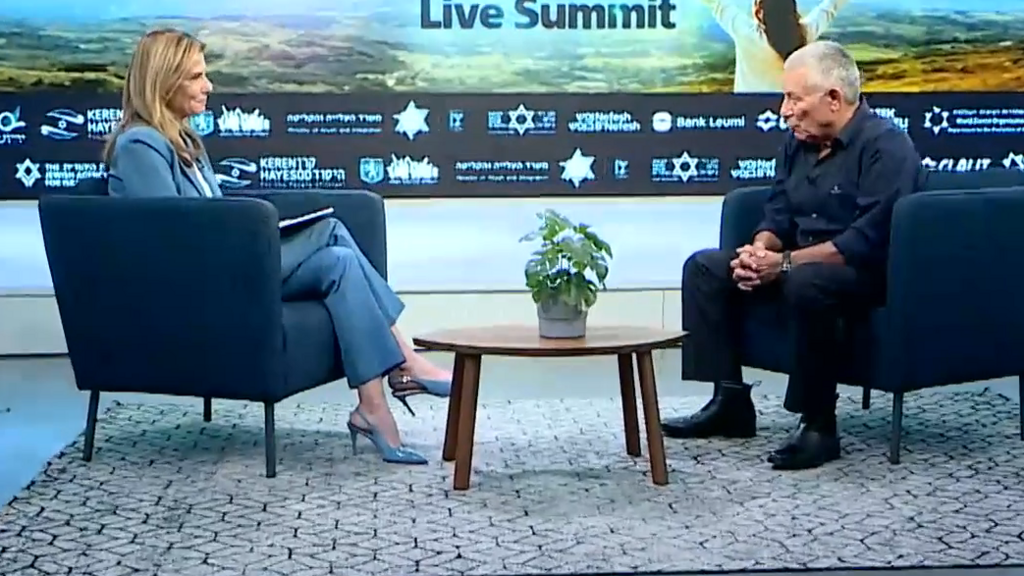
Maj. Gen. (res.) Doron Almog, chairman of the Jewish Agency for Israe at Ynet Global’s Global Aliyah Live Summit
(Photo: Screenshot)
Almog pointed to new olim he recently met in a kibbutz in northern Israel, including immigrants from France, Britain and Latin America. Their enthusiasm, he said, offered a striking contrast to the tendency of veteran Israelis to focus on the country’s difficulties.
That experience also reflects what Almog sees as an important model for the future of aliyah: immigration built around communities rather than individuals.
“Don’t come alone,” he said. “Come with the group. Come with your community.”
Begin the process long before an oleh boards a plane
The idea is to begin the process long before an oleh boards a plane, helping potential immigrants understand where they could live, how they could work and what kind of community could surround them once they arrive.
Almog acknowledged that the transition is rarely simple. Potential olim worry about finances, employment, language and whether they will ever completely fit into Israeli society. But he argued that Israel itself was built through successive waves of immigration and that each one ultimately reshaped the country.
He cited the roughly one million immigrants who arrived from the former Soviet Union beginning in the 1990s, whose influence can now be found across medicine, academia, culture, politics, sports and other parts of Israeli life.
“Aliyah is a growth engine,” Almog said.
That is also why, he said, attracting olim should form part of Israel’s rebuilding strategy following the war, particularly in the north and south. The Jewish Agency wants to encourage new immigrants to consider communities outside the center of the country and participate in rebuilding areas that have suffered economically and physically.
'We need you. We love you. We want you.'
Yet Almog repeatedly returned to a distinction that could prove crucial for the next wave of aliyah: Jews should not come only because life elsewhere has become more difficult.
The message from Israel, he said, has to be that they are wanted here. “We are brothers and sisters,” Almog said. “We need you. We love you. We want you.”
For the next generation of olim, Almog said, what matters most is not simply the decision to relocate but what they bring with them: energy, belief and commitment.
There will be crises, he acknowledged, as well as “many moments of pride.” What can sustain people through both is the feeling that they belong to something larger than themselves. “Bring the spirit and the commitment,” he said.
And the change taking place extends beyond Aliyah itself. Almog pointed to growing participation in programs that bring Jews to Israel for shorter periods, increased volunteering and solidarity missions, and expanding partnerships between Diaspora Jewish communities and communities inside Israel.
Taken together, he said, those developments represent something larger than another increase in immigration numbers.
“We see a new chapter,” Almog said, a new stage in the relationship between Israel and Jewish communities around the world.
First published: 14:38, 09.08.26