


As Israel moves to seize Gaza City, dismantle Hamas and keep a long-term military presence, critics warn that Netanyahu’s October 7, 2025, deadline for seizing Gaza City could uproot thousands more residents and further deepen the political vacuum left by Hamas’ retreat and the Palestinian Authority’s 18-year absence.
That gap is already being contested on the ground: clan-based militias are stepping into governance roles, mediating disputes and escorting aid convoys in parts of the Strip. Rooted in Bedouin and clan traditions, these kinship systems have long mediated disputes, distributed aid and maintained social order when formal government structures faltered. The war has brought them back to the forefront, operating as de facto municipal authorities in many neighborhoods.
A Hamas-free pocket in eastern Rafah—controlled by the clan-based “Popular Forces” of Yasser Abu Shabab—has emerged as an example of an alternative local order. Its future is uncertain, but the enclave is drawing attention as both an anomaly and a possible preview of postwar governance.
Yasser Abu Shabaab is the leader of an armed militia operating in the southern Gaza Strip against Hamas


The Yasser Abu Shabab – Popular Forces Facebook page—followed by more than 30,000 people—describes the group as “The voice of truth against terrorism for a safe homeland for all” and labels its feed as the group’s “media office.” Operating in the eastern sector of Rafah, near the Gaza–Egypt border, the group showcases its activities through frequent online updates.
In a July 30 video, Abu Shabab said his forces carried out a “special operation” evacuating dozens of civilians from Deir al-Balah, Nuseirat and Khan Younis to “safe areas” under their control in eastern Rafah. The group said it spent months building the refuge to shelter Gazans “still suffering from Hamas’ looting and repression.” On July 31, it said its fighters “secured and imported dozens of trucks” carrying flour and other supplies, and on Aug. 6, it reported escorting “a large number of trucks” loaded with food, flour and cooking oil out of its territory.
Omar Salim, 22, a student from Rafah, said that Yasser Abu Shabab and his fighters were one of the few realistic options for ending Hamas’ rule.
“What Yasser Abu Shabab’s popular forces are doing is probably the best option we’ve got right now. We just want peace—we don’t want to be ruled by armed groups like Hamas that drag us into war. We’re sick of it,” Salim said.
“Sure, they still need to get better organized, but they’re working on it. These days, a lot of families are moving into areas controlled by the popular forces because they feel safer there than in the neighborhoods where Hamas militias are still around.”

In Deir al-Balah, Ibrahim Ahmed, 36, who worked at a local mobile phone shop until the 2023 war began, described the chaos and deprivation now gripping Gaza as “mired in uncertainty,” with many “grappling with anxiety about what lies ahead.” People rush to stockpile food and medicine, he said, “but soaring prices and persistent shortages complicate these efforts.”
Ahmed said he sees no alliances among the warring factions. “Israeli forces have largely subdued Hamas, which now clings to a mere handful of weapons, primarily to instill fear among civilians and quash dissent,” he said. “Hamas’ claims about readiness to resist an Israeli takeover of Gaza City are hollow media posturing—a facade for maintaining their waning influence.”
He added that the Palestinian Authority “appears increasingly irrelevant,” while armed groups like Abu Shabab “navigate freely within Israeli-controlled territories” and avoid conflict with Israeli forces. “This dynamic suggests Israel may turn to these clans during a potential period of military governance, positioning them as a counterbalance to both Hamas and the Palestinian Authority,” Ahmed warned. “Mr. Netanyahu and the Israeli military are cultivating a new power structure. But Gaza risks descending into civil war and chaos.”
Meanwhile, Hamas’ feared counterintelligence Sahm unit continues to kill, torture, maim and intimidate Palestinians in Gaza, with the group posting graphic images and videos of its actions on a Telegram channel believed to be operated from Belgium.
The footage shows detainees beaten, bound and in some cases executed, as the unit seeks to stamp out suspected dissent or collaboration. Other Facebook videos last week showed a convoy of masked, rifle-waving fighters patrolling a Gaza neighborhood.
On the platform—one of the few spaces where Gazans can safely vent about the suffering caused by Israel’s war and Hamas’ grip on their streets—users mocked the fighters’ covered faces and apparent comfort amid civilian hunger and deprivation.

Gazans loot aid trucks in Khan Younis
Mahmoud Hamdan, 41, a father of three from Gaza City, said a military operation to reclaim the city is “unlikely to unite factions; instead, it may deepen divisions, fragment communities and increase violence.”
“Palestinian civilians suffer the most,” Hamdan explained, “trapped between Israel and Hamas, with no control or refuge in their homes amid the chaos.” He sees “no clear political alternative”—neither from clan factions nor possible Arab troop involvement. In his view, the main aim is “strengthening Netanyahu’s power,” with the prime minister “manipulating the situation with Hamas to justify his controversial political moves.”
Hamdan’s fears of Gaza sliding toward civil war come as even some of Hamas’ staunchest foreign patrons signal a shift.
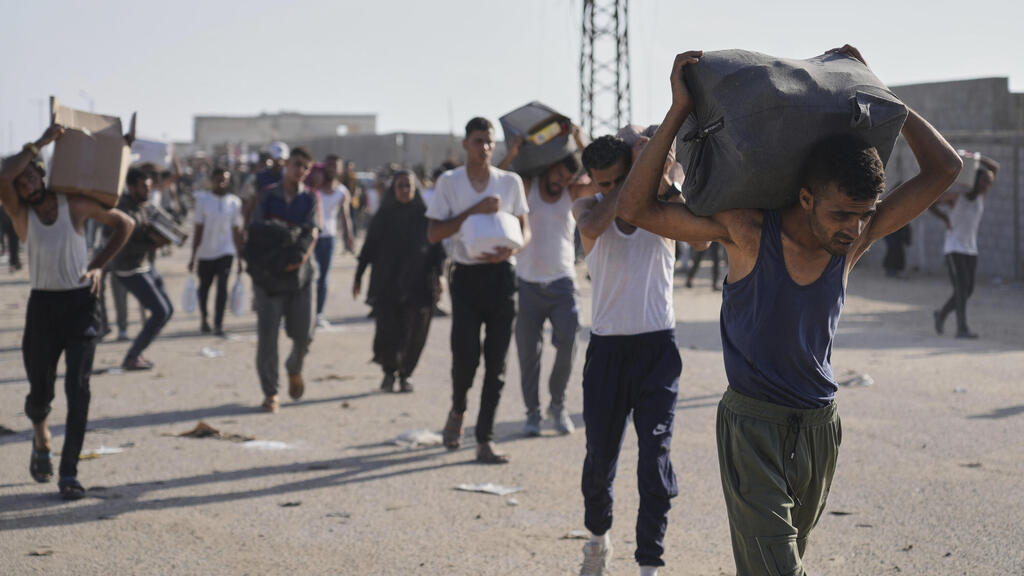
Gazans receive aid in Rafah
(Photo: Abdel Kareem Hana/AP)
Pivoting from years of alignment with Hamas, Qatar and Turkey—two of the movement’s most reliable political and financial backers joined other Arab and Muslim-majority states on July 29, 2025, in a joint declaration urging the group to return control of Gaza to the Palestinian Authority and disarm.
At the same time, a new technocratic governance plan is being advanced by former Israeli intelligence operative Ari Ben-Menashe, now a Montréal-based lobbyist, who is positioning West Bank businessman Samir Hulileh to lead a transitional administration under an Arab League framework acceptable to the Trump administration—if not all elements of the Netanyahu cabinet.
This article is written by Wassem Abu Mahdi and published with permission of The Media Line