


Julia Cheban, 24, and Abed al-Rahman al-Ziadna, 26, were murdered on Oct. 7, 2023, at the place they loved most — the sea. The young couple, she Jewish and he Bedouin Muslim, were among the first victims of Hamas terrorists who invaded southern Israel that morning.
Videos the couple filmed at dawn from Zikim Beach, just north of the Gaza border, captured the moment their last morning together turned to horror. After spending a romantic night on the sand, a red alert rocket siren is heard in the background. Abed calls out to Julia as gunfire echoes nearby. Then, in a quiet voice, he says one word: “War.”
'They loved the sea more than anything'
According to investigators, Julia was shot first on the beach. Abed then tried to flee in his car with several other civilians, but the group was gunned down inside the vehicle. His body was identified first; Julia’s was found 10 days later.
Footage of Julia Cheban and Abed al-Rahman al-Ziadna from Zikim Beach on October 7


The relationship between the young Bedouin man from Rahat and the Jewish woman from southern Israel drew attention from both communities, but those who knew them say it was defined by warmth and acceptance.
“They loved each other deeply and were always together,” said Julia’s friend Liron Hazut. “A month before the attack they came to my wedding. They were so full of life — they made everyone around them happy.”
Abed’s father, Aatef al-Ziadna, 53, described his son as “the flower of the family.” He and his wife Amal have 10 children, the youngest only 10 years old. “Every weekend he went to the beach — to Ashkelon, Tel Aviv or Eilat,” the father said. “He loved the sea since childhood. I still swim three or four times a week to try to forget. The sea was his life, and that’s where he stayed.”
A love without boundaries
Julia and Abed met three years earlier in Beersheba. Their families say the relationship gradually deepened. Julia would visit the al-Ziadna home in Rahat, join family celebrations, and keep in touch with Abed’s sisters and sisters-in-law.
“At first we worried, but then we saw how much they truly loved each other,” said Julia’s sister Katya, 41. “When I think of her, the first thing that comes to mind is sunshine. She was all light, always smiling. She was our youngest, and she had this innocent, bright spirit.”
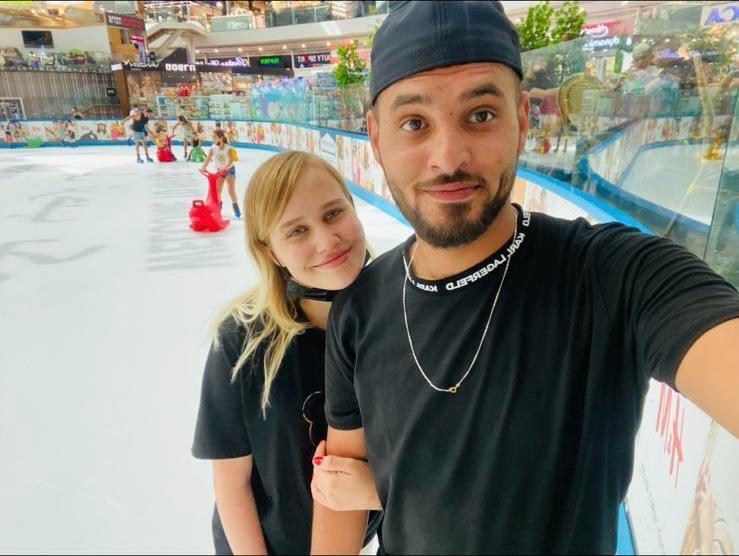
The couple’s shared passion was the sea. They spent weekends diving, camping and traveling to Israel’s coasts. “He had a love for the sea that went deep into his heart,” said Aatef.
At the entrance to the al-Ziadna neighborhood in Rahat, a small roundabout now bears a sign in Abed’s memory. Along the road stands a home flying an Israeli flag — it belongs to Abed’s relative, Yousef al-Ziadna, a bus driver who rescued 30 people during the Hamas terrorist assault by taking them to safety in his minibus and leading dozens more through nearby fields.
'At 6:45 a.m., the line went dead'
On October 6, Abed celebrated with his family at a wedding in Rahat. “They told him, ‘Abed, you look like a flower,’” his father recalled. “He smiled and said, ‘I’m finished — soon I’ll have my own wedding.’ Then he went to the sea.”
The next morning, at 6:30 a.m., Abed messaged his family that rockets were being fired. Fifteen minutes later, contact was lost. “My sons called me — ‘Dad, Abed isn’t answering,’” Aatef said. “We kept sending messages, but he didn’t reply. At first we thought he’d been kidnapped. We saw two blue checkmarks on WhatsApp — like someone was reading — but then nothing. In the end they told us to come to Ramla.”
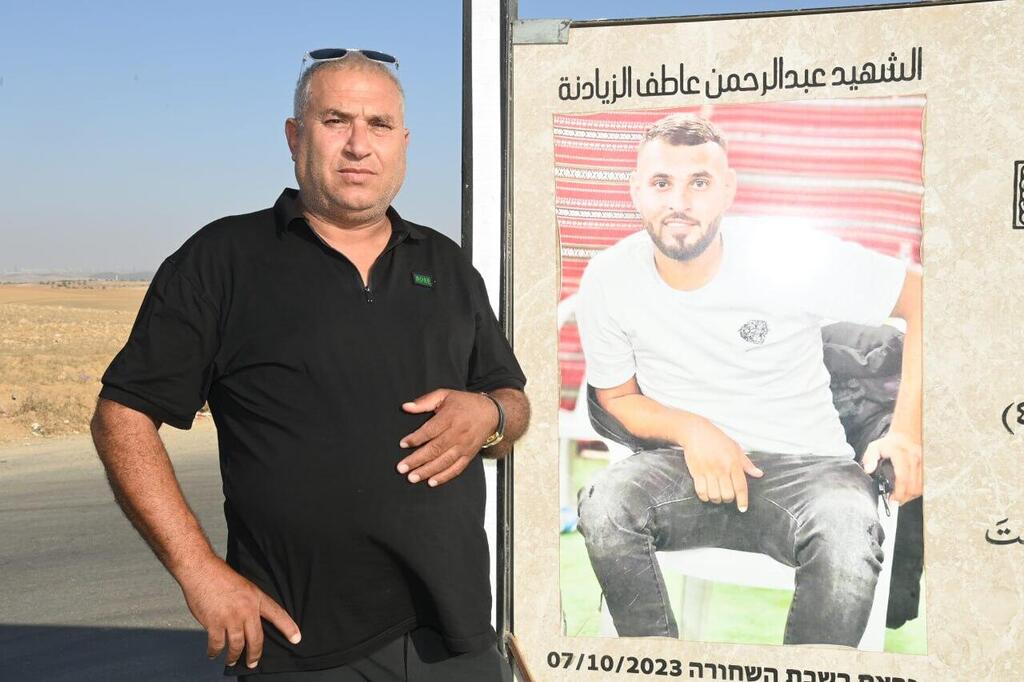
Aatef al-Ziadna
(Photo: Herzl Yosef)
That Sunday evening, an ambulance arrived at Beit Kama, near Rahat. Aatef identified his son’s body. “We buried him that night at 11 p.m.,” he said quietly. “He was just on the beach, swimming. He didn’t hurt anyone. But the terrorists had no mercy. All they wanted was to kill.”
According to evidence at the scene, Abed was murdered inside his car, possibly while trying to help other beachgoers escape. The back seat was covered in blood that did not belong only to him.
'You’ll always be 24'
The couple had been planning to marry that summer. “He proposed to her,” said Aatef. “She loved life here. She wanted me to build them a home.”
Two months ago, Julia’s mother, Oksana, marked what would have been her daughter’s 26th birthday. “This day should have brought joy and happiness,” she wrote. “But it never will again. You’ll always be 24. The lights went out, and we live in darkness, pain, and emptiness. You had your whole life ahead of you, our beloved sunshine, our ray of light.”
Julia’s sister Katya posted her own tribute online. “The longing doesn’t fade — it only changes shape,” she wrote. “It slips into every small space: the songs you loved, a stranger’s smile that reminds me of you. Until I see you again, I hold you close in my heart, with every breath and every step.”

Julia and her family
In a message posted this week, Oksana added: “My daughter, you were always a bright ray of light. Life with you was joyful and full. You loved life, and that’s how you’ll always be remembered. Your love keeps me alive. You are always with me, my love.”
'We’re all one blood'
For the al-Ziadna family, grief is intertwined with a message of coexistence. “The story of these two is a story about love,” said Aatef. “Love doesn’t distinguish between Muslim and Jew. If they fell in love, they would have married. We live in one country and must protect one another. There’s no ‘this one’s Jewish and that one’s Arab.’ We all live here together, all one blood, all the same.”
The entire family attended Julia’s funeral. “They both left this world before their wedding,” Aatef said. “I just hope the next world will be better.”