

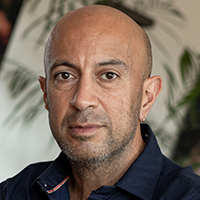
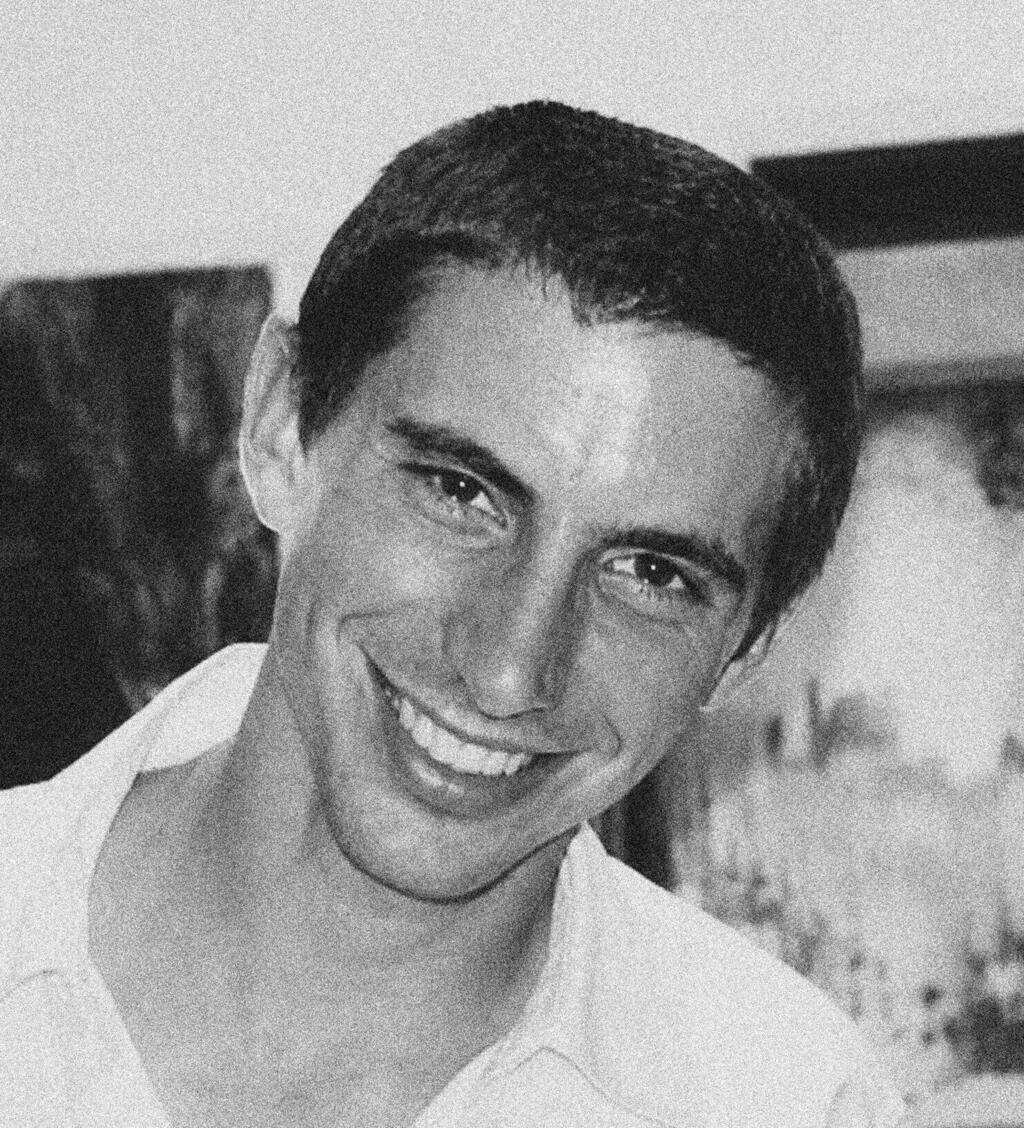
Twelve years after the fall of Lt. Hadar Goldin in an encounter in Rafah toward the end of Operation Protective Edge, his family was able earlier this week to visit his grave on the anniversary of his death, the fifth of Av.
Much has been written and said about the efforts by the State of Israel to bring home Goldin’s body, which was abducted by Hamas terrorists into the Gaza Strip and hidden by the organization for more than 11 years, until it was finally returned in November 2025. Still, many operations connected to the attempts to bring Hadar back and obtain intelligence about the place where Hamas was holding his body remain classified, hidden from the public eye.
The underground tunnel network where Lt. Hadar Goldin was held, in Rafah, Gaza
(Video: IDF)


Over the years, the State of Israel, the IDF and the security services invested significant resources in attempts to reach Hadar Goldin. But it appears that were it not for a small intelligence team named "Bring Back Your Sons,” which managed to locate the place where Hamas hid Hadar’s body, he might not have returned to Israel to this day.
“Bring Back Your Sons” was established by Col. M., 51, from central Israel. M. led the intelligence effort that accompanied the special operations to locate and return Goldin to Israel for nearly nine consecutive years. Over the years, and especially after October 7, M. became a key figure with vast knowledge connected to the entire issue of hostages and missing persons, and led numerous intelligence and operational deceptions designed to provide real information about the fate of all the hostages.
M.’s interest in the issue of hostages and missing persons began back in 2008, around the establishment of the Shin Bet’s special investigation team that examined the abduction of Gilad Shalit. From there, he went on to serve in a number of positions in Military Intelligence until he was called to the flag again in 2015 by Lt. Gen. Gadi Eisenkot, then the relatively new IDF chief of staff.
Eisenkot asked M. to take on a mission: to turn over every stone and extract every piece of information connected to the fallen IDF soldiers abducted by Hamas, Oron Shaul and Hadar Goldin, and later also the two Israeli civilians held by the organization in Gaza, Avera Mengistu and Hisham al-Sayed. M. agreed and formed a small intelligence team with S. and D., two reserve officers. Over time, many professionals from a range of fields whose mission this became joined them.
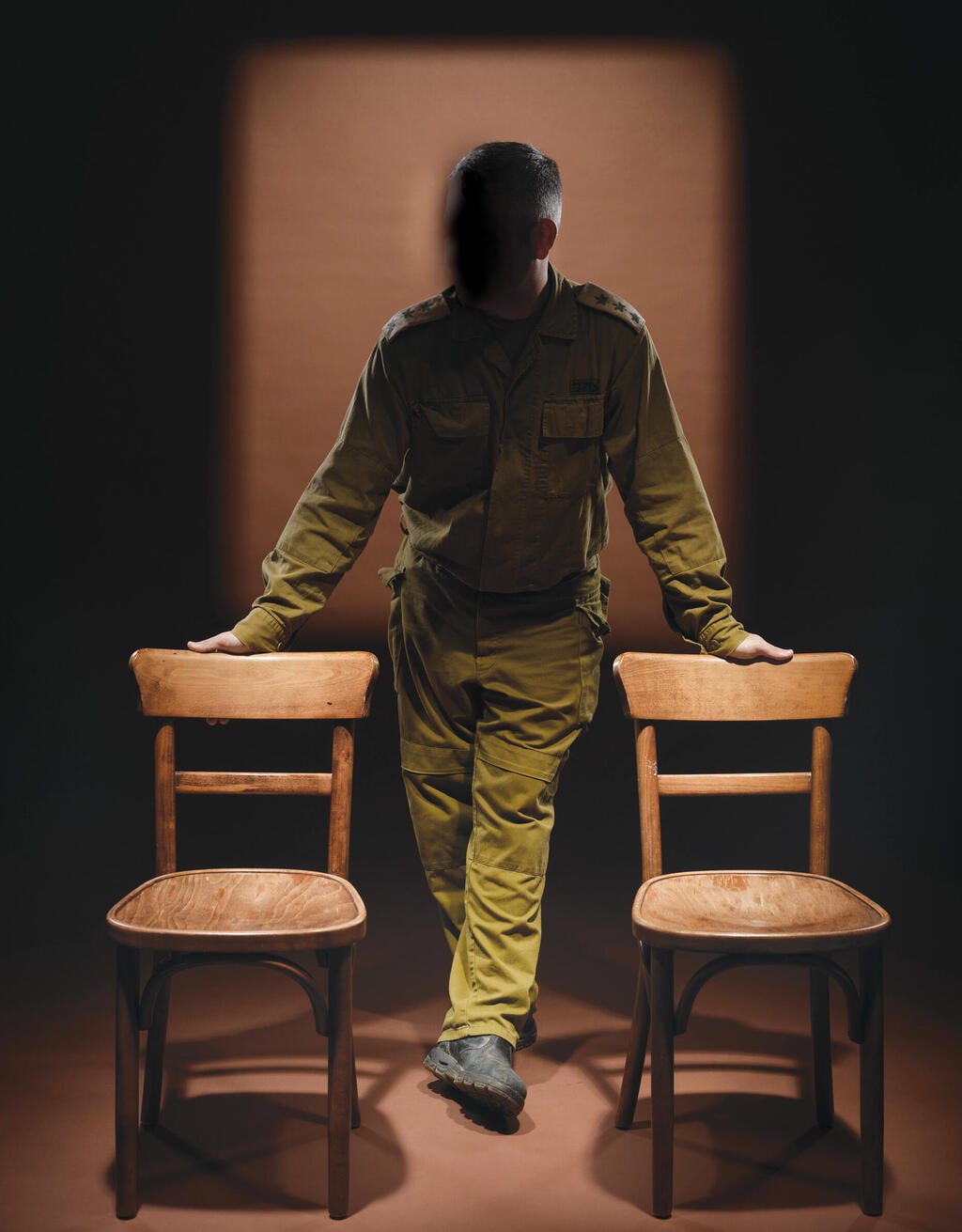
take on a mission: to turn over every stone and extract every piece of information connected to the fallen IDF soldiers abducted by Hamas
(Photo: Yonatan Bloom)
M. drew inspiration for the team’s name, “Bring Back Your Sons,” from a Naomi Shemer song based on the prophet Isaiah’s prophecy of redemption: “Surely the islands look to me; in the lead are the ships of Tarshish, bringing your children from afar, with their silver and gold, to the name of the Lord your God, the Holy One of Israel, for he has glorified you.” (Isaiah 60:9)
The mistaken working assumption and the golden intelligence
“We understood pretty quickly that our mission was to find a needle in a haystack,” said S., who was added to the team because of her knowledge of operating a certain technological system. She had previously served in the Gaza Division, including during Operation Protective Edge, and worked on intelligence related to strikes in Gaza. From the moment she joined the team, she showed up almost every day with the goal of collecting another piece of information, part of the impossible puzzle that the “Bring Back Your Sons” team was trying to assemble.
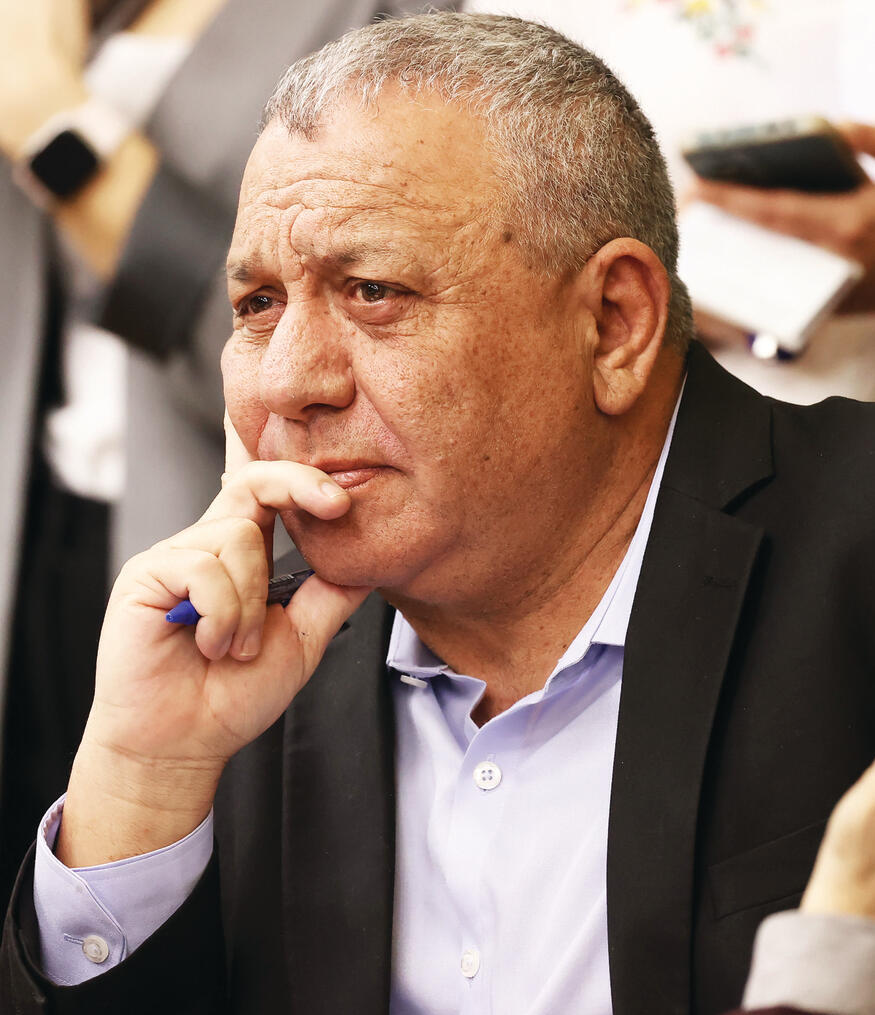
Then new IDF chief of staff Gadi Eisenkot asked M. to take on the task of bringing Goldin's body home
(Photo: Amit Shaabi)
Through moves that at times sound as if they were taken from an impossible espionage series, with great effort and even greater ingenuity, this team ultimately succeeded in bringing back Hadar Goldin.
On Aug. 1, 2014, after the ceasefire in Operation Protective Edge had already gone into effect, Goldin’s team from the Givati Reconnaissance Battalion was ambushed in the al-Tanur neighborhood of Rafah. In the fighting, the reconnaissance battalion commander, Maj. Benaya Sarel, was killed alongside Staff Sgt. Liel Gidoni. Goldin was hit by gunfire and abducted into a tunnel by Hamas terrorists. Only later would it become clear that he had been killed at the scene.
One of the first people to reach the scene was an officer from Sayeret Matkal, A.H. Only days earlier, he had examined the scene of the abduction of Golani soldier Oron Shaul in Shijaiyah. Before that, he had also been involved in the attempts to locate the three teenagers kidnapped about a month and a half earlier in Gush Etzion — Naftali Frenkel, Gilad Shaer and Eyal Yifrah.
A.H., who understood from the initial findings at the scene what had happened to Goldin, realized he had to locate the tunnel into which he had been abducted, in order to quickly determine whether there were findings there that would make it possible to establish his death with certainty. Indeed, after a few hours, he managed to locate the evidence that would allow Dr. Chen Kugel of the Abu Kabir forensic institute to determine Goldin’s death.
At the same time, a Givati force acted in an attempt to hit the terrorists who had abducted Hadar’s body, while employing the “Hannibal Directive,” an Israeli military protocol designed to prevent the capture of soldiers by terrorists, even at extreme operational risk that may endanger the soldier’s life in order to prevent transfer into enemy hands. The force advanced as far as what the IDF calls the “Tanzer Route,” where commanders stopped the Givati Brigade commander at the time, Col. Ofer Winter.
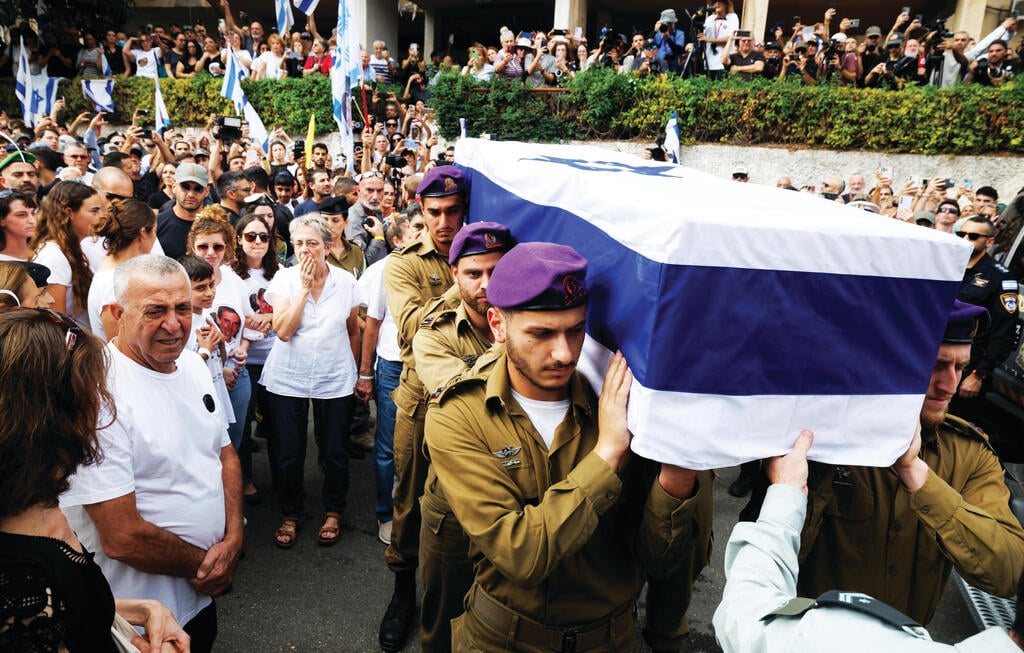
Goldin's funeral on November 25, 2025
(Photo: Ziv Koren)
The day after the abduction, Hamas published a statement saying that “contact was lost with the cell that abducted the Israeli soldier,” and that the tunnel where they had been located had collapsed as a result of Israeli Air Force strikes. In effect, from that point and for many months, the working assumption on the Israeli side and by the captives and missing persons team in Military Intelligence was based on the belief that Goldin’s body had most likely been buried with his captors in the tunnel. Several days later, Hamas bulldozers appeared at the site, demonstrating what seemed to be energetic activity aimed at locating the bodies of its men.
“Eisenkot and Lior Lotan, who was then the official in charge of the captives and missing persons file, called me to a meeting and asked me to go over the files of Oron and Hadar,” M. recalled. “Something there didn’t make sense to me. I knew that with the type of bombs the air force used in the strike on the tunnel, it would be hard to collapse it. In addition, I built a kind of model showing the movement of Hamas operatives, which we will call the ‘red route,’ and the ground activity of the IDF and the aerial strikes, which were called the ‘blue route.’ I showed that, in effect, only one hour and 50 minutes after Hadar’s abduction did the first strike capable of collapsing a tunnel take place. And if you do a simple calculation, you understand that even walking slowly with a body, after an hour and 50 minutes, you would already be far from the place where the air force bombings were carried out.”
About two months later, M. returned to Eisenkot and Lotan and asked to establish a special team, given the fact that enough intelligence had been collected pointing to other possibilities. From M.’s perspective, such a team could lead to the coordinates where Goldin was being held. Eisenkot and Lotan agreed to M.’s proposal, and thus it was decided to establish the team, which operated separately from the “regular” captives and missing persons team in Military Intelligence.
M.’s assumption that Goldin was not under the ruins of the collapsed tunnel was supported from several directions. First, by what is known as “golden intelligence.” Israeli intelligence located a Hamas document. “The Nukhba forces were still at the beginning of their path,” S. recalled. “Part of my work during my regular service was to track the development of that force.”
Intelligence tracking of the Nukhba forces taught of the removal of the body of an Israeli soldier from one of the tunnels. M. explained to Chief of Staff Eisenkot that according to Hamas procedure, the body was transferred from the abductors to a “separation cell,” which would move the body or captive to a hidden place without the abductors knowing where it was being held.
“In addition,” M. said, “we knew that according to the procedure the abductors needed to move Goldin as quickly as possible west of the Tanzer Route. In other words, the Rafah Brigade was the one holding Hadar.”
The helmet cameras and the graffiti
Years after Goldin’s abduction, a dramatic development took place that surprised the Shin Bet, which was working in full coordination with M.’s team. A Palestinian collaborator operated by the Shin Bet called the Shin Bet switchboard and asked to speak with his handler. But the handler was on vacation, and he was transferred to a substitute handler. In that conversation, the operative said something that put the system on alert: “I know you contacted me because of the information I have about the location of Hadar Goldin’s body.” He demanded that he be extracted from Gaza if Israel wanted to hear more about the place where the body had been hidden.
The Shin Bet began preparing the extraction operation, but during the planning period, it emerged that Hamas had already exposed him and managed to “double” him — to turn him into a double agent. Back to square one. There was still no lead regarding the place where the body was hidden.
M. continued working in parallel. He summoned all the soldiers and officers who had gone down into the tunnel into which Hadar was abducted, and the team began questioning them one by one. They also collected footage from the soldiers’ helmet cameras. One of the first things M. understood was that, at a certain stage, an IDF force had used mapping technology inside the tunnel that emits smoke, making it possible to identify smoke coming out of every tunnel opening.
In addition, using the helmet cameras, the team noticed quite a few graffiti inscriptions in Arabic on the tunnel walls. Very quickly, they understood that these were names of streets under which the tunnel passed, a discovery that allowed the team to draw the tunnel’s route and track the exit shafts from it.
Based on the smoke findings, M. and his team narrowed the search area to a specific zone, a “polygon” in military language. Here, the expertise of the reservist S. was required, after she had accumulated many hours during Operation Protective Edge operating a technological system that enabled retrospective tracking of events in Gaza. Together, they began tracking the smoke signals detected on August 1, the day of the abduction. They added to that picture what they had already understood about the tunnel route.
Another working assumption, which connected to what S. was doing, was that Hamas would try to move Goldin to a hospital or secret clinic to check his condition or to keep the body in a refrigerator. And here began long and painstaking work. S. tracked every vehicle that arrived at the hospitals in the area, and then followed those that came from the same suspicious grid square.
Until one day, she noticed an ambulance that arrived at Youssef al-Najjar Hospital in Rafah several hours after the incident in which Hadar was abducted. First, she noticed the ambulance passengers unloading a stretcher, and then she followed the route the ambulance had taken to the hospital. She understood that it had left a house in the suspicious area, the al-Tanur neighborhood of Rafah, and then noticed something that startled her: Several people were seen leaving a house located on the route of the tunnel in question, loading a large black bag onto the ambulance.
“I can’t say with certainty that it was a body, but you can see an elongated black bag,” S. recalled.
The ambulance was seen leaving the grid square — the suspicious polygon. “Then I called M. and D., who was my direct commander, and told them: ‘I think I found it.’”
And that was when the penny dropped on the Israeli side: He had been taken from the abduction area and was being held at an unknown target in order to negotiate over the body in the future. The team brought those conclusions to the chief of staff, the head of Military Intelligence and Lotan. The answer they heard was quite clear: How can we know for certain that this was not a Hamas operative? How will we know it was Hadar Goldin?
The hospital and the emergency tunnel
Now, the team’s mission was to confirm the connection between Goldin and the ambulance seen in the recorded video. During the retreat after the abduction, Hamas terrorists left radio devices in the field. The team examined the radio recordings on the frequency used by Hamas operatives and managed to intercept a message said in real time by the people in the ambulance, that “the mission will be completed in the next few minutes.”
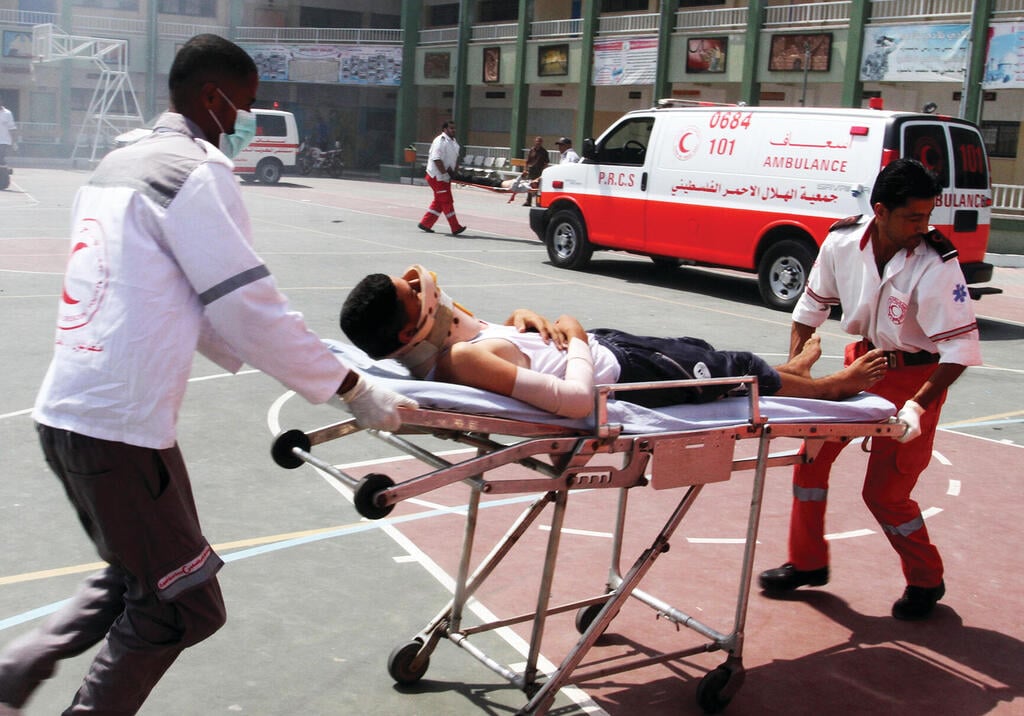
Yousef al-Najjar Hospital in Rafah
(Photo: Anadolu, Getty Images)
That was not enough, of course, and the team’s next mission was to understand what had happened inside Youssef al-Najjar Hospital in Rafah. Was Goldin’s body brought there to be transferred to a separation cell, as Hamas procedure required, or to be held there in refrigeration?
“We tried to understand whether such a possibility even existed at the hospital,” M. said. “We checked the size of the morgue, what refrigerators were there, activated every possible intelligence source. Maybe there was an area isolated for the purposes of Hamas’ military wing that others could not access? This was also the first time we understood that connected to the Goldin story was a Hamas doctor named Marwan al-Hams, who later became director of the hospital.”
M. explained that one of the biggest problems in such a mission is clearing away irrelevant intelligence.
“In raw intelligence there is a lot of noise. You have no idea what is connected to you and what is not, and you need to work to sort it. Let’s say someone reported tight Hamas security around a goods refrigerator in the Yibna neighborhood of Rafah. Is it connected to Goldin or not? And so I had to ‘rule out’ several suspicious sites — an orchard in the Rafah area and that suspicious refrigerator. And now, after I ruled out suspicious sites, I needed to shake the blanket and make Hamas make a mistake. To make them move Goldin.”
Here began a surprising and original intelligence move. With the help of the Shin Bet and other parties, the team used two collaborators suspected of having been turned by Hamas, with the team understanding that when one of them spoke with his “handler” on the Israeli side, someone in Hamas was listening.
On the Israeli side, alertness was at its peak, alongside tense waiting for Hamas to make a mistake. The mistake was ultimately made by none other than the commander of Hamas’ Rafah Brigade, Muhammed Shabana. When the organization received reports of an Israeli effort to obtain information connected to Goldin’s body, his commander summoned Hamas’ head of military intelligence, who then contacted Shabana directly. In response, Shabana gathered several of his men and asked them to go check what had happened to the body and whether it was possible the Israeli side had reached it.
“This was a move that took months,” M. said. “It does not happen within a few days. It is a connection of many pieces of information, tracking Shabana and his people, through the meeting, the briefing, the departure afterward.” At first, Shabana thought there was no chance the “Jews” had indeed reached Goldin, and nevertheless ordered the matter to be checked fully.
“This happened several years before October 7; we understood that his people had reached a mosque in Rafah, stayed there for about an hour and returned to their homes. That evening, Shabana calmed down and told his people that ‘everything is fine, business as usual.’ And we understood that there is something in this mosque, meaning a tunnel. But go figure out exactly where in the tunnel.”
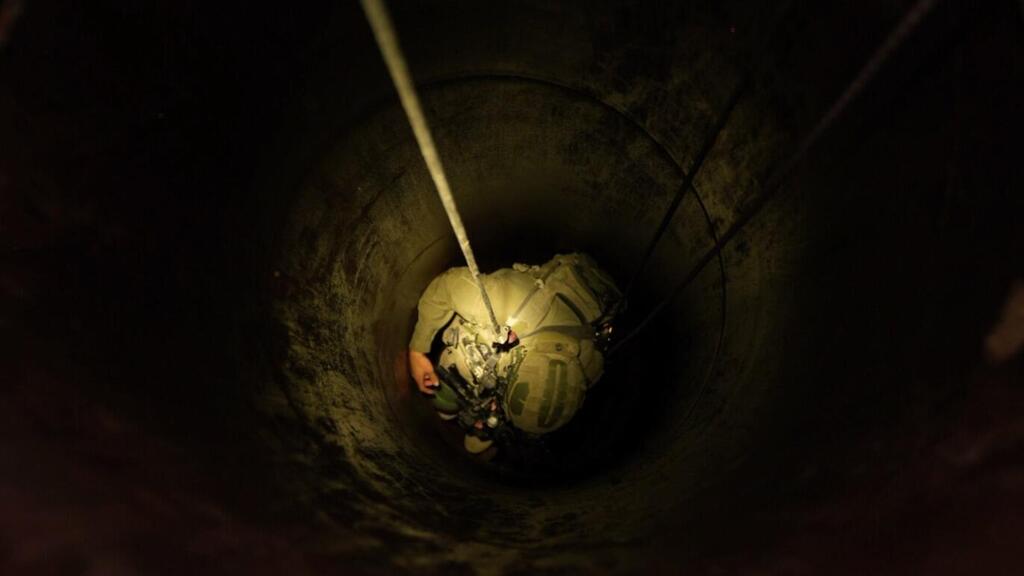
Yahalom soldiers seal the tunnel
(Photo: IDF Spokesperson's Unit)
An examination showed that this was an emergency tunnel of Hamas’ military wing, meaning it was not used day to day. The place was sealed and closed. In those years, the IDF was not in Gaza at all and was maintaining a kind of ceasefire, as part of the policy dictated by Prime Minister Benjamin Netanyahu not to lead to escalation in Gaza. In other words, the political echelon did not even contemplate the possibility of a ground operation in the tunnel to rescue Goldin, even though the location of the tunnel where he was being held was already known.
The hidden rooms and the fighting in the giant tunnel
For four years from the moment the tunnel was located, almost nothing happened, until October 7 arrived. Only then was M., whose team was no longer active, called to the hostages and missing persons headquarters under the command of Maj. Gen. (res.) Nitzan Alon. Most of the headquarters’ effort in the first weeks was to compile the most accurate lists possible of who among the hostages was alive and who was not, and of course where they were being held. Information regarding the location was critical not only in the hope of rescuing the hostages, but primarily to prevent them from being harmed by Israeli forces.
M. was appointed to be responsible for intelligence for special operations, and in parallel for the four captives and missing persons who had been in Hamas’ hands even before October 7. On the Israeli side, it was understood that Hamas had made a clear separation between the hostages and bodies from Oct. 7 and those from before the war, mainly for information security reasons.
The request by the captives and missing persons headquarters to the IDF was to avoid bombing the tunnel in Rafah where, according to all assessments, Goldin was being held. And so another seven months passed, until the start of the IDF operation in Rafah, which finally made it possible to try to reach Hadar Goldin.
The hostages and missing persons headquarters enlisted in the effort the commander of the 162nd Division, Brig. Gen. Itzik Cohen, who was managing the fighting in the sector and had previously been Goldin’s commander. He gave the green light for an operation that would last about two weeks. M. joined forces with the commander of Shayetet 13, who agreed to command the task force made up of Shayetet and Yahalom fighters. The goal: to reach that mosque in the Yibna neighborhood and descend into the tunnel to find Goldin.
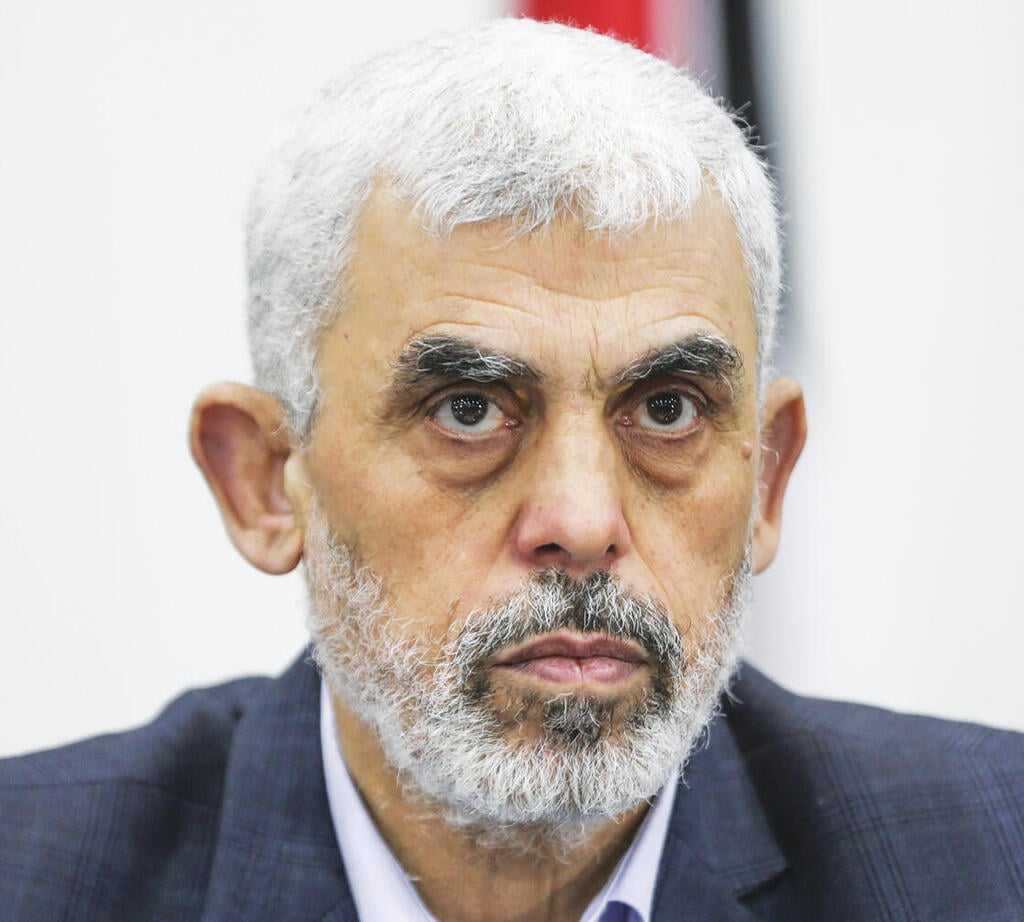
Assassination of Sinwar led to the discovery of important intelligence information
(Photo: Anadolu, Anadolu Agency via Getty Images)
But the ground maneuver intended to clear the way for the forces to reach that mosque lasted more than two weeks. The forces eventually reached a shaft leading to the tunnel where the body was most likely being held, and from there managed to reach the main shaft. But the fighting there was difficult and complicated.
“It was far beyond ordinary,” M. said. “We very quickly understood that this was not another shaft, not another tunnel. Stubborn fighting by Hamas operatives took place there, with many blockages, secret doors, booby traps. There were three levels there and a route of about seven kilometers. The soldiers of the Yahalom unit told us they had never before encountered a tunnel like that.”
The searchers’ working assumption was that Goldin’s body had been preserved in refrigeration, and therefore the instruction was to search for a room with a refrigerator. The problem was that behind many doors in that tunnel were rooms that could not be identified from the outside and were discovered only when the walls were broken.
In July 2024, during the tunnel search, the forces tried to open one of the secret doors, and then shouting was heard from the other side and fire was opened at the soldiers. In retrospect, it emerged that these were the bodyguards of Mohammed Sinwar and Mohammed Shabana, and that this was their command center. Following that incident, the two fled from there, and their escape led to the collapse of Hamas’ command-and-control structure in Rafah, and subsequently to the flight and collapse of the entire Hamas Rafah Brigade.
Hadar’s weapon and the Hamas doctor
The days passed, and M. understood that the operation in Rafah was nearing its end and that the political echelon might halt the effort to locate Goldin.
At the same time, information was received that the Hamas doctor from Rafah, Marwan al-Hams, had himself brought Goldin’s body down into the tunnel, preserved it and locked it behind an iron door. Now it was necessary to bring al-Hams in for questioning.
Between August 2024 and January 2025, the searches inside the tunnel stopped and Israeli forces locked it. In effect, there were not enough available combat troops to continue the search operation, and the efforts resumed only in early January 2025 with a force from the Yahalom unit that became available. For half a year, the forces went room by room through the tunnel in question but found nothing. They managed to locate the place where Goldin’s body was examined during that Hamas deception operation, and the understanding was that the body had been moved from that room to another location in the tunnel after the examination.
The excavation inside the tunnel advanced without any findings until the elimination of Mohammed Sinwar and Hamas Rafah Brigade commander Mohammed Shabana, who were hiding in a tunnel beneath the European Hospital in Khan Younis. The IDF used many engineering tools to reach the tunnel where the two were buried, on the assumption that valuable information would also be found there. Among other things, it emerged that Shabana had been carrying Hadar Goldin’s personal weapon. In addition, an item of intelligence importance was found among the ruins of the tunnel.
“We returned to the tunnel, dismantled the walls and found nothing,” M. said.
Then came an impressive operational success: IDF forces, the Shin Bet and, of course, the hostages and missing persons headquarters succeeded, after long months of effort, in abducting from Gaza the Hamas doctor Marwan al-Hams, who had meanwhile become the director of the hospital in Rafah. Ynet previously has reported that al-Hams’ arrest was carried out after he was lured in a special operation to appear for a television interview for an invented documentary. But in his interrogation, he revealed nothing. Even after M.’s team brought the doctor down into the tunnel, he refused to provide information to Shin Bet interrogators who pressed him.
On Oct. 1, 2025, Yom Kippur, IDF forces arrested the doctor’s daughter, Tasnim, in order to apply pressure on him — but that step did not help either. A short time later, on October 10, the ceasefire agreement was accepted.
But even then, after committing to return to Israel all the bodies and captives in its hands, Hamas insisted and claimed that it could not reach Goldin. After several weeks of arm-twisting, after Israel transferred precise information about the place where Hadar was being held, and after a siege on Hamas wanted men in what became known as the “Rafah pocket,” Hamas returned Hadar Goldin to Israel on November 9. Two days later, he was brought to burial.
The victory
The “Bring Back Your Sons" team — M., S. and D. — devoted years upon years of their lives to the issue of captives and missing persons, and they were not alone. Hundreds of soldiers, Shin Bet personnel and Military Intelligence officers worked tirelessly not only to return Goldin, but to return the bodies of all IDF soldiers held in Gaza and all the hostages. Day and night, on Sabbaths and holidays.
Simcha Goldin, Hadar’s father, called the return home of his son's body a victory in more ways than one.
“You go to bring Hadar, but along the way you bring about the crushing of the Rafah Brigade. That is the victory as far as I am concerned,” he said. “The achievement of returning the fallen soldier is ultimately the convergence of the value of bringing the soldier home, Hadar or any other soldier, with adherence to the operational objective — an intelligence effort, M.’s tremendous effort and the IDF’s major operation in the tunnel in Rafah.”