

While global attention is focused on what the mass protest shaking Iran may yield, the Middle East is responding with restraint, certainly compared with the region’s obsessive focus on the Palestinian issue. This caution does not reflect indifference or a belief that Iran’s turmoil is irrelevant. Rather, it stems from a mix of anxiety and prudence shared by both allies and proxies of the Islamic regime and its sworn adversaries.
The deepest fears are found within the “axis of resistance,” particularly among its Shiite members. The Islamic regime effectively created these actors in its own image, above all, Hezbollah. They were meant to advance the ideological goal of exporting the Islamic Revolution while serving Iran’s national interests. Chief among those interests is building a “ring of fire” around Israel, Tehran’s principal enemy, for deterrence or attack if Israel acts against Iran, and establishing a “Shiite crescent” to ensure Iranian dominance and weaken Sunni states, especially those closely aligned with Washington.
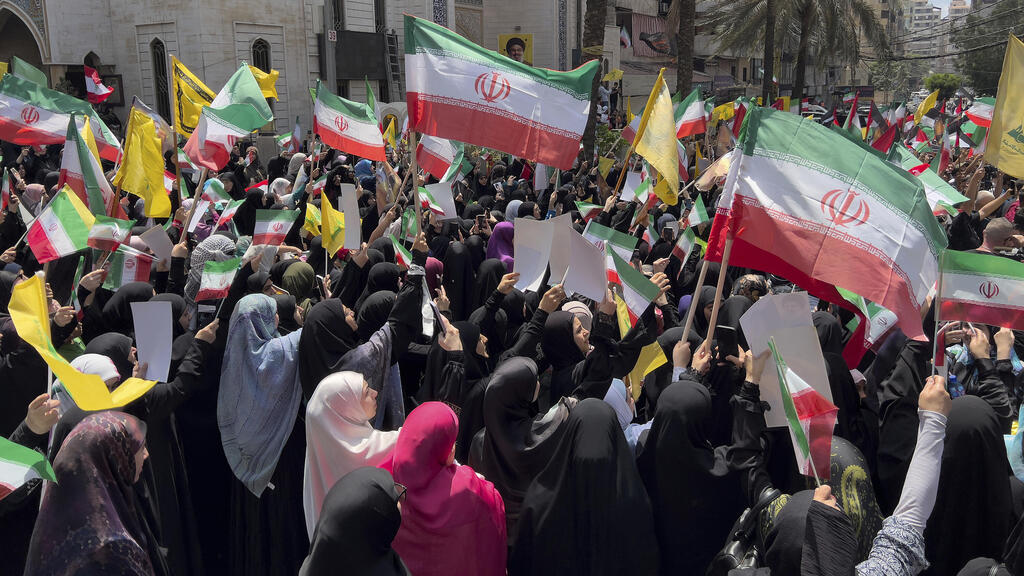
The axis Tehran cultivated through massive investments over nearly half a century failed to meet its goals in the latest confrontation. The vision of unifying fronts to undermine and ultimately collapse Israel was not realized. Key members of the axis, mainly Hezbollah and Hamas, suffered devastating blows, while others effectively collapsed, most notably the Assad regime in Syria. Now the flames are reaching the core of the system that birthed and sustains the axis. Thus, two years and three months after the October 7 attack, which the resistance camp viewed as the opening stage of an apocalyptic vision for Israel’s destruction, a reality has emerged that threatens the survival of the Islamic Republic itself.
Such anxiety has accompanied every wave of protest in Iran. In the past, the regime even relied on its proxies, primarily Hezbollah, to help suppress unrest at home. This time the fears are heavier for three reasons: the sense that the current protests are unprecedented in intensity and reflect deep generational anger; the weakened state of resistance actors after the war; and the determination displayed by Trump. For Shiite members of the resistance camp, the fall of the Islamic regime would mean a return to their pre-revolutionary status as marginalized groups in Lebanon, Iraq and Yemen.
“A possible collapse of the Iranian regime would be a tectonic earthquake in the Middle East, comparable to the impact of the 1979 Islamic Revolution,” says Danny Citrinowicz, an expert on Iran and the axis of resistance. “The proxies would not necessarily collapse, but they would weaken dramatically. Governments that have suffered from them and from Iran’s deep involvement could grow stronger, led by Lebanon, as could Shiite communities outside the Middle East, such as in Nigeria, Ivory Coast and parts of South America.”
The sharpest dilemma is evident in Hezbollah, the Islamic Republic’s favored son, now trapped between growing pressure to disarm and the threat of a broad Israeli military operation to neutralize its presence in southern Lebanon. The group does not expect help from Tehran but is also careful not to promise support if Iran is attacked. “We stand alongside the regime in confronting America and Israel,” Hezbollah said this week, without pledging assistance.
“Since the ceasefire, Hezbollah has been in a strategic defensive posture,” says Prof. Eyal Zisser of Tel Aviv University. “It has kept a low profile, avoided responding to Israeli strikes and did not assist Iran even during Operation ‘Like a Lion.’ Continued unrest in Iran, or even a limited American move, will not necessarily ignite the northern border. Hezbollah is fundamentally tied to the Iranian regime, but it is also a Lebanese organization rooted in the Shiite community. It could survive a regime collapse, though only through significant ‘Lebanonization’ and a reduced military role.”
In Lebanon, increasingly bold voices are speaking out against Hezbollah, alongside modest hopes that the government may act or that the group itself may show flexibility on weapons, especially south of the Litani River. Ali al-Amin, editor of Al-Janoubia, accused Hezbollah of “defending Iran before Lebanon,” warning that its weapons exact a heavier toll on Lebanese society and serve narrow interests rather than the public will. “At the same time as genuine sympathy for the Iranian people, there is concern in Beirut about the fallout from an American move, especially the risk of a broader regional escalation,” Zisser adds.
“The Houthis are not feeling pressure yet,” says Inbal Nissim-Louvton, a Yemen researcher at the Dayan Center. “They do not see themselves as a full Iranian proxy, but as partners in an alliance of interests.” The Houthis have recently expanded ties with Russia and China and appear more focused on developments in southern Yemen and on Israel’s relations with nearby Somaliland.
They were always treated as a stepchild
The Shiite militias in Iraq remain one of the regime’s few pillars of support. Abu Hussein al-Hamidawi, head of Kataib Hezbollah, warned this week that war against Iran “will not be a picnic.” Yet the Iraqi government fears the country could become a battlefield and pay a heavy price for Tehran. Unlike Hezbollah, whose response expectations are low, the Iraqi militias and the Houthis could take part in action against Israel, with or without Iran.
The Palestinians were always a stepchild in the resistance camp, Sunnis within a largely Shiite alliance. Hamas is not a classic Iranian proxy, but it fears the collapse of a longtime ally. Palestinian Islamic Jihad is more deeply anxious, as its survival depends almost entirely on Iranian support. Both have largely avoided public comment on the protests or the regime’s brutal repression.
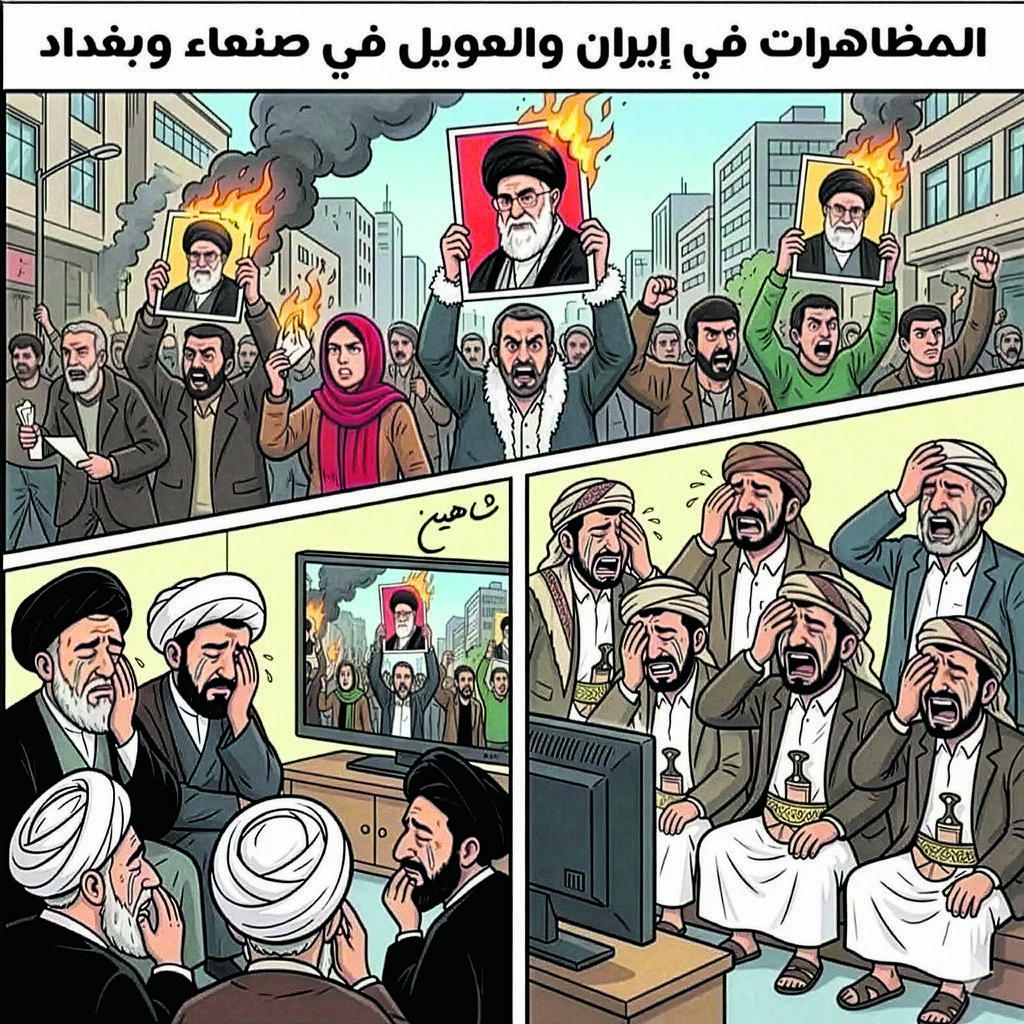
Cartoon circulating online: The Houthis and Hezbollah whining in the face of the protests in Iran
Unease is also evident among Iran’s Arab rivals, led by the Gulf states. Despite their hostility to Tehran, they are avoiding public encouragement. Saudi Arabia and other Gulf states reportedly urged Trump to avoid strikes that could disrupt global oil markets. Qatar and Oman are mediating between Tehran and Washington. Even Syria’s al-Sharaa regime, hostile to Iran, has remained silent, wary of retaliation. The Arab stance reflects fear of retaliation by a wounded Iran and aversion to popular revolutions after the trauma of the Arab Spring.
An opportunity and a reminder
While Israel voices optimism about the rise of a liberal or even pro-Israeli regime, Arab states fear chaos or a more radical takeover in Tehran. “Gulf states see Iran as a serious threat, but they are approaching the protests soberly,” says Ali al-Marabi, editor of the Paris-based Kul al-Arab. “There is concern about anarchy spreading across the region and recognition that there is no clear alternative leadership in Tehran.”
There is also Arab concern that Israel would benefit most from the regime’s collapse, through the removal of a major threat, stronger ties with Washington and the possible rise of a friendly regime in Tehran. Egyptian researcher Dr. Emad Ennan argues that many Arabs still view Iran as a restraining force on Israel and fear that its collapse would allow Israel to pursue unchecked regional hegemony, especially on the Palestinian issue. Turkey has also voiced unease. Foreign Minister Hakan Fidan said Ankara opposes the use of force against the Iranian regime, reflecting fears of regional instability and Israeli strategic gains.
In Israeli discourse, it is widely argued that even if the regime survives the current wave, it is a lame duck and that another, possibly decisive, wave is approaching. A weakened regime would struggle to support its allies and would act more cautiously, particularly against Israel.
The upheaval in Tehran could improve Israel’s strategic position, but it requires sobriety: avoiding direct intervention; recognizing deep Arab suspicion; understanding that the fall of the resistance camp’s leader does not erase the ideology or hostility toward Israel; and acknowledging that no regional drama will eliminate the Palestinian issue, which still demands serious and searching debate that Israel has long avoided.
Dr. Milshtein heads the Forum for Palestinian Studies at the Dayan Center at Tel Aviv University.
First published: 06:05, 01.17.26