

Syrian President Ahmed al-Sharaa has spent the past week accelerating a series of moves that could reshape both Syria’s internal power structure and its regional relationships, from reported contacts with Israel to a sweeping plan to absorb Kurdish forces into the national military.
The week began with a reported face-to-face meeting in Amman between Mossad chief Roman Gofman and Syrian Foreign Minister Asaad Hassan al-Shibani. The substance of the meeting has not been disclosed, but the fact that it took place at all is notable, as is Jordan’s reported role as host. Amman has long maintained quiet security coordination with Israel while keeping its political dealings highly discreet.
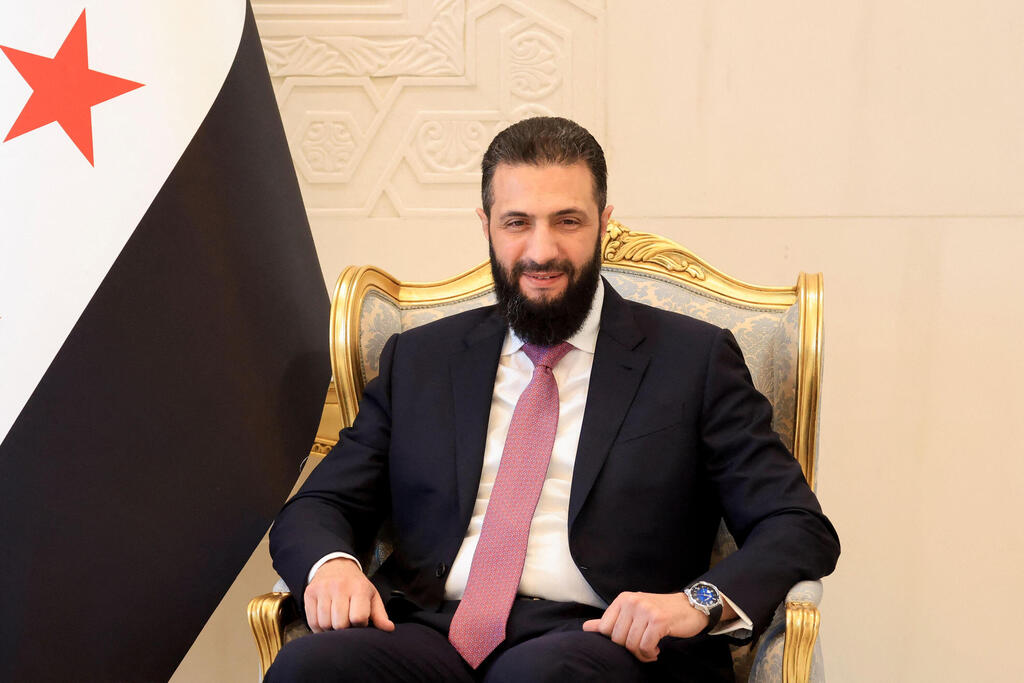
Syrian President Ahmed al-Sharaa
(Photo: Ludovic Marin/AFP)
Attention then shifted to Washington, where President Donald Trump announced the removal of remaining restrictions on economic cooperation with Syria. The decision potentially opens the door for American companies, as well as European firms with ties to the U.S. market, to invest in a country desperately in need of reconstruction after years of war.
Syria requires vast sums to rebuild destroyed neighborhoods, restart exports and revive industrial production. Until now, Trump had praised al-Sharaa personally while retaining the leverage provided by the Caesar Act sanctions framework. This week’s move marked a significant change, clearing the way for foreign businesses to enter the Syrian market more freely.
Israeli officials are watching developments in Damascus closely, particularly from the presidential complex overlooking the capital. Al-Sharaa has so far resisted pressure to send Syrian forces into Lebanon to confront ISIS elements or Iranian influence, arguing instead that Damascus has more immediate priorities.
His position has been that Syria and Lebanon must first settle their shared border, then work together against weapons and drug smuggling, before each side focuses on its own territory.
The most consequential move, however, may be unfolding inside Syria itself. After exploratory talks and secret meetings, Kurdish military commander Mazloum Abdi was invited this week to meet al-Sharaa at the presidential palace in Damascus, once associated with the Assad family and now used by the new leadership.
The emerging plan calls for the Kurdish armed forces in northern Syria, numbering more than 60,000 fighters and around 2,000 officers according to the source, to be integrated into the Syrian army. The stated objective is to create a unified military capable of incorporating the country’s ethnic and religious differences rather than maintaining parallel armed structures.
Under the proposal, Abdi would move into a senior position alongside al-Sharaa, effectively beginning a new phase in relations between Damascus and the Kurdish leadership. He also used a news conference to announce the dissolution of separate Kurdish combat formations and their incorporation into the Syrian military.
The merger would present substantial practical challenges, including differences in language, command structure, political culture and military organization. Kurdish forces operate largely in Kurdish-speaking areas, while the Syrian military remains overwhelmingly Arabic-speaking. Al-Sharaa, who formally holds the title of interim president, would remain commander in chief of the unified force.
The integration plan also addresses the large number of women serving in Kurdish armed formations. According to the proposal described in the source, female fighters would continue to serve in their home regions in northwestern Syria, but under the authority of the Syrian Interior Ministry rather than an independent Kurdish command.
That arrangement could create cultural friction between communities with sharply different social norms, particularly over the public role and appearance of women. Kurdish female fighters have long been among the most visible symbols of the autonomous administration in northern Syria, while more conservative social customs remain prevalent elsewhere in the country.
A further sign of the Kurdish leadership’s growing role in Damascus is the expected advancement of senior Kurdish politician Ilham Ahmed. She is being considered for a seat in the Syrian parliament and could receive responsibility for foreign affairs or constitutional matters, or possibly be appointed ambassador abroad.
Ahmed has previously acknowledged in interviews with Western media that the Kurdish administration maintained direct contacts with Israel in an effort to secure international support.
Taken together, the developments suggest that al-Sharaa is trying to consolidate power through integration rather than confrontation. At home, that means bringing Kurdish military and political structures into the Syrian state. Abroad, it means encouraging Western investment, avoiding unnecessary military entanglements in Lebanon and maintaining discreet channels with Israel even in the absence of formal relations.
The strategy remains risky. Incorporating tens of thousands of Kurdish fighters into a national army would require balancing competing loyalties, identities and command structures, while Syria’s economic recovery depends on outside investment entering a country still emerging from years of destruction.
But the direction is increasingly clear: al-Sharaa is seeking to turn Syria from a collection of rival armed and political centers into a more centralized state, while simultaneously reopening it to the region and the wider world.