


Prime Minister Benjamin Netanyahu’s speech at the UN was a masterclass in domestic public diplomacy. In a well-structured address, he laid out all the arguments for why Israel is acting the way it is in Gaza. But there is one problem: the world is not buying it. For the international community, Netanyahu’s words were no more convincing than reheated noodles.
For all his rhetorical skill — and he has plenty — the world expects the Israeli leader to present policy. That was missing. What he offered was more of the same. He did not even address President Donald Trump’s initiative.
Netanyahu's speech at the UN
(Video: UN)


What was absent from Netanyahu’s speech can be summed up in a single word: hope. Hope for the world and, no less important, hope for Israelis.
This past week marked a low point for Israel’s international standing. Western countries recognized a Palestinian state. World leaders accused Israel from the UN podium of committing “genocide.” And Netanyahu’s showmanship could not disguise the diplomatic failures for which he and his government bear responsibility.
Israelis love gimmicks, but when they pile up, they lose their punch. The barcode was a clever idea, even if blocked in Israel. Showing Hamas’ atrocities at the UN was also important — but only now? Where was this for the past two years? The video was screened only for elites, not the wider public. Families of hostages objected to a broader release, and no Israeli official took responsibility to authorize it with blurred faces. It came across as a way to cover the lack of substance with stunts.
The gimmicks reached their peak when Netanyahu held up large cue cards with multiple-choice questions: “Who wants the United States to die?” and “Who murdered European citizens?” The answers, which he then revealed, were Iran and terror groups Israel is fighting or has fought. It was this performance that led some to call it his “riddle speech.”
(Photo: ANGELA WEISS / AFP)
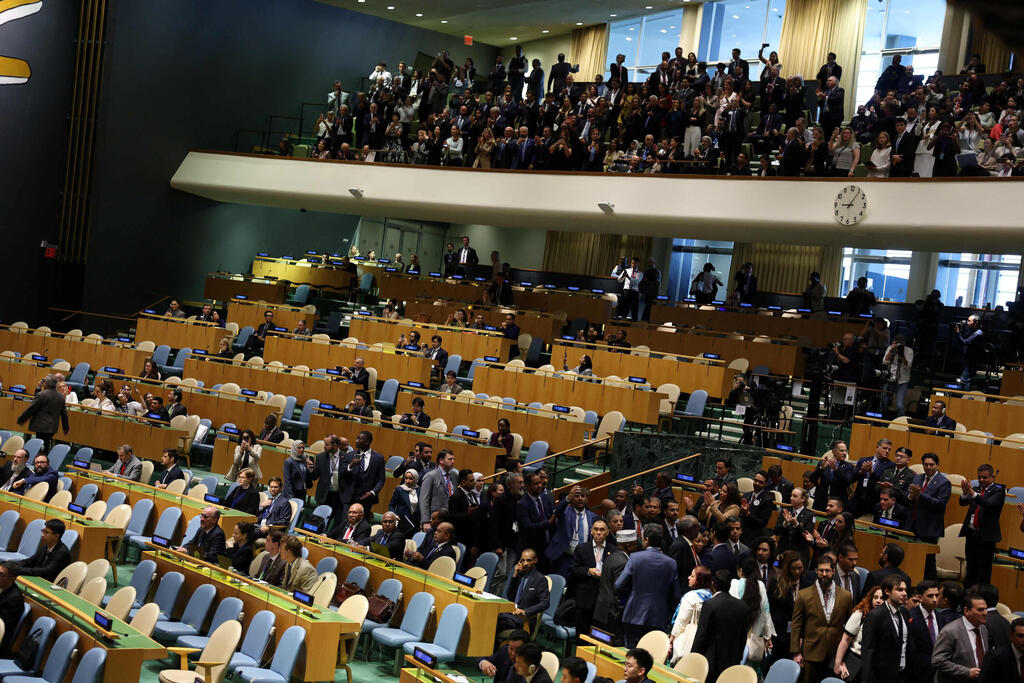
The walkouts at the start of the speech, and the half-empty hall during it, were the most visual expression of Israel’s current reality: isolated, abandoned, shunned. In the room remained the leaders of Papua New Guinea and Tonga, as well as New York City Mayor Eric Adams, who showed rare solidarity. That was meaningful — but too little. Israeli officials at the UN said the walkouts were organized by Palestinians and Arab states, who distributed entry passes to provocateurs to create a spectacle. Unfortunately, it worked.
Israel, for its part, packed the gallery with Netanyahu loyalists: philanthropist Simcha Felic (spelling unconfirmed), businessman Mor Zmira, tycoon Hezi Bezalel, lawyer Alan Dershowitz, socialite Nicole Raidman and her two children, Jewish leader Malcolm Hoenlein, and others. They stood, applauded and shouted “bravo.” Dershowitz told Ynet: “It was a wonderful speech. It really drove home that Jewish lives are no longer cheap and that Israel will fight back. He followed the Talmudic principle: If someone comes to kill you, rise up and kill him first. It was an interactive speech. A great success. The people who left the hall stayed for Iran and China. They would have stayed for Hamas. This just shows their hypocrisy.”
Netanyahu, however, was not at his best. He looked tired, his speech was too long, and he stumbled several times — even confusing Austria with Australia. He seemed to be in the grip of a panic attack. This was not the sharp Netanyahu his audiences are used to.
(Video: UN)
There were meaningful moments. Reading the names of 20 hostages still alive was moving, though he left out the names of the dead and of two whose lives are believed to be in grave danger — even as some of their parents sat in the gallery. His direct words to the hostages were powerful. If they heard them, they surely drew strength.
Listing Israel’s strategic achievements since October 7 was also the right move. In the endless Gaza war, Israel’s military successes have been forgotten, and it was good that Netanyahu reminded the world of them. His rejection of the genocide accusation was articulate and effective.
But diplomats were puzzled when Netanyahu lashed out at European governments. For a moment, he seemed to think he was president of the United States. With all due respect to his fluent English, what may work for an American president does not work for an Israeli prime minister. Publicly berating European leaders at the UN is not how you influence policy. It only deepens the rift.
To his credit, Netanyahu did extend a hand to Lebanon and Syria — a gesture of at least some hope. He also addressed the people of Gaza and Hamas’ leaders.
This will be remembered as Netanyahu’s “riddle speech.” But it is unlikely to be remembered as one of his strongest UN addresses. Perhaps that is because Israel finds itself in such a deep diplomatic low, and patience has run thin. Still, it was good that Netanyahu presented Israel’s version of events. At the very least, he did not abandon the stage.