

Prime Minister Benjamin Netanyahu is set to address the United Nations General Assembly on Thursday after days of sharp criticism of Israel from world leaders over the Gaza war, West Bank settlements and Palestinian statehood, taking the podium as he seeks to push back against accusations leveled at his government and refocus international attention on Iran.
Netanyahu is scheduled to speak at about 2 p.m. New York time, 9 p.m. in Israel, during an unusually brief visit expected to last only several hours. His schedule is markedly thinner than during previous trips to the annual gathering, with no meeting planned with U.S. President Donald Trump.
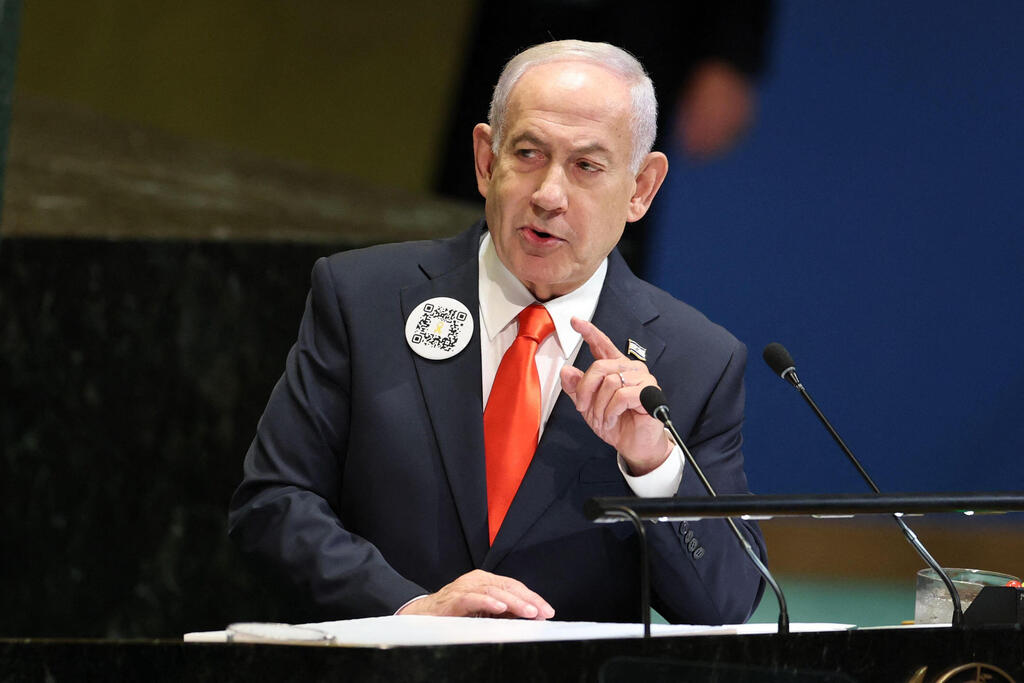
Prime Minister Benjamin Netanyahu
(Photo: ANGELA WEISS / AFP)
Before leaving Israel, Netanyahu signaled that his speech would be confrontational.
“You hear the terrible lies being spread there; I will fight for the truth,” he said, adding that there would be “surprises.”
Netanyahu has said he intends to defend Israel and the IDF against international criticism. Iran is also expected to feature prominently, with the prime minister likely to address Tehran's nuclear and missile capabilities and its efforts to rebuild after the latest conflict. Israeli officials have indicated that the address could include new information and visual material concerning Iran.
The speech comes at the end of several days in which Israel has repeatedly been the subject of criticism from the General Assembly podium, including from UN Secretary-General António Guterres, Turkish President Recep Tayyip Erdogan, Jordan's King Abdullah II, Qatari Emir Sheikh Tamim bin Hamad Al Thani and French President Emmanuel Macron.
Israel rejects allegations that it has committed genocide in Gaza and says its military operations have targeted Hamas and other terrorist groups. It has also accused critics of minimizing the security threats it faces and, in some cases, ignoring Hamas' Oct. 7, 2023, attack on southern Israel.
Guterres warns over Gaza and West Bank
Guterres, delivering his final General Assembly address before his term ends Dec. 31, condemned Hamas' Oct. 7 attack while sharply criticizing the scale of Israel's military response in Gaza.
He described the Hamas assault as “abhorrent” but said the ensuing Gaza war had brought a scale of death and destruction he had not witnessed during his years as secretary-general. He also warned that violence, Palestinian displacement and settlement expansion in the West Bank were eroding prospects for a two-state solution.
Guterres renewed his support for two states and called for international law to be upheld consistently, part of a broader address in which he warned that global institutions were struggling under the weight of wars, geopolitical divisions and declining trust.
Erdogan delivered one of the most forceful attacks on Israel, urging countries to increase pressure on Jerusalem over Gaza and calling on governments that have not recognized a Palestinian state to reconsider.
The Turkish president condemned the humanitarian situation in Gaza and accused the international community of failing to stop it. Turkey has repeatedly characterized Israel's campaign as genocide, an allegation Israel rejects.
Jordan's King Abdullah II also focused heavily on Israel, Gaza and the West Bank, accusing the Israeli government of policies aimed at changing realities on the ground and making a viable Palestinian state impossible. He pointed to settlement expansion, land seizures and settler violence in the West Bank while describing destruction in Gaza as part of a broader threat to Palestinian statehood.
Qatar's emir, Sheikh Tamim bin Hamad Al Thani, accused Israel of “genocide in the fullest sense of the word” in Gaza and criticized Israeli policy in the West Bank and elsewhere in the region.
French President Emmanuel Macron said the humanitarian situation in Gaza was a “spectacle that shames us all” and criticized increasing settler violence in the West Bank, arguing that it was undermining Palestinian rights and prospects for a two-state solution.
Macron also triggered a dispute with Israel over comments concerning Hamas' presence in the West Bank. His remarks were initially reported as saying Hamas had never operated there, prompting an angry Israeli response. A French diplomatic source later said the remarks had been mistranslated and that Macron meant Hamas had never governed the West Bank.
The criticism has not been limited to Middle Eastern leaders. Brazil's President Luiz Inácio Lula da Silva accused Israel of genocide and warned of lasting trauma among Palestinians, while British Prime Minister Andy Burnham condemned Hamas' Oct. 7 attack and affirmed Britain's support for Israel's security but also criticized Israeli government policy in Gaza and the West Bank.
Abbas: Israel ‘destroying’ two-state solution
Hours before Netanyahu's scheduled appearance, Palestinian Authority Chairman Mahmoud Abbas addressed the General Assembly by video after the United States denied him a visa to travel to New York for the second consecutive year.
The General Assembly voted 152-3, with four abstentions, to allow Abbas and other senior Palestinian officials to participate remotely in UN meetings when U.S. visa restrictions prevent them from attending. Washington has cited Palestinian efforts to pursue Israel in international tribunals and what it describes as attempts to “internationalize” the conflict among its reasons for the restrictions.
Abbas accused Israel of waging a “genocidal war” in Gaza, seeking to forcibly displace Palestinians and protecting what he called “settler terrorism” in the West Bank.
He also argued that Israeli policy was destroying prospects for a two-state solution and warned against another Nakba — the Arabic word for “catastrophe,” used by Palestinians for the mass displacement surrounding Israel's establishment and the 1948 Arab-Israeli war.
Israel rejects Abbas' accusations and maintains that its military campaign was launched in response to the Hamas-led Oct. 7 attack.
Iran expected to take center stage
Despite the focus on Gaza and the Palestinians throughout the General Assembly, Netanyahu is expected to devote a substantial portion of his speech to Iran.
Trump used his own General Assembly address Tuesday to issue a stark warning to Tehran, saying the United States could “annihilate” Iran if a peace agreement was not reached while also saying he believed a deal remained possible after the November U.S. midterm elections.
Iranian President Masoud Pezeshkian, meanwhile, used his appearance at the gathering to criticize U.S. policy and question Washington's commitment to diplomacy. The continuing U.S.-Iran confrontation has been one of the dominant Middle East issues surrounding this year's General Assembly.
Netanyahu is expected to discuss Iran's efforts to rebuild its nuclear and ballistic missile capabilities and could present intelligence or imagery intended to demonstrate the extent of that work. His aides are preparing visual aids, continuing a tactic Netanyahu has used in previous UN appearances, including his famous 2012 presentation featuring a cartoon-like bomb diagram.
He is also expected to address the Iranian people directly and discuss broader regional threats, including developments in Lebanon.
Lightning visit, no Trump meeting
The political backdrop to Netanyahu's speech is unusual in another respect: The prime minister is making one of his shortest U.S. visits in years.
He is expected to spend only about six hours in the United States, landing at a military airfield, traveling to Manhattan for the General Assembly and returning to the airport after his address.
Netanyahu will not meet Trump during the trip. Their schedules do not overlap, with Trump having left New York after his own UN appearances. Netanyahu is also not expected to meet Secretary of State Marco Rubio.
The Prime Minister's Office said Netanyahu's planned meetings include leaders from Argentina, Bolivia, Paraguay, Panama, Ethiopia, Colombia, Greece, Slovenia and Papua New Guinea, although the compressed timetable leaves little room for the extensive bilateral diplomacy that traditionally accompanies his General Assembly appearances.
Earlier plans for the trip were considerably broader. Netanyahu had been considering traveling to Texas for a possible meeting with Elon Musk and a visit connected to SpaceX, but the stop was canceled. Israeli officials had also explored meetings with Gulf leaders, but none had been finalized as the visit approached.
Protests and another possible walkout
Netanyahu is also expected to face protests both inside and outside the UN.
Pro-Palestinian demonstrators are planning protests in New York around his appearance, while Israeli anti-government activists and supporters of Israel are also expected to hold demonstrations. Security has been tightened around the UN complex during the gathering of world leaders.
Attention will also be focused on the General Assembly hall itself. Delegates staged a large walkout when Netanyahu addressed the gathering last year, and Israeli officials expect another hostile reception this time.
The visit comes amid an increasingly bitter exchange between Netanyahu and New York City Mayor Zohran Mamdani. Mamdani has called Netanyahu a war criminal and accused him of genocide in Gaza, allegations Netanyahu rejects. Netanyahu, in turn, has accused the mayor of supporting Hamas and fueling antisemitism.
The United States is not a member of the International Criminal Court, which issued an arrest warrant for Netanyahu in 2024 alleging war crimes and crimes against humanity in connection with the Gaza war. Israel rejects the court's jurisdiction and the allegations against the prime minister.