

It is impossible to overstate the importance of the war against Iran, whose defeat would carry significance far beyond the removal of an immediate threat. The scale of the Iranian danger far exceeds the nuclear threat or the ballistic missile threat, which in the massive quantities the regime intended to produce could wreak devastation comparable to nuclear weapons, albeit without radiation.
A nuclear Iran is nothing like nuclear North Korea or Pakistan, which have essentially created an insurance policy for themselves. The Iranian regime, by contrast, is driven by a messianic, apocalyptic ideology with ambitions of global hegemony. For them, taking control of the entire Middle East and its energy resources is only the first stage, intended to enable the accumulation of vast economic power and global influence, while positioning the Shiite minority as the leading force in Islam. To that end, they have built a military network that includes organizations and alliances in Iraq, Yemen, Syria, Lebanon and Gaza, with links extending as far as Venezuela.
The comparison to Nazi Germany is not only about declarations of annihilation toward the Jews, but also about a regime with unchecked ambitions for world domination, one that has effectively taken hostage a highly capable people in an industrial state that is also an energy power — enabling it to pursue its most extreme visions.
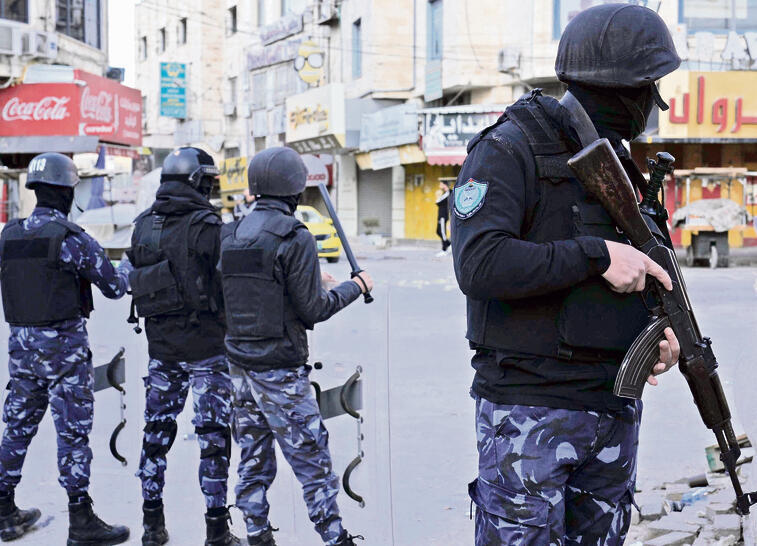
Palestinian police officers on duty in Jenin
(Photo: Majdi Mohammed/AP)
Just before reaching the point of no return — immunity through the acquisition of nuclear weapons — this regime has been halted by Israel and the United States, making this war one of the most significant events in human history. Unlike Nazi Germany, the Iranian threat has been stopped at the last moment, without the cost of a Holocaust or a war with tens of millions of casualties.
The folly agreement was violated
While Israel is prioritizing, rightly, the fight against Iran — even at the expense of allocating resources to operations against Hezbollah — a report published in recent days by the Regavim movement points to a new front taking shape. Under the seemingly innocuous label “Palestinian police,” a large army is emerging in the heart of the country. The danger is evident from the misleading name itself: this is not a police force, but an army in every sense.
The Oslo Accords — a misguided agreement that initially permitted a police force of 18,000 personnel — were never upheld. The “partners” quickly exceeded those numbers, doubling them. The gun that appeared in the first act was fired in the second — the terror war initiated by those same partners in 2000, which claimed well over 1,000 Israeli lives.
And what was the conclusion drawn in Israel from that devastating failure? That it must be continued. The “Palestinian Authority,” described here as a factory for terrorists — one that incites, educates for terror and rewards attackers with large sums — remains intact. Its “police” force continues to grow and even includes terrorists who were granted amnesty by Israel’s Shin Bet security service and are now considered “police officers.” This false portrayal is part of a broader illusion that casts the PA as a positive alternative to Hamas.
The “Palestinian police” now numbers some 60,000 personnel — twice the size of Israel’s police force and nearly one-third the size of the IDF’s standing army. It includes specialized units such as “Unit 101,” a 2,000-strong commando force specializing in urban warfare, breaching operations and tactical parachuting; the S.A.T. unit, a rapid intervention and raid force using sport motorcycles for deep incursions and trained in firing while in motion, numbering close to 2,500 fighters — roughly the size of an infantry brigade; and the BTS unit, “the Bat,” which specializes in covert operations and nighttime combat in complete darkness using advanced night-vision equipment.
Training for these “police” units is conducted by Western countries, with Israel’s consent. At its center is a U.S.-Canadian framework (USSC) based at the International Police Training Center in Amman, Jordan. There, National Security battalions undergo training that includes the use of weapons. This provides international legitimacy for training the force, while masking a much broader military buildup taking place elsewhere, in fully military training tracks beyond oversight.
This includes training at military academies in Pakistan and Russia, where officers receive instruction in command and control of regular units, conventional warfare and the use of artillery and armored forces. They graduate with degrees in military science — meaning the PA’s command echelon is becoming a professional military leadership. In parallel, there is naval commando and operational diving training in Pakistan, tactical parachuting in Italy and conventional military training in Algeria — all contributing to a range of offensive capabilities. A network of scholarships and training extends to countries such as Indonesia, Bangladesh and South Africa, illustrating the scale of the project to transform the police into a trained army within Israel’s borders.
Contrary to the illusion promoted by the Rabin government that “the Palestinian police will fight terror without the High Court and without human rights groups,” what has emerged is a force that has fought Israel using weapons it was given. The preview came in 1996, when 17 IDF soldiers were killed within five days, ostensibly over the opening of the Western Wall tunnel. During the Oslo war from 2000 to 2004, this escalated into a campaign of mass murder — yet this did not lead to recognition that the PA and its police are a dangerous enemy.
Since the end of the intifada, a steady military buildup has continued, accompanied by a “drip” of terror attacks by PA security personnel alongside attacks by Hamas and similar groups. Between 2020 and 2025, at least 118 members of these forces were directly involved in terrorism, most of them killed while carrying out attacks and later honored by the PA as “martyrs.”
One example is Majed Mansour, a former member of Mahmoud Abbas’ presidential guard, trained in Jordan by the U.S. military and a skilled sniper. Two years ago, he opened fire on a minibus near Dolev, about nine kilometers from Modiin, single-handedly pinning down an elite Duvdevan unit for hours, killing one soldier and wounding seven others.
'Security personnel terrorists'
Involvement in terrorism reaches the highest levels. For example, Mohammed Abu Bakr, who was killed in a clash with the IDF, served as the personal bodyguard of Mahmoud al-Aloul, Abbas’ deputy. Senior PA figures such as Jibril Rajoub and security spokesman Talal Dweikat have boasted that 365 members of the security forces are imprisoned in Israel, some serving life sentences, and that about 2,000 “martyrs” from these forces have been killed over the past 30 years — indicating even broader involvement in violence and terrorism.
The security forces themselves do not hide the purpose of their military training, as reflected in the content taught. The ultimate goal is not civilian policing, but building an offensive force aimed at taking control of territory within Israel. Social media accounts linked to the training base in Jericho feature videos declaring intentions to “return” to cities such as Jaffa, Tiberias, Haifa and Safed.
On the Iranian issue, Benjamin Netanyahu is portrayed here as a Churchill-like figure for his vigilance and early action. On the Palestinian issue, however, he is described as a full partner — alongside past governments and the entire security establishment — in denial, dismissal and inaction.