


The disciplinary steps announced Sunday by IDF Chief of Staff Lt. Gen. Eyal Zamir came as no surprise to Israel’s defense establishment, aligning closely with the findings of the panel led by Maj. Gen. (ret.) Sami Turgeman on the failures surrounding Hamas’ Oct. 7 attack. While most senior officers were removed only from reserve duty, the move was viewed as a public statement that senior commanders would not simply step aside on their own but would also face formal censure.
The measures did not include widespread dismissals from active service. Many of the senior officers involved — some of whom had already resigned and accepted responsibility — were removed only from reserve roles. They included former Military Intelligence chief Maj. Gen. (ret.) Aharon Haliva, former Southern Command head Maj. Gen. Yaron Finkelman and former Operations Directorate chief Maj. Gen. Oded Basyuk. Only one officer, the former intelligence chief of the Gaza Division, Lt. Col. A., was placed on an “immediate dismissal track.”
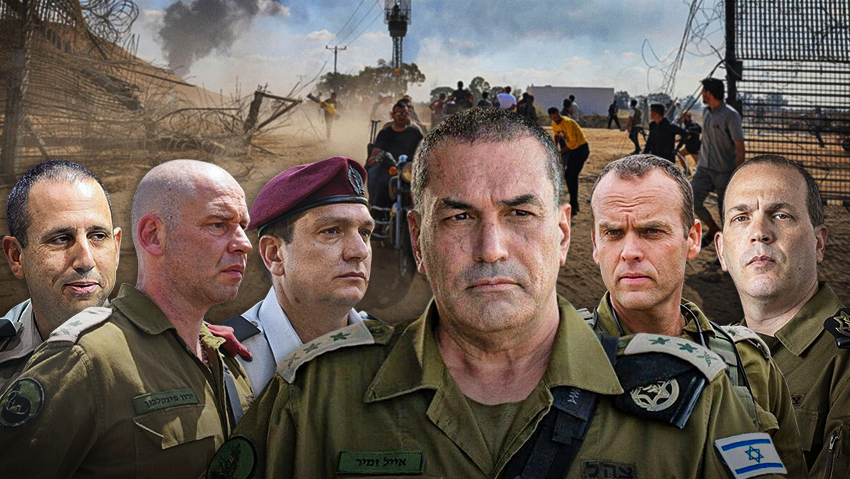
(Photo: IDF, Moti Kimchi, Avigail Uzi, Hani Alshaer/AFP)
The most contentious debate remains over Maj. Gen. Shlomi Binder, the current head of Military Intelligence. On Oct. 7 he served as chief of the Operations Division, and the Turgeman Committee identified numerous failures in his division’s performance that day. The findings reinforced earlier criticism from former chief of staff Lt. Gen. (ret.) Herzi Halevi, who had already declined to endorse Binder’s promotion at the time.
Despite that, Zamir decided Binder will remain in his post until completing his term. In private conversations, Zamir said dismissing Binder now “would cause enormous damage to the State of Israel,” arguing that replacing the intelligence chief at this stage would be highly irresponsible given current operational pressures. In his public remarks, Zamir said Binder is “the most suitable commander” to lead Military Intelligence at a moment when Israel may “return to combat in arenas where we have already operated,” a pointed reference to Iran and Hezbollah.
Turgeman, however, maintains that Binder should not be allowed to serve out his full term. While acknowledging the operational challenges Israel faces, he argued that Binder has not faced meaningful personal consequences and that his promotion, despite the failures of Oct. 7, sends the wrong message. Turgeman suggested Binder could have been given a limited transition period — for example, a year — to stabilize the branch while a successor was prepared, ensuring that he also bore a clear professional cost.
Haliva, the former head of Military Intelligence, told Zamir he had taken full responsibility and conducted all necessary internal reviews. He reiterated his demand for a state commission of inquiry. Such a commission, however, has stalled, leaving the responsibility borne largely by the IDF, while the political echelon and Shin Bet have so far avoided comparable scrutiny. Unlike the army, Shin Bet operations remain shielded under Israel’s Security Service Law, which prevents public disclosure of names or roles.
The dispute over accountability — and over how far it should extend — continues to divide senior defense officials as Israel prepares for potential escalations across multiple fronts.