


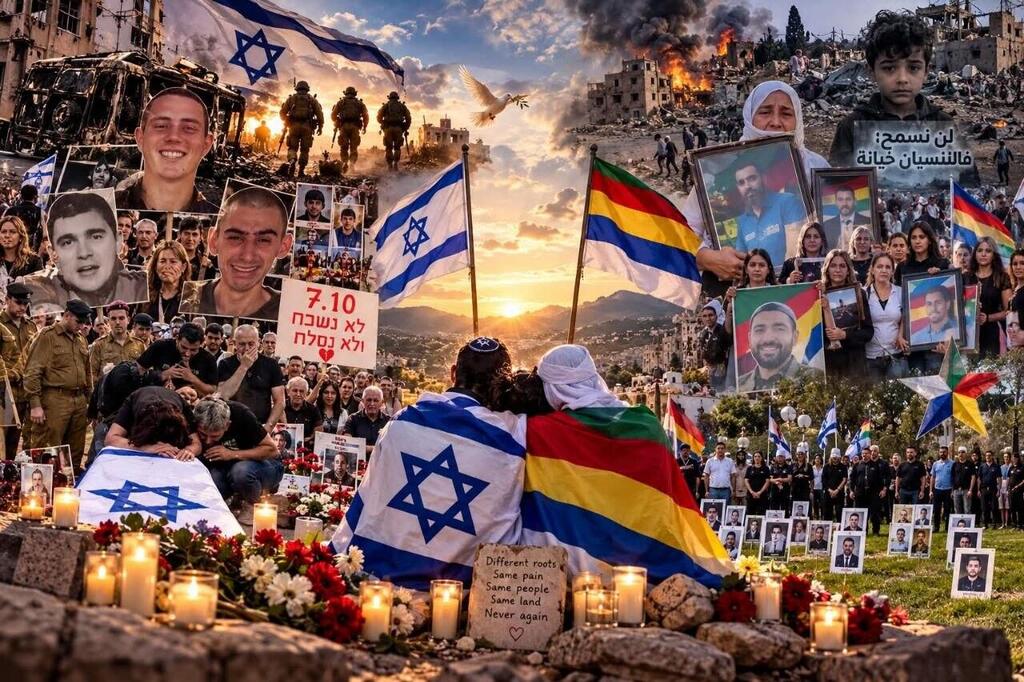
October 7 carries a heavy meaning in Israeli society. It is the day Hamas and other Palestinian terrorist organizations attacked Israel, killing, abducting and sexually assaulting civilians, burning homes and communities, and turning entire towns in southern Israel into crime scenes. For Israelis, there is no need to explain what October 7 means. It is a date that has entered the national memory. But beyond Israel’s border, in Sweida on Jabal Bashan, the date will also be marked. In Sweida, it has become a date that many Druze recognize through their own experience.
The comparison is not rhetorical. It is rooted in what happened to the Druze community itself.
In July 2025, Druze communities in Sweida were subjected to massacres, executions, abductions, displacement and the destruction of homes and villages. Armed terror groups attacked Druze civilians, while forces affiliated with the Syrian interim government were involved in the violence. The United Nations documented killings, forced displacement, sexual and gender-based violence, and systematic incitement against Druze.
I do not believe this should be described with diplomatic language.
For many Druze, July 2025 was an attempted genocide against their community, an attack intended not merely to defeat an armed opponent, but to terrorize an entire minority because of its identity.
And the violence did not begin in 2025.
On July 25, 2018, ISIS attacked Sweida. Fighters entered communities and killed civilians. Suicide bombings followed. More than 200 people were killed, and dozens of Druze women and children were abducted.
These are not two isolated events. They are part of the reason the Druze of Sweida look at October 7 and immediately understand what Israelis mean when they speak about the fear of jihadist violence reaching civilian communities.
There is also a political consequence. For generations, the Druze of Sweida regarded themselves as part of Syria. That relationship has been fundamentally damaged. After the events of July 2025, many no longer see their future within the Syrian state as it exists today.
They are not asking simply for better representation in Damascus. They want autonomy. Many want independence.
They want control over their own territory, security and political future. They do not want to return to a Syrian system they regard as hostile to minorities and increasingly shaped by jihadist ideology.
This position cannot be dismissed as a temporary reaction to the latest round of massacres. It reflects a much deeper collapse of trust.
Druze demonstration in Sweida in July 2025, chants: "The people want Israeli intervention"


The same applies to their relationship with Israel.
During the July 2025 crisis, Israel intervened militarily and presented its actions as the defense of the Druze. Israel was the only country acting decisively on their behalf when they believed their community was facing an existential threat.
That experience changed perceptions. It created a connection between the Druze of Sweida and Israel that is difficult to understand through conventional regional politics alone.
The connection is also about identity.
The Jewish people have their own historical memory of persecution, massacres and attempts to destroy Jewish communities because they were Jewish. The Druze feel emphasized with the jewish narrative. But the underlying question is familiar: what happens to a small minority when its identity itself becomes a reason for violence?
That question has become increasingly relevant to the Druze of Sweida.
There is another reason the connection is becoming stronger: the incitement has not disappeared. Anti-Druze rhetoric, accusations of treason and hostility toward the community remain part of the political and social environment surrounding Sweida. When a minority is repeatedly portrayed as an enemy because of its identity, its religion or its perceived relationship with Israel, the result is not reconciliation. It is further alienation.
This is why October 7 has significance in Sweida.
The Druze who gather there to mark the massacre are not simply commenting on Israeli politics. They are identifying with another people that has experienced mass violence against civilians and has concluded that survival requires security, political power and the ability to defend itself.
For Israel, this creates an important reality that should not be ignored. The relationship between Israel and the Druze of Sweida is no longer based only on historical ties or geography. It is being shaped by what happened in July 2025 — and by the conviction among many Druze that Israel was the country that came to their defense.
The political map of Syria may change again. But the Druze of Sweida have already changed their perception of where they belong.
They want autonomy. They want independence. And they want the right to determine their own future.
October 7 therefore carries a different meaning on Jabal Bashan. It is a reminder that the experience of a community under attack can create political alliances that did not exist before.
The Druze of Sweida remember July 25, 2018.
They remember July 2025.
And now they are marking October 7.
Because they believe they understand what it means to be targeted for who you are — and to decide that you will never again leave your survival in someone else's hands.