


The decree enacted by the Belgian government on Saturday, July 18, 2026, to ban imports from Israeli communities across the West Bank represents a critical shift in Western Europe's geopolitical alignment. By formalizing these economic restrictions prior to its summer recess, Brussels has aligned itself with the hostile diplomatic campaigns championed by Spain, Ireland, Norway, and the Netherlands. Wrapped in the sanitized language of diplomacy, European bureaucrats frame this as an enforcement of United Nations Security Council Resolution 2334. Predictably, Egypt applauded the decision, calling on the global community to adopt identical measures.
Beneath this veneer of legality lies a darker domestic reality. The decision to single out the Jewish state for economic warfare is a profound act of political capitulation to domestic radicalism. It is a direct consequence of the rise of political Islamism and a terrifying resurgence of antisemitism systematically hijacking the democratic institutions of Western Europe.
Gallery

The Belgian government issued a decree to ban imports from Israeli communities across the West Bank
(Photo: Shaul Golan)
The demographic engine of European foreign policy
To understand this diplomatic assault, one must examine the demographic and cultural transformations sweeping through Western Europe’s capital cities. Israel has long warned its partners that tolerating unbridled radicalism and systemic hostility against Zionism would erode their own democratic values.
Today, that prediction is reality. In urban centers like Brussels, Antwerp, Paris and London, the political center of gravity has shifted under the pressure of rapidly growing, highly mobilized immigrant populations. Within these demographics, organized Islamist networks have captured the political narrative, transforming opposition to Israel into a core litmus test for electoral viability. Left-wing coalitions and green parties, desperate to maintain their grip on power, have increasingly found themselves beholden to these voting blocs.
Terrified of triggering social unrest within their parallel societies, European politicians have chosen the path of least resistance. They appease the radical street by sacrificing their strategic relationship with the only stable democracy in the Middle East. Electoral dynamics in cities like Brussels and Antwerp confirm that left-wing and green coalition partners routinely prioritize anti-Israel resolutions over critical local governance to appeal to concentrated voter bases, illustrating how European foreign policy has been weaponized to satisfy domestic demographic pressures.
The physical peril facing European Jewry
The immediate consequence of this political opportunism is the escalating danger confronting Europe’s Jewish populations. Following the events of October 7, anti-Jewish hatred across the continent has surged to its highest levels in generations, marked by unprecedented spikes in reported hate crimes. Comprehensive reports published by the European Union Agency for Fundamental Rights paint a devastating picture, revealing that 96% of European Jewish respondents have encountered intense antisemitism in their daily lives. Over three-quarters reported being forced to hide their Jewish identity in public out of a justified fear for their safety.
Data compiled by the Community Security Trust demonstrate that antisemitic hate incidents have shattered historical records, infiltrating schools, campuses, public transit and neighborhoods. When a European government formally declares that products manufactured by Jews in their ancestral homeland are illicit, it provides explicit state validation to the mobs driving this crisis. This institutional delegitimization translates directly into violence on European streets, where synagogues require permanent military protection and kosher businesses face vandalism.
The strategic fallacy of territorial concessions
The animosity directed toward Israel from capitals like Brussels, Dublin and Madrid is existential, not policy-dependent. To a continent grappling with an identity crisis and yielding its public squares to Islamist influence, Israel serves as a convenient scapegoat. The strategic high ground of the West Bank is not a bargaining chip to satisfy unelected foreign bureaucrats, but rather an indispensable territorial shield against regional radicalism.
If Israel were to succumb to international economic pressure and withdraw from these vital hills, the resulting vacuum would be rapidly occupied by Iranian proxies and terrorist networks. The topography overlooking Ben Gurion Airport and the Tel Aviv metropolitan area would be transformed into a permanent launching pad for rockets, replicating the catastrophic realities witnessed in Gaza and southern Lebanon. European leaders can easily afford to indulge in utopian peace fantasies, but Israeli leaders, who must live with the lethal consequences of security failures, do not have that luxury.
The anatomy of European hypocrisy
The sheer hypocrisy underlying the Belgian decision is as profound as it is transparent. The international arena is filled with genuine military occupations, illegal annexations and state-sponsored atrocities, yet the European Union consistently fails to achieve consensus on punishing the world’s most egregious authoritarian regimes.
European foreign ministers spent months debating complex customs tariffs and special licensing mechanisms specifically designed to harm Israeli business owners, exposing an obsessive fixation on the Jewish state. Meanwhile, Turkey’s illegal, decades-long occupation of Northern Cyprus, or Russia's military campaigns, never face identical forms of state-mandated economic warfare from Brussels.
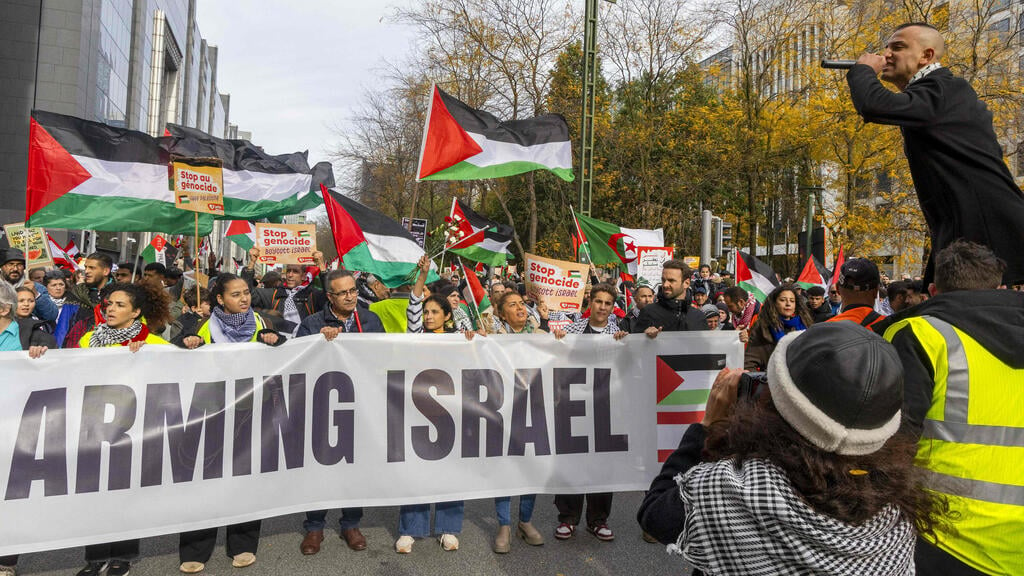
Anti-Israel demonstration in Brussels
(Photo: Nicolas Maeterlinck/ Belga / AFP)
This severe double standard perfectly fulfills the globally accepted definition of modern antisemitism. When the international community routinely applies a unique, impossible set of standards to Israel that it applies to no other sovereign nation, its underlying motives are exposed as malicious. Even Egypt’s eager endorsement of this boycott serves as a calculated attempt to appease its own restive domestic public opinion, proving that in the Middle East formal peace agreements are maintained solely through overwhelming deterrence and hard power, not mutual affection.
Economic resilience and the Zionist future
Despite the hostile intentions of certain Western European capitals, Israel's ultimate shield remains its undisputed technological, economic and military superiority. The global economy does not run on the moral grandstanding of Belgian politicians; it runs on the critical, irreplaceable innovations pioneered by the Jewish state. The world relies heavily on Israeli advancements in cybersecurity, artificial intelligence, unmanned defense systems and water management technologies. A localized, discriminatory boycott of goods from the West Bank will never succeed in crippling the robust, high-tech economy.
As Western Europe continues to succumb to its demographic and moral crises, Israel must actively pivot its foreign policy away from these unreliable partners. It must deepen its strategic, military and economic alliances with nations across Eastern Europe, Africa and Asia that possess a clear-eyed understanding of the global struggle against radical extremism.
The capitulation of the Belgian government on July 18, 2026, is an explicit warning sign of a fracturing European moral order, not a measure of Israeli isolation. The State of Israel will continue to fortify its sovereign borders, defend its citizens, and build its future without seeking the permission or validation of foreign institutions. Israel’s national survival has always depended on its internal unity, its military prowess. While Western Europe chooses the path of cultural and political submission, the State of Israel will always choose the path of clarity, self-reliance and ultimate victory.
Amine Ayoub, a fellow at the Middle East Forum, is a policy analyst and writer based in Morocco. Follow him on X: @amineayoubx