


For much of the past three years, public discussion of southern maritime threats has focused on Yemen. Israeli news cycles routinely track Houthi missile launches, sirens in Eilat and cargo ships detouring around the Cape of Good Hope.
Yet across the Bab el-Mandeb, a major geopolitical rupture has emerged along the African side of the Red Sea. On October 1, 2026, diplomatic relations between Ethiopia and Eritrea collapsed after Addis Ababa closed its embassy in Asmara and expelled 10 Eritrean diplomats, prompting Asmara to sever all ties. That same day, Ethiopia and Egypt exchanged diplomatic expulsions.
Ethiopian government forces march on the town of Amada, which was captured from the Tigray rebels
(Video: Reuters)


These developments have turned the western Red Sea into a more dangerous arena of regional confrontation, raising the risk of gaps in surveillance and maritime enforcement.
The maritime route from the Gulf of Aqaba to the Indian Ocean functions as one interconnected security system. Instability can spill into shipping lanes, create openings for hostile actors and weaken Israel’s strategic depth along its southern maritime routes. Recognizing these structural changes on the African side is increasingly important to freedom of navigation and Israeli security.
The shattered accord and diplomatic expulsions
The immediate catalyst for this crisis is the collapse of the 2018 Joint Declaration of Peace and Friendship between Ethiopia and Eritrea. Eight years ago, Prime Minister Abiy Ahmed and President Isaias Afwerki signed a landmark agreement ending two decades of border conflict, helping Abiy earn the Nobel Peace Prize.
Eritrean forces later fought alongside Ethiopian federal troops during the 2020-2022 Tigray war. The November 2022 Pretoria Agreement halted major hostilities, but political distrust remained.
That fragile peace has now dissolved. Fighting has spread across Tigray, Afar and Amhara as Ethiopian federal forces and a TPLF-led opposition alliance battle for control. Ethiopian authorities have accused Eritrea, Egypt and Sudan of supporting opposition forces, allegations those governments reject.

On October 1, Addis Ababa formally severed diplomatic relations with Eritrea and declared 10 Eritrean diplomats persona non grata, giving them 48 hours to leave. Eritrea responded by severing diplomatic ties and accusing Ethiopia of threatening its sovereignty and seeking access to Eritrean ports.
The diplomatic confrontation widened the same day when Ethiopia expelled senior Egyptian diplomat Ahmed Moharam Ahmed Soliman. Egypt retaliated within hours by expelling an Ethiopian Embassy counselor.
Military mobilization and heavy fighting are intensifying across northern Ethiopia, raising the risk that the conflict could spill across the Eritrean border.
Fueling the escalation is Ethiopia’s persistent drive for sovereign maritime access. Since Eritrea’s independence in 1993, landlocked Ethiopia has relied overwhelmingly on Djibouti for its international trade, with more than 95% of its import-export trade by volume using the Addis-Djibouti corridor.
On January 1, 2024, Abiy signed a controversial memorandum of understanding with Somaliland under which Ethiopia sought to lease 20 kilometers of coastline for maritime access and a naval facility. Somalia condemned the agreement as a violation of its sovereignty, bringing Ethiopia’s search for sea access into sharper conflict with Mogadishu.
Egypt, Sudan, and strategic pressure
This crisis intersects with Egypt’s broader effort to counter Ethiopian influence in the Horn of Africa. Cairo and Addis Ababa have long been locked in a confrontation over the Grand Ethiopian Renaissance Dam, which Egypt regards as a major threat to its water security.
The recent diplomatic expulsions underscore how quickly the conflict in northern Ethiopia is becoming a broader regional dispute. The African Union has urged Ethiopia, Eritrea and Egypt to exercise restraint.
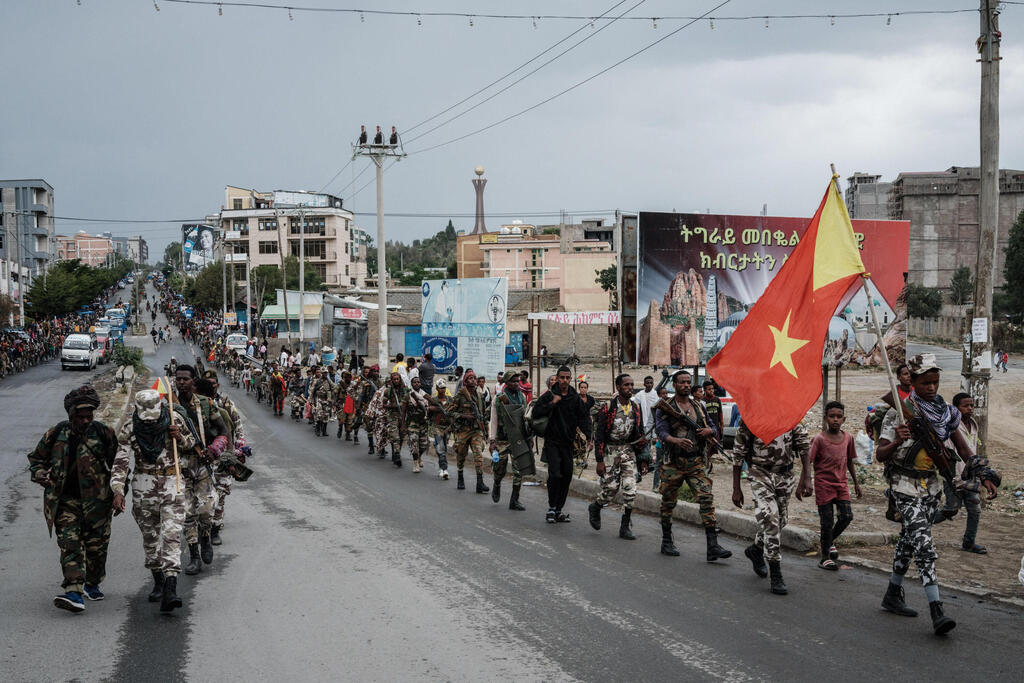
Tigray People’s Liberation Front (TPLF) fighters march in Mekelle, capital of Ethiopia’s Tigray region, June 30
(Photo: Yasuyoshi Chiba / AFP)
Egypt has also deepened its military relationship with Somalia through a security agreement, arms deliveries and, by 2026, the deployment of Egyptian forces under the African Union’s AUSSOM mission. At the same time, Cairo has expanded high-level security coordination with Eritrea, including cooperation involving maritime transport and ports.
Together, these relationships place Ethiopia under increasing strategic pressure from several directions and give Egypt greater regional reach around Ethiopia’s eastern and northern approaches.
Sudan’s continuing war adds another layer of uncertainty, making developments along the African Red Sea coast even harder to isolate.
Cairo’s expanding military footprint carries major consequences for regional security. Egypt’s economy has already been hit by Red Sea disruptions, with Suez Canal revenues falling by more than 60% in 2024.
If Egyptian forces become drawn into proxy warfare or direct clashes around Ethiopia’s perimeter, the economic and security costs could increase. An economically strained and militarily overextended Egypt would add another complication to regional stability and the security environment around Israel’s western border.
Smuggling, escalation, and the Iranian threat
The maritime security risk from the Ethiopia-Eritrea crisis is not that the African coast will suddenly become lawless. It is that prolonged conflict could create new gaps in surveillance and enforcement.
The Suez Canal handled roughly 12% to 15% of global trade before the Red Sea crisis, while the Bab el-Mandeb itself is one of the world’s critical maritime chokepoints. Eritrea controls more than 1,000 kilometers of Red Sea coastline, extending northward from the Bab el-Mandeb and across the sea from Yemen.
If Eritrean forces divert significant resources toward the confrontation with Ethiopia, maritime surveillance around ports such as Massawa and Assab could become harder to sustain.
Existing smuggling networks already exploit the wider Red Sea and Horn of Africa. Trafficking networks use small vessels to move weapons and other illicit cargo across maritime routes linking Sudan, the Horn and Yemen.
Full-scale hostilities between Ethiopia and Eritrea could widen existing monitoring gaps, creating more favorable conditions for weapons traffickers, human smugglers and pirates to operate. Recent reporting has also linked Houthi networks and Iranian support to smuggling activity involving Sudan, Somalia and Eritrea.
Iran and the Houthis have demonstrated the ability to exploit maritime smuggling routes around the Red Sea and Horn of Africa. A deeper conflict on the African shore could make those routes harder to monitor and create additional opportunities for weapons transfers, intelligence collection and logistical activity.
The timing is especially important because the Yemeni side of the Bab el-Mandeb is also becoming more contested. Houthi forces have advanced to strategically important positions near the chokepoint, while Saudi Arabia is preparing a military operation aimed at breaking Houthi control of the maritime corridor.
Israel therefore faces a strategic problem on both shores of the same maritime system.
Strategic priorities for Jerusalem
Israel’s immediate security demands naturally draw attention to Gaza, Lebanon, Syria and Yemen. But the Red Sea’s African shore is becoming too strategically consequential to remain outside Jerusalem’s daily security calculations.
The African side of the Red Sea represents an intelligence requirement comparable to the maritime approaches around Yemen, requiring sustained monitoring of ports, airfields, coastal radar, military deployments and emerging foreign security infrastructure.
Particular attention should focus on Assab and Massawa in Eritrea and Berbera in Somaliland. Tracking troop movements, naval activity and factional alliances along this coast is essential for detecting and countering maritime threats before they reach the southern approaches near Eilat.
Diplomatic engagement can also reinforce regional maritime security structures. That means maintaining communication with regional partners, monitoring security conditions around critical port infrastructure and ensuring international naval forces maintain adequate awareness of the African coastline rather than concentrating exclusively on Yemeni waters.
For Israel, the lesson is straightforward: The Red Sea cannot be secured by watching Yemen alone. The African shoreline is becoming an increasingly important arena for competition among Ethiopia, Eritrea, Egypt and outside powers.
If that competition spills into maritime infrastructure, smuggling networks or foreign military deployments, the consequences could eventually reach the waters through which Israel’s southern trade and security routes pass.
No single crisis needs to become a regional war for the strategic balance to change. The danger is that a hostile actor could gain an uncontested foothold on the western side of the Red Sea while attention remains fixed on Yemen.
Amine Ayoub, a fellow at the Middle East Forum, is a policy analyst and writer based in Morocco. Follow him on X: @amineayoubx