

I stood alone on April 28, 2024, with an American and Israeli flag at UCLA, trying to hold back hundreds of anti-Israel demonstrators who had just broken through metal barriers separating their encampment from our permitted pro-Israel rally. Behind me was a stage and screen we had spent time and money organizing. I was a human barrier. If they wanted to move forward, they would have to go through me.
A man in a yellow safety vest stood nearby. I assumed he was UCLA security. When I asked for his help pushing the crowd back, I realized he was actually with them, guiding their advance. Every time he stepped toward me, the crowd followed.
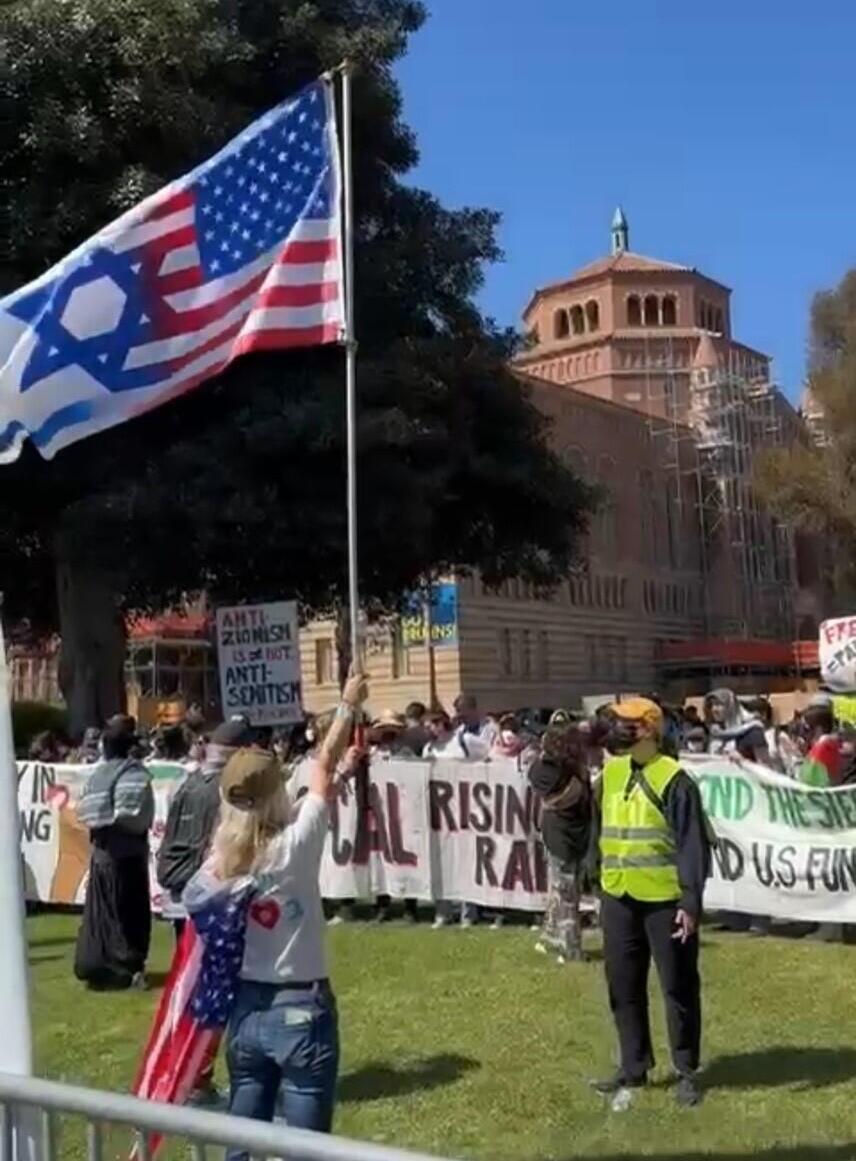
Aya Shechter with an American and Israeli flag at UCLA stands alone against anti-Israel demonstrators during a permitted pro-Israel rally
(Photo: Courtesy)
My lone stand made for a powerful image. But it is not what pushed the crowd back. What pushed them back was when others joined me, shoulder to shoulder, forming a horizontal line. We walked forward together. Only then did they retreat. That day became the largest pro-Israel rally on an American campus and the first organized demonstration held directly in front of the encampments, a turning point that preceded similar rallies at other universities and the eventual dismantling of those encampments.
That moment taught me something I still recognize as a gap in the Jewish world, even two and a half years after October 7: You cannot defeat a system with a single act of courage, a viral video or a campaign, brilliant as it may be. You defeat it with coordinated, sustained, horizontal pressure.
The anti-Israel infrastructure on American campuses was not built overnight. For over two decades, while Jewish philanthropists funded university buildings and put their names on libraries and lecture halls, adversarial forces funded something far more consequential: professors, department chairs, curricula, and bright students who would carry their ideology forward.
Research by the Institute for the Study of Global Antisemitism and Policy has documented billions in foreign donations, primarily from Qatar, flowing into American universities, much of it unreported as required by law. ISGAP found a direct correlation between these undisclosed funds and the rise of antisemitic incidents on campus. Students sat in buildings bearing Jewish names while being taught, semester after semester, to see Israel as the embodiment of colonial oppression.
When the encampments appeared, many of us recognized immediately that there was nothing grassroots about them. The tents were identical in make, model and color. Printed booklets with pre-written chants were handed to students. "From the river to the sea" did not catch on because of the rhyme. It caught on because it was part of a coordinated messaging operation, years in the making, requiring no original thought from its participants.
Our adversaries understood two things we have yet to act upon. First, that influence requires coordinated effort across institutions, geographies, and years. Second, that public opinion is shaped in the long term, through curricula, through the slow accretion of ideological frameworks, through the patient cultivation of a generation of activists.
'From the river to the sea' did not catch on because of the rhyme. It caught on because it was part of a coordinated messaging operation, years in the making, requiring no original thought from its participants
And yet here we are, still fighting a system with campaigns. We bring a Nova survivor to speak once on a campus and expect a student who spent a year in a sponsored professor’s mandatory ethnic studies course to suddenly change his mind. We produce a viral video and feel we made an impact. These are vertical attacks against a horizontal system. They energize our base but rarely change a single mind not already with us.
In recent weeks, I spoke with lay leaders, organizational heads, and federation executives from coast to coast, searching for a simple document: a short list of priorities the Jewish community could present, as one voice, to every candidate running for office. Something as straightforward as: support adoption of the IHRA definition of antisemitism, bubble-zone protections around houses of worship, anti-BDS contracting rules, and clear enforcement when protests become harassment.
You might be surprised, or perhaps not, to learn that no such document exists. There is not even a single requirement the broad Jewish community is currently pushing together. More than two years after October 7 exposed a well-oiled antisemitic machine on American soil, we are still fragmented. Still fighting one-off battles against a coordinated adversary.
The best time to build a coast-to-coast civic engagement network was 20 years ago. The second-best time is now, especially ahead of the 2026 midterm Congressional elections in November. We need strategic organizing, not another campaign, not another rally, not another feel-good moment, but a permanent, coordinated system that trains Jewish communities in civic engagement, connects them across regions, and enables consistent pressure at every level – from school boards to city halls to the halls of Congress.
My picture with the American-Israeli flag at UCLA looks good. But standing alone with a flag is not what changed anything. What changed things was a horizontal line of defense made of people, moving together. The Jewish community needs to stop mistaking a powerful reaction for a strategy and start building the line.
Aya Shechter is the chief programming officer of the Israeli-American Council (IAC)