


On August 23, 2026, Iran’s National Security and Foreign Policy Commission approved Article 3 of the draft Strategic Action Plan for the security and development of the Strait of Hormuz. The provision would authorize charges on foreign commercial vessels for navigation, environmental protection, insurance, safety, fuel supplies in special cases and related services. Fees would apply to ships from countries Tehran deems authorized to pass and could be paid in Iranian rials or any currency designated by the government. The measure still requires full parliamentary approval and further steps before becoming binding law; exact fee levels and enforcement mechanisms have not been published.
To outside observers, the step appears as asymmetric posturing and a challenge to Western sanctions. The waterway has historically carried roughly 20 percent of the world’s seaborne crude.
Gallery

Strait of Hormuz. The waterway has historically carried roughly 20 percent of the world’s seaborne crude
(Photo: REUTERS/Stringer)
Beneath the rhetoric lies a more constrained reality: an effort to extract revenue from a vital trade artery at a moment when other sources of hard currency have become harder to sustain.
The scale of the pressure
The economic backdrop explains the timing. The Iranian rial had fallen to historic lows, with the dollar trading near or above two million rials on the open market. Domestic purchasing power has eroded and public discontent has intensified. Inflation continues to hollow out household budgets. Energy subsidies that once helped maintain social quiet have grown increasingly difficult to finance.
The Islamic Revolutionary Guard Corps, which controls substantial portions of the Iranian economy, has seen its shadow financial channels come under sustained pressure. Washington’s campaign has targeted not only primary oil exports but the third-country mechanisms that once converted crude into usable hard currency. Workarounds have grown more expensive and less reliable. The conflict that began in February compounded these difficulties, disrupting traffic through the strait, raising insurance rates and cutting into both legitimate and illicit revenue streams.
Against that background, the committee vote represents an attempt to generate more direct cash flow by standing at the narrow gateway of global oil trade and requiring payment. The model looks less like a carefully calibrated long-term strategy than a response to immediate fiscal constraints.
Coercion presented as maritime services
Iranian lawmakers frame the charges as legitimate fees for security, environmental protection and maintenance inside waters they claim. Under the United Nations Convention on the Law of the Sea, the Strait of Hormuz is treated as an international strait. The right of transit passage belongs to all ships engaged in continuous and expeditious transit. Coastal states may not impose unilateral tolls or arbitrary levies that condition that right. Labeling the payments “service fees” does not alter the substance when payment becomes a practical requirement for passage. The practice challenges long-settled rules designed to keep the world’s critical waterways open and predictable. Neither Iran nor the United States has ratified UNCLOS, yet the transit-passage regime is widely regarded as customary international law.
The timing is deliberate. As Tehran escalates nuclear rhetoric and enrichment activity, it simultaneously seeks to convert global trade infrastructure into a source of leverage and revenue. Whether this succeeds depends on the resilience of energy markets, insurers and major importers—factors Tehran may be underestimating.
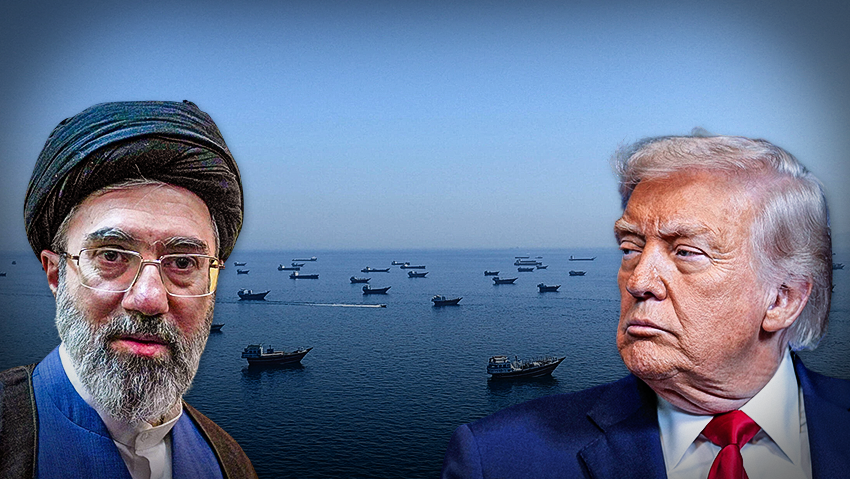
Mojtaba Khamenei and Donald Trump. Neither Iran nor the United States has ratified UNCLOS, yet the transit-passage regime is widely regarded as customary international law
(Photo: Hamed Jafarnejad/ISNA/WANA (West Asia News Agency) via REUTERS, AP/Alex Brandon, REUTERS/Stringer)
Diplomatic costs and isolation
Rather than strengthening Iran’s position, the fee regime risks further isolating the country. For years Tehran worked to present itself as a responsible regional actor, courting Gulf neighbors and positioning itself as an economic partner for Asia. Unilateral charges on Hormuz shipping threaten the core interests of every country that depends on the strait.
Gulf Cooperation Council states rely on free movement of oil and commercial traffic and regard the policy as a direct threat to regional stability. Major Asian importers in China and India require reliable access to Gulf crude. Arbitrary fees or transit obstacles raise costs and insurance rates. Beijing may continue purchasing discounted Iranian oil under sanctions pressure, yet it has little interest in arrangements that systematically inflate the price of using the world’s most important energy corridor.
The vote illustrates a leadership prioritizing short-term revenue for the security apparatus and its proxies over longer-term relationships. It is the behavior of a government that has narrowed its options and is prepared to accept diplomatic costs in exchange for immediate funds.
Policy implications for Israel and its partners
Israel and its partners in Washington and European capitals should not treat this development as routine theater. Accepting the idea that a coastal state can tax or condition commercial transit through an international strait would set a dangerous global precedent.
Any attempt to enforce these fees should be framed clearly as an illegal condition on transit passage. If Iranian forces stop, inspect or extract payment from vessels that refuse, responses should include naval deterrence grounded in international law. The multinational naval presence already monitoring the region—initiatives such as the Combined Maritime Forces—would benefit from clearer rules of engagement and expanded escorts or security guarantees for commercial shipping. The message to Tehran must remain unambiguous: international straits stay open and transit will be protected if required.
Highlighting the regime’s fiscal constraints supplies further evidence that sanctions and sustained pressure are limiting Tehran’s ability to fund its proxy network at previous levels.
Exposing structural weakness
The committee decision to formalize fees on the Strait of Hormuz is not the action of a confident power. It is the response of a government operating under acute fiscal strain after years of sanctions and the costs of the conflict that erupted in February. Nuclear threats and maritime demands rank among the limited remaining instruments available.
The international community should not confuse constraint with strength. Treating the fee regime as the coercive act it is allows Israel and its allies to highlight the regime’s structural difficulties, defend global trade routes and tighten the isolation of a leadership whose options have narrowed. The move may generate some short-term revenue. It will not restore the broader economic capacity or diplomatic space the regime has lost.
The pattern is consistent. When conventional revenue streams tighten, Tehran reaches for chokepoints and coercion. Each such reach further advertises the underlying weakness. Markets, insurers and governments that treat the fees as a routine cost of doing business would reward the tactic and invite similar demands elsewhere. Clarity about the legal status of transit passage, combined with credible protection of shipping, removes the incentive. The regime’s fiscal predicament is real. Its ability to convert that predicament into lasting strategic gain remains limited.
Amine Ayoub, a fellow at the Middle East Forum, is a policy analyst and writer based in Morocco. Follow him on X: @amineayoubx