

No one yet knows the actual election results, but one thing is already certain: Arab voters turned out in enormous numbers, with their parties projected to win a record number of Knesset seats. It is easy to understand the enthusiasm that has swept through the Arab public, particularly the Bedouin community.
Their leaders openly discuss their national aspirations. Mansour Abbas has spoken of the autonomous Bedouin regions he would like to see established in the Negev and Galilee. He has also declared that his party would work to prevent the demolition of illegally constructed homes in the Negev, while he and his fellow candidates refuse to recognize Hamas as a terrorist organization.
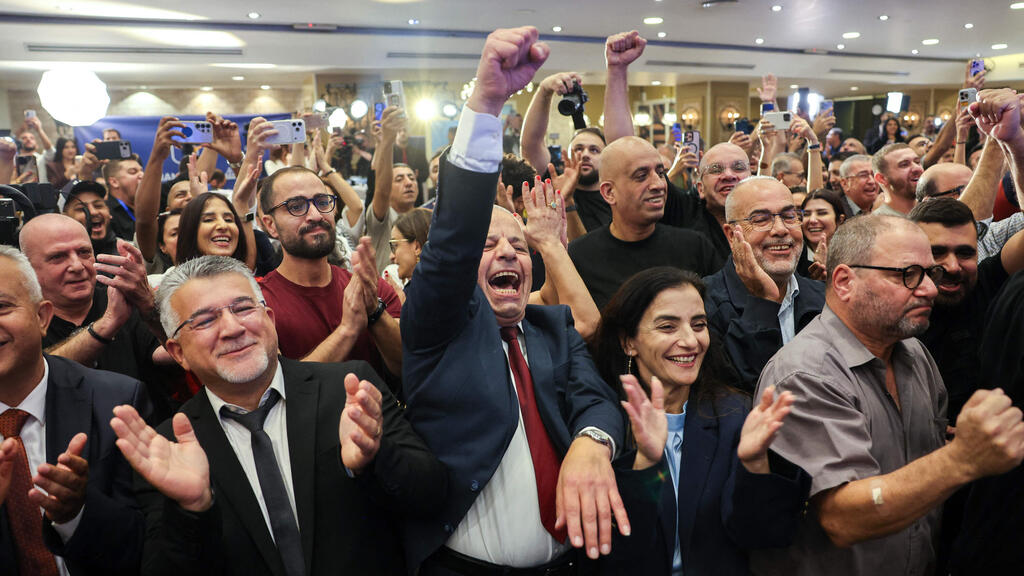
Arab Joint List party celebrates in Nazareth
(Photo: Ahmad Gharabli/ AFP)
But what drove voters to the polls was not necessarily those positions themselves. Rather, it was the support and legitimacy these aspirations received from leaders of the left-wing bloc, who made no secret of their desire and plans to rely on Arab parties to establish a minority government. Once the left gave those aspirations the green light, Ra'am and Joint List voters developed an appetite for political influence.
While these dangerous aspirations were granted unjustifiable legitimacy, another community was subjected to extreme demonization: the ultra-Orthodox. They became the punching bag of the left and of many who made the country's fate dependent on drafting ultra-Orthodox men into the military immediately.
The possibility of conducting a difficult but essential dialogue with a community that is an integral part of Israeli society and the Jewish people became virtually impossible. Yet relying on those who refuse to condemn Hamas somehow became acceptable.
The rate of military enlistment among ultra-Orthodox men continues to rise. There are extremists who make a great deal of noise, but there are also many who want to integrate into broader society. They, too, have faced vicious delegitimization.
The possibility of conducting a difficult but essential dialogue with a community that is an integral part of Israeli society and the Jewish people became virtually impossible. Yet relying on those who refuse to condemn Hamas somehow became acceptable.
In the process of frightening us about the ultra-Orthodox, it became acceptable to normalize not "Arabs" as a whole, but those who openly seek to change the identity of the State of Israel.
There is plenty of room to criticize the ultra-Orthodox community. But the treatment of a group that is an inseparable part of Israeli society and the Jewish people, some of whose members serve in the IDF, work and contribute to society, demands serious soul-searching.
We are already paying the price, reflected in the astronomical numbers of voters supporting those who seek Bedouin autonomy, not in Gaza, Sinai or Lebanon, but in the Negev and Galilee.
Correcting course must begin with genuine soul-searching, both among the political leadership and throughout Israeli society. We must end the incitement and delegitimization directed at the ultra-Orthodox, engage them in substantive dialogue about military service, employment and contributing to the country, and seek solutions that will enable broader integration into society.
At the same time, clear boundaries must be established for anyone seeking to undermine Israel's security or change its character.