


While the eyes of the world are fixed on the high-stakes summit in Washington between President Donald Trump and Prime Minister Benjamin Netanyahu to finalize a "Peace through Strength" strategy against the Iranian missile threat, Egyptian President Gen. Abdel Fattah el-Sisi has spent the last week performing a desperate act of political theater in Cairo. The sweeping cabinet reshuffle finalized on Wednesday—a frantic reordering of 14 ministerial portfolios—is being marketed by the Egyptian state as a "fresh start" for an ailing economy.
But this is no reform. It is a glaring admission of domestic failure and a strategic retreat into the archaic habits of a bygone era. Sisi is no longer just rearranging the deck chairs on a sinking economic vessel; he is actively centralizing power to mask a regime that is becoming a profound strategic.
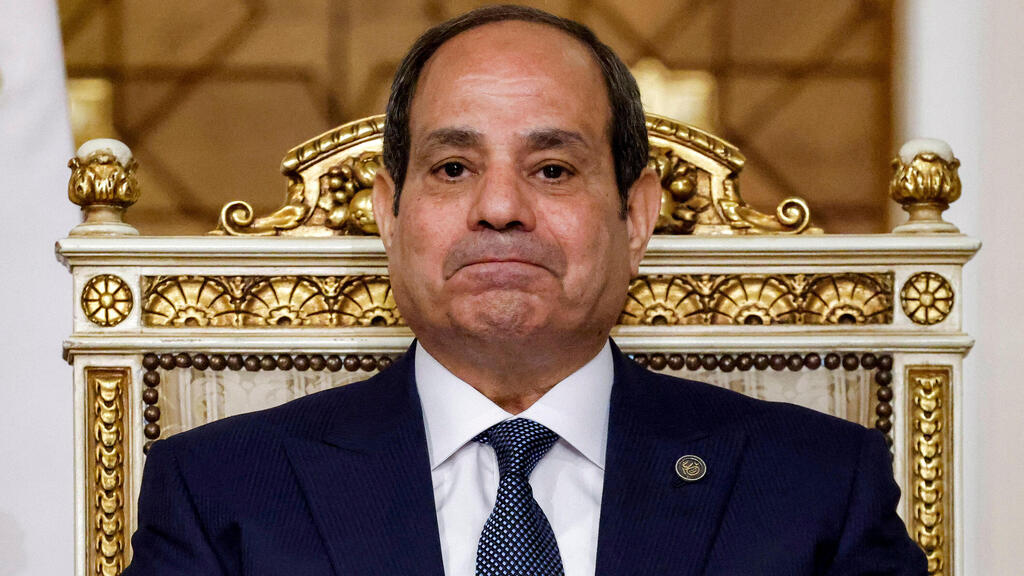
Egyptian President Abdel Fattah el-Sisi
(Photo: Benoit Tessier/Pool/Reuters)
The headline of this reshuffle is the sudden elevation of Lieutenant General Ashraf Salem Zaher to the post of defense minister. Zaher, who previously directed the Military Academy and oversaw the "human development" of the officer corps, is the fourth man to hold this position since Sisi took power in 2014. By choosing a man whose career has focused on the ideological and technical "indoctrination" of the next generation of soldiers, Sisi is moving to ensure that the military remains a loyalist bastion rather than a national institution.
Tellingly, Zaher’s name was notably absent from the initial list sent to Parliament for a vote on Tuesday. Under the Egyptian constitution, the defense minister requires the prior approval of the Supreme Council of the Armed Forces (SCAF) before the president can even present the choice to the rubber-stamp legislature. This "state within a state" maneuver proves that, despite the talk of "new blood," the military’s iron grip on the Egyptian heart remains untouched and unaccountable to civilian oversight.
The "new blood" Sisi has introduced elsewhere is already mired in the very rot it was supposed to fix. Within hours of the announcement, the appointments of Jehan Zaki (culture minister) and Randa al-Minshawi (housing minister) were met with a firestorm of allegations regarding past intellectual property theft and financial misconduct. While regime loyalists in Parliament dismiss these as "malicious rumors," the speed with which these scandals have surfaced highlights the fundamental flaw in Sisi’s selection process: loyalty to the "pouvoir" is the only metric that matters.
The economic dimension of this reshuffle is perhaps the most insulting. Prime Minister Mustafa Madbouly, now entering his ninth year of overseeing economic stagnation, continues to promise that 2026 will be the year Egyptians finally "reap what they sowed" during a decade of "painful reforms." Yet, the only thing the Egyptian public is reaping is record-high inflation and crumbling infrastructure.
 Amine Ayoub
The appointment of Hussein Issa as a deputy prime minister for Economic Affairs is a bureaucratic shell game designed to satisfy the IMF’s demand for "coordination." In reality, no amount of coordination can fix an economy where the military continues to monopolize the private sector and where the state’s answer to infrastructure failure—like the catastrophic floods currently plaguing provincial cities—is to arrest the photographers who document the damage.
This domestic fragility is matched by a dangerous regional petulance. The newly solidified military leadership is moving forward with the provocative deployment of 1,100 troops to Somalia. While Sisi masks this as an African Union "peacekeeping" mission, it is a transparent attempt to create a tactical nuisance for Israel and Ethiopia in the Red Sea. This deployment is a direct response to Israel’s strategic alignment with the stable, pro-Western reality of Somaliland. By inserting Egyptian boots into the volatile Somali-Ethiopian borderlands, Sisi is choosing to export his military's focus to a "Southern Front" rather than contributing to the broader anti-Iranian regional architecture.
While Trump and Netanyahu discuss the future of regional defense and the containment of the Iranian axis, Sisi’s Egypt is doubling down on a playbook of repression, electoral fraud, and proxy games.
The formal resurrection of the Ministry of Information under Diaa Rashwan—a man whose specialty is managing the regime’s international "gaslighting"—proves that Sisi is more interested in controlling the narrative than improving the reality. Rashwan’s new mandate will undoubtedly be to sanitize the regime’s failures and target any "foreign-funded" research that dares to point out the obvious: the Sisi regime is a hollowed-out military-industrial complex with a starving, frustrated population.
- Amine Ayoub, a fellow at the Middle East Forum, is a policy analyst and writer based in Morocco.