

The massacre of Israeli athletes at the 1972 Munich Olympics was a turning point that triggered a deep shift in Israel’s counterterrorism doctrine under late Prime Minister Golda Meir. The guiding principle was clear: Jewish blood would not be spilled with impunity.
Since then, targeted reprisals have become an integral part of Israel’s national security posture and a central pillar of its military doctrine, both overt and covert. From the assassinations of terrorists from the military wing of the Palestinian Liberation Organization (PLO) officials decades ago to Tuesday’s strike on Hamas leaders in Doha, this is the Munich Doctrine—next generation.
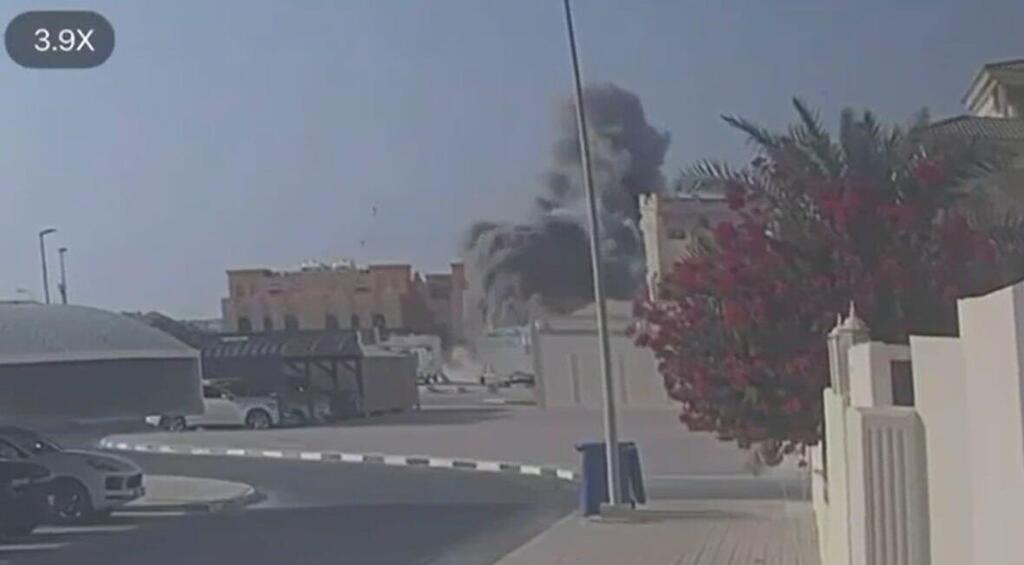
Smoke rises after an Israeli strike targeting senior Hamas officials in Doha, Qatar, Sept. 9, 2025
Historical justice was served: the attempt to eliminate the senior leadership of Hamas’ so-called political branch—headed by mass murderer Khaled Mashaal and deputy Khalil al-Hayya, who also leads hostage negotiations—effectively shakes the organization’s decision-making echelon. The impact is expected to be felt immediately on at least three levels.
First, and most crucially, is the question of timing, given the danger posed to Israeli hostages and the growing outcry of their families. This is a sensitive dimension, where intelligence services are expected to act proactively to safeguard the hostages as a complement to military action.
Second, the airstrike on Qatari soil signals that Israel is challenging the current channels of negotiation and, perhaps as a statement of intent, seeks to fundamentally alter the reality in this context. Mediation channels and their interlocutors can be replaced, opening the door to direct engagement with Hamas’ Gaza military wing leadership under Izz ad-Din Haddad. Still, even if most of the political leadership is eliminated, Hamas’ core positions on hostage releases are unlikely to fundamentally change—and may even harden.
Third, if confirmed, the killing of Zaher Jabarin—seen as a power center in the West Bank and a successor to arch-terrorist Saleh al-Arouri, eliminated in Lebanon in early 2024—could further destabilize an already volatile security reality in the West Bank, especially in the wake of Monday’s deadly attack in Jerusalem.
At the systemic level, initial indications that the United States was not involved in the operation—together with signals coming from the White House—may point to added complexity in Washington-Jerusalem relations at this time.
 Avi Kalo Photo: Aloni Mor
Yet in the Arab world, the first impression was that the U.S. was involved, even passively, with speculation that CENTCOM had been informed in advance or in real time about such a surgical airstrike. That perception could damage the credit President Donald Trump has earned in the eyes of Hamas and weaken Qatar’s standing in the process and in the region.
For Israel, these may seem secondary issues at the present moment, but they could ultimately prove decisive in shaping the character of negotiations in the foreseeable future—especially at a moment when the Israeli government refuses to engage seriously with the question of the post-war reality.
Either way, the dramatic assassination attempt underscores, for anyone still in doubt, that the ground has shifted completely under Hamas’ feet in the post–Oct. 7 era. Put differently: things will never go back to the way they were. The shift creates an opportunity for profound change in the Palestinian arena, with Hamas sooner or later removed from formal centers of power—even if the movement remains deeply embedded in Palestinian society and active as a beacon of terrorism.
In sum, and also as a starting point: even after the dust settles over Doha, the cloud of uncertainty surrounding efforts to bring home the hostages and end the Gaza war is only growing heavier. Responsible leadership must address this, as citizens and soldiers abandoned under its watch remain in captivity for nearly two years.
However justified the strike—thousands of kilometers from Israel’s borders—it will not in itself return the hostages. The government must fundamentally change course, harness shifting realities and secure a hostage deal—sooner rather than later.