


The foreign ministers of the GCC countries — the Gulf Cooperation Council — met in Manama, Bahrain’s capital, on Thursday with U.S. Secretary of State Marco Rubio and issued a stunning joint statement. The statement read as though it came from a different America. The America we once knew. The America that existed before Trump decided to sign the surrender agreement. The America before the countless news conferences by Vice President JD Vance, who has served as the agreement’s propagandist, with more than a few jabs at Israel.
That statement, published on the U.S. State Department website, includes all the clauses Israel had dreamed would appear in the memorandum of understanding: the ballistic missile threat, the drones and support for terror proxies. On the Strait of Hormuz, the statement cites the obligation to maintain “free, unconditional and unrestricted navigation,” including opposition to the imposition of fees or “attempts to gain control over the strait.” The renewal of ties with Iran is conditioned on “ending its destabilizing behavior.” On Lebanon, the statement mentions the obligation to disarm Hezbollah and the Lebanese state’s exclusive authority over all its territory.
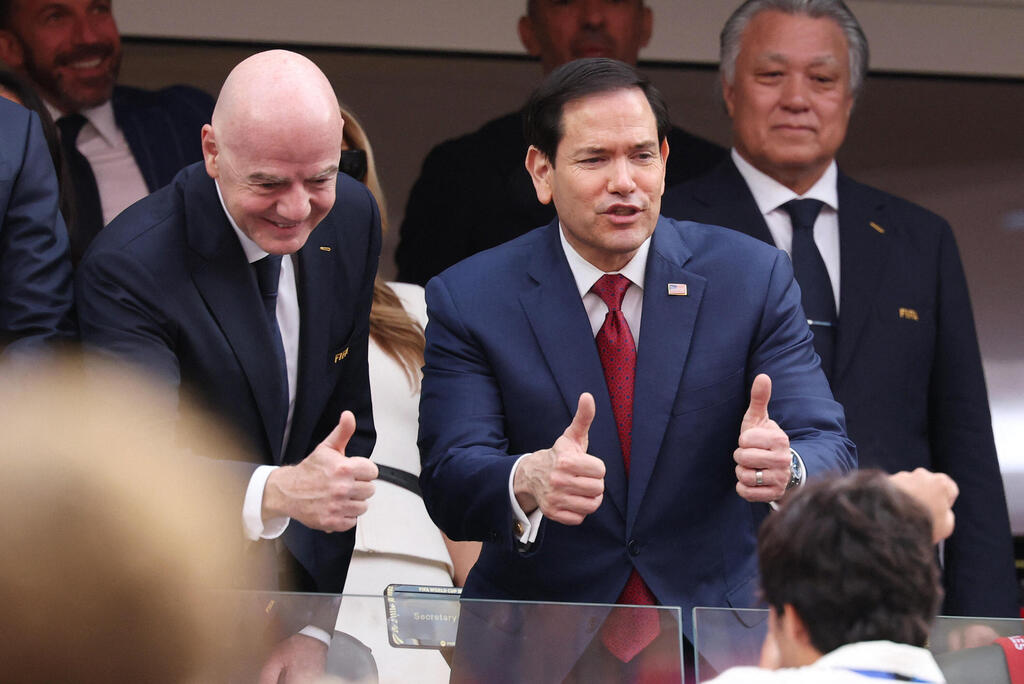
US Secretary of State Marco Rubio with FIFA President Gianni Infantino at the USA vs. Paraguay 2026 World Cup match
(Photo: Mario Anzuoni/Reuters)
How can the gap be explained between the memorandum of understanding — or, what it really is, the surrender agreement — and the Manama statement, which includes the clauses missing from the U.S.-Iran agreement? It appears that two souls are competing within the American administration. This is both an ideological dispute and a personal rivalry. It is the opening act in the battle for the Republican presidential nomination. On one side is Vance, who opposed the war from the outset, pushed to end it, conducted the shameful negotiations that led to the surrender agreement and is now almost the only explainer of that agreement. On the other side stands Rubio, who, without saying a word against the agreement, has shown through his actions in recent days that he is doing everything he can to limit the damage.
For example, Vance was behind the establishment of a “conflict prevention mechanism” in Lebanon, which includes Qatar, Pakistan and Iran in the monitoring mechanism — but not Israel. One has to read it twice. The Manama statement is a slap in the face to that mechanism, because it explicitly opposes the involvement of foreign countries, meaning Iran; reiterates opposition to Iranian funding for Hezbollah; and expresses support for talks with Israel. The agreement signed Friday between Lebanon and Israel is a direct continuation of the Manama statement and a fatal blow to the mechanism Vance created, this time with the joint backing of the Gulf states, Lebanon and Israel.
After it seemed that the entire administration stood behind the surrender agreement, which abandoned Lebanon to Iran’s mercy, Rubio’s return to the arena points to the possibility of a shift. This does not mean every clause in the Manama statement will be implemented in the near future. After all, it is a statement, not a binding agreement. Nor is it clear what the chances are that the Israel-Lebanon agreement will take shape on the ground. Hezbollah is already taking to the streets and threatening civil war.
After many long weeks in which Vance appeared to have the upper hand, Rubio has stepped in to bring the United States back to sanity
Still, something real has happened. The “conflict prevention mechanism” sponsored by Vance has been taken off the table. Lebanon belongs to Lebanon. Between Vance’s attempt to grant Iran standing, including in Lebanon, and Rubio’s counterresponse to push Iran out, Rubio won.
Just Thursday, Esmail Qaani, commander of the Quds Force in Iran’s Revolutionary Guards, issued a threat against Israel: “You must leave all of Lebanon today, or you will be forced to flee.” There is no doubt that Qaani’s threat is also a direct result of Vance’s disgraceful monitoring mechanism. This does not mean Iran will tuck its tail between its legs and refrain from trying to interfere. Not at all. But now, at least, the Gulf states and the United States are lining up against Iranian involvement.
The agreement makes clear that Israel’s deployment in southern Lebanon will be gradual and coordinated with the Lebanese army. More than that, Section 7 states explicitly: “Nothing in this framework prevents the states from exercising their inherent right to self-defense... No third party may exercise this right on their behalf.” In plain terms: Israel has the right to continue the war against Hezbollah, and Iran has no right to intervene.
It is not over and it is not complete. But after many long weeks in which Vance appeared to have the upper hand, Rubio has stepped in to bring the United States back to sanity. That is good, first of all, for America itself. And yes, it is good for Israel too.