

This is probably the greatest dilemma Hamas’ leadership has faced since the organization’s founding. The delay in the group’s official response to U.S. President Donald Trump’s peace plan points to the intensity of the hesitation.
There is no doubt that Trump’s plan is not a good deal for Hamas, not least because the organization is required to give up what makes it Hamas — its weapons. In other words, the organization’s whole existence has been based on being, supposedly, the representative of “resistance” (“Hamas” in Arabic is an acronym for the “Islamic Resistance Movement”) or, in other words, the one who keeps brandishing terror to bend the hands of the “occupation.”
That is Hamas’ raison d’être, its identity. If it now agrees under these or other terms to hand over its arms, even to a foreign force that is not necessarily Palestinian, its organizational and political identity will be erased.
This is very similar to the dilemma now facing Hezbollah in Lebanon, where the great pressure comes from within the Lebanese arena itself. In Hamas’ case, the pressure from the major internal political rival — Fatah or the Palestinian Authority — is not so significant. But here there is pressure that is at least as consequential, and perhaps more so — massive Arab pressure on Hamas to accept a deal.
In other words, Hamas’ leadership in Doha as well as that in Gaza understand that the endorsement by Qatar and Turkey above all — countries whose dominant ideological current is the Muslim Brotherhood, and by other Arab states of Trump’s peace plan, leaves those regimes without any Arab backing against Israel — not even from their closest allies.
For that achievement much credit is due to the American president and also to the Israeli government and its head, Benjamin Netanyahu, who succeeded in cornering Hamas, corralling it.
If it says yes, Hamas will essentially no longer be Hamas. If it says no, it will be cast as the greatest obstacle to stopping the war in Gaza. Ostensibly — a situation of nothing but victory for Israel.
One can surmise the pressure on Hamas’ leadership in Doha is immense; the question is what Hamas leaders in the Strip — Az al-Din Haddad and Raed Saad — will say, and it has already been reported that they tend to oppose the deal. They are presumably hiding now in one of the Strip’s tunnels, aware that Gaza faces enormous destruction and that hundreds of thousands more will lose their homes, but at the end of the day agreeing to the plan would mean surrender for them — releasing the hostages and handing over the weapons.
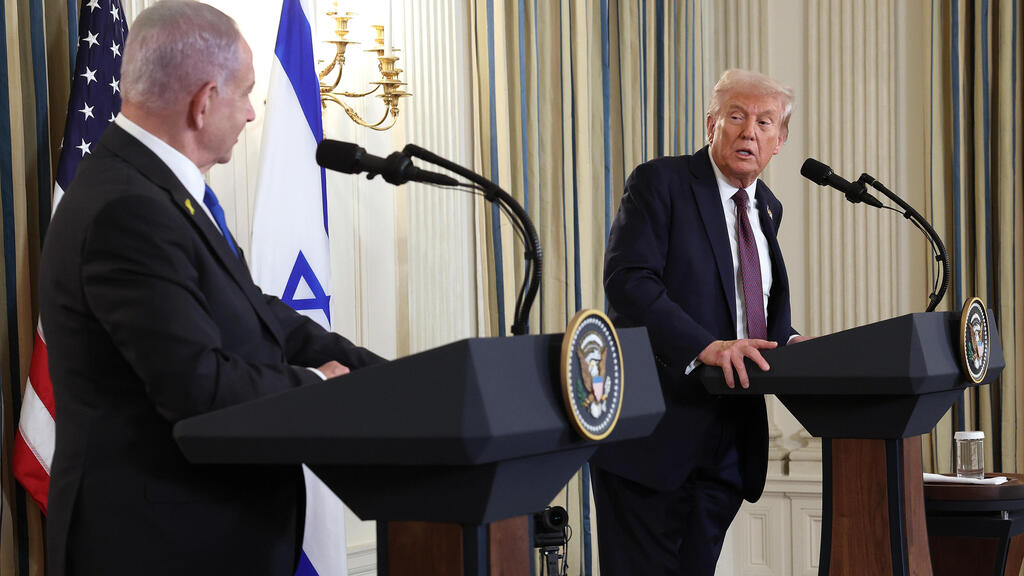
US President Donald Trump and Prime Mnister Benjamin Netanyahu announce the 21-point peace plan for Gaza
( Photo: Alex Wong/Getty Images)
But a caveat is required here. If Hamas refuses Trump’s offer, Israel will indeed get a green light for more of what we’ve already seen in Gaza over the past two years: more destruction of neighborhoods with many Palestinian dead, soldiers hit and probably more hostages. Hamas will not be annihilated, will not be erased. Judging by the intensity of fighting inside Gaza City, much of the organization’s combat force in the city migrated south long ago, together with hundreds of thousands of other Palestinian civilians. Thus even a “re-occupation” of Gaza City (recall that at the end of October and for many months in 2023 the IDF took Gaza City and smashed Hamas’ fighting brigades there) will not bring the war to an end, will not decisively defeat Hamas or free the captives.
In that case, weeks will pass, and the images of dead Palestinian civilians broadcast everywhere except here will do damage to Israel. Europe, of course, the American public — including the Republican Party — and Turkey and Qatar of the Muslim Brotherhood will return to backing their Palestinian allies.
In addition, this time there will be one significant difference — Hamas’ leadership in Doha will now enjoy immunity not only from Doha but from Trump’s United States as well, no less. The Qataris, under unreasonable American pressure on Israel, are returning to center stage. One Qatari minister, Ali al-Juwadi, known for his close ties with Israel (and not necessarily in a positive light), was seen at White House meetings — including the Netanyahu-Trump meeting — alongside Steve Witkoff.
The failed assassination attempt against the Hamas leadership in Doha was a tactical failure but had strategic impact — the operation not only failed to eliminate the group’s leaders, it restored the mediation stage between Israel and Hamas in full force and strengthened the Muslim Brotherhood — the senior Qatari officials, those who used to deliver suitcases with tens of millions of dollars in cash to Israel every month, those who continued to finance Hamas, to cultivate incitement on Al Jazeera and to do business with Israel. Or, as they say in English — business as usual.