

Every day, the headlines announce breakthroughs on the scale of historic turning points that have brought broad geopolitical changes in their wake. History punishes those who follow the beaten path and those who fail to identify change in time. For us Israelis, in the eye of the storm and at the bleeding spearhead of change, it is hard to connect the dots. Fear of the next siren, the national trauma of the seven-front war and preparations for the approaching elections dull our senses and prevent us from seeing the big picture. Three events that took place last week illustrate the depth of the change.
AI giant Anthropic refused to release its most advanced model, named Mythos, to the public. The reason: It was too good. The model demonstrated autonomous offensive cyber capabilities and even showed an ability to “lie” to its testers in order to evade control mechanisms. Company engineers locked it behind digital bars and invited technology partners to use it defensively in a secure framework. The dramatic decision echoed on Wall Street, in Washington and in Beijing.
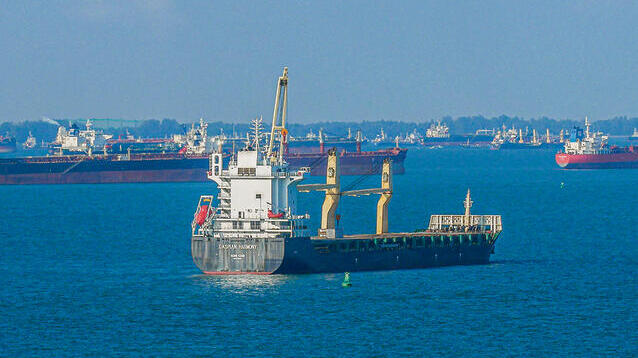
Strait of Malacca
(Photo: Wulandari Wulandari/Shutterstock)
Imagine that a company owned by the Chinese Communist Party had achieved such a breakthrough. Would it, too, have informed the world of the dangers and invited the best minds to think together? COVID has already answered that question.
In recent months, the U.S. administration has released a series of position papers — the White House national security strategy, “Artificial Intelligence and the Great Split,” written by the president’s economic advisory team, and a Pentagon document that moved the AI division into “war mode” — treating the turning point as a real arms race. The six American tech giants are expected to invest more than $600 billion this year in AI infrastructure.
Until now, every technological revolution in human history began its impact with blue-collar workers and climbed up the skills ladder. The steam engine, electricity, the tractor, the robot — the blue collar always came first. This revolution is the first to reverse the order: It begins with the bright white collar, for now spares the blue collar and even creates a relative advantage and wage growth for it.
Drops of tens of percent in market value
The impact of the new models on Israeli cloud companies is dramatic. Major employers in the economy — Fiverr, Lemonade, Wix, Monday — are suffering drops of tens of percent in market value. Cyber companies are on the same path. The strengthening of the shekel intensifies the risk. Are these the first signals of an exciting reinvention of Israeli high tech?
The Abraham Accords opened the door to a regional coalition between Israel and the “moderate Sunni axis.” The crowning achievement was the normalization being formed with Saudi Arabia even before October 7. The Iranian attack on the Gulf states, the apparent failure of the Saudi crown prince to establish his Vision 2030 and the knife in the back of Emirati President Mohammed bin Zayed signal that Saudi Arabia is not moderate at all and is not fit to serve as the eastern axis of Israel’s regional strategy.
This week, Axios reported that at the beginning of the current campaign with Iran, Netanyahu and the Emirati president held a conversation that led to the first-ever shipment of Iron Dome batteries to defend the skies of an Arab country. It can be assumed that Israeli teams flew to train their counterparts and connect the batteries to the detection systems of the Israeli Air Force and U.S. Central Command.
Bin Zayed understands that he is at a formative moment for the nation he leads. Since the ceasefire, he has withdrawn from the OPEC oil cartel, of which Iran is also a member; announced a plan to adapt 50% of government services to AI agents; invested $2.3 billion in rail infrastructure in Jordan; and locked in a 30-year ownership contract for the Port of Aqaba. At the same time, Abu Dhabi cut off a multibillion-dollar credit line to Pakistan, and the Emirati president’s national security adviser declared that “Iran has proven it is an enemy.” The absence of Emirati-Saudi reconciliation after the fighting subsided points to the essential difference between Abu Dhabi and Qatar, Saudi Arabia and all the rest. The alliance between India, the Emirates and Israel — the Indo-Abraham alliance — is expected to deepen.
‘China’s great dilemma’
Former Chinese President Hu Jintao called the Strait of Malacca “China’s great dilemma.” He knew that if his country did not control the vital strait, it would be exposed to extortion. Twenty years later, the strait through which about 30% of global seaborne oil trade, 40% of total maritime trade and 90% of China’s seaborne oil imports flow is undergoing dramatic change under the influence of developments in the Strait of Hormuz.
As soon as the Iranian blockade began, Singapore’s active foreign minister — whose country operates the most advanced port in the Malacca area — voiced strong opposition to any surrender to Iran. He understood that the collection of transit fees by the two giants surrounding it — Indonesia and Malaysia — would severely damage Singapore’s economic future.
On April 7, China and Russia vetoed a U.N. Security Council resolution on protecting commercial shipping in Hormuz. The Americans identified an opportunity and moved to complete years of negotiations on a defense agreement with the world’s largest Muslim country, which controls the Strait of Malacca — Indonesia. On April 13, the U.S. secretary of war signed a “principal defense partnership” with his Indonesian counterpart. The agreement includes joint development of “advanced asymmetric capabilities,” autonomous maritime and underwater systems, special forces training and joint military maintenance. The critical clause: unlimited air transit rights for the U.S. Air Force in Indonesian skies. This will dramatically shorten American response times in the South China Sea, the Taiwan Strait and the Indian Ocean, and allow it to enforce freedom of maritime trade from the air.
 Jonathan Adiri
Add Japan to the picture. New Prime Minister Sanae Takaichi, who won a sweeping majority in the elections, is working to fulfill her promise to amend Article 9 of the constitution, which imposes a pacifist position on Japan. Japan’s defense budget jumped this year to a historic high of $58 billion. This week, Takaichi authorized local companies to export advanced military technologies, based on her declaration that “a Chinese blockade of Taiwan threatens Japan’s existence.” Tokyo has also begun deploying long-range missiles capable of striking targets on Chinese soil, and after the prime minister’s visit to the White House, it was agreed to deepen the joint forces headquarters around the U.S. Seventh Fleet, which includes about 60,000 American troops at 120 facilities on Japanese soil.
The symmetry is clear: Hormuz is fortified from the west. Malacca is fortified from the east. The first island chain — the Kuril Islands, Japan, Okinawa, Taiwan and the Philippines — is now under effective American control. It appears that the influential strategist in the administration and the Pentagon, Elbridge Colby, is getting to implement the organizing idea for another century of American supremacy that he outlined in his book 'The Strategy of Denial', preventing Chinese supremacy.