


The Arab and Muslim world is interlaced with alliances, such as the Organization of Islamic Cooperation, with 57 member states, and the Arab League, which includes 22 countries. Alongside them is the Gulf Cooperation Council, and it seems the past few months have proved that, even in the face of Iran, which abuses them without any serious response, they are unable to unite.
The United Arab Republic, established in 1958 and made up of Egypt and Syria, lasted only three years. All these alliances did not prevent a single war or a single conflict. The new alliance among Turkey, Pakistan and Saudi Arabia, with the option of adding Egypt, is neither the first nor the last on the list.
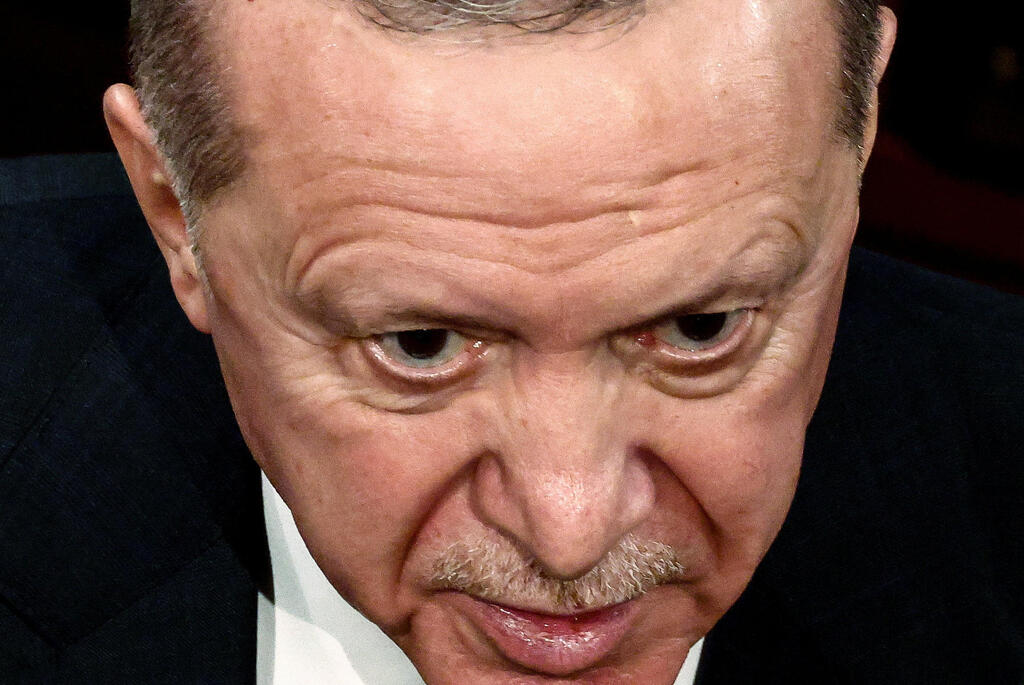
Turkey's President Recep Tayyip Erdogan: The new coalition strengthens Turkey's actions against Israel
(Photo: Yara Nardi/Reuters)
These alliances were supposed to create closeness among Muslim and Arab countries. After all, they share the same religion, and in broad regions also the same language and culture. But it seems that even if Israel tried, and there is no need for such an effort, it would not reach the massive number of casualties in wars between and within Arab and Muslim states. Since Israel’s establishment, about 12 million people have been killed in the Arab and Muslim world in wars. In the past decade alone, the fighting in Libya, Sudan, Yemen and Syria was not only internal. Usually, Arab states compete over spheres of control inside those same countries, only intensifying the mutual and mass slaughter.
So now a joint defense alliance has been formed among three important and powerful countries. Two of them, Turkey and Saudi Arabia, are competing for leadership of the Muslim world, and the potential entrant, Egypt, also aspires to the crown of the Arab world. There is no need to belittle this alliance, because Pakistan is more connected to Iran, while Tehran has until now been Saudi Arabia’s enemy. Turkey under Recep Tayyip Erdogan is a Muslim Brotherhood state. Saudi Arabia was once a center of Muslim Brotherhood activity, but in 2014 the Muslim Brotherhood was outlawed. Saudi Arabia feared that the golem it had created, global jihad, was about to rise up and destroy it. Egypt, where the Muslim Brotherhood movement was founded, and where a president identified with the movement served briefly, outlawed it already in 2013. That was the main reason for a decade of tension between Turkey and Egypt.
Israel is in trouble because instead of normalization with Saudi Arabia and an expansion of the Abraham Accords, the current direction is away from normalization
So what is the meaning of the new coalition? It should not be dismissed. It has the potential to cause damage both to the U.S. and to Israel. To the U.S., because the coalition is a kind of official declaration of disappointment. The war with Iran left the Gulf states wounded and bleeding. The U.S. did not succeed in removing the Shiite monster that seeks regional hegemony. On the contrary. Iran suffered unprecedented bombardments by the world’s strongest power and not only did it not blink, it also exposed the weakness of the U.S. and its Gulf allies. Iran may be on the verge of economic collapse, but it is somewhat strange that a country on the verge of collapse manages to outmaneuver the mighty superpower.
Israel is in trouble because instead of normalization with Saudi Arabia and an expansion of the Abraham Accords, the current direction is away from normalization. In addition, the enormous economic project known as IMEC — a corridor from India or the Gulf states to Europe — is on the agenda. The corridor was originally intended to pass through Israel, but Turkey is now demanding that it pass through Syria, continue into Turkey and from there to Europe. One can assume that the new coalition strengthens the Turkish direction. Here we have yet another consequence of the Israeli folly of rejecting Saudi Arabia’s outstretched hand.
True, it was Hamas’ October 7 massacre that was meant to thwart normalization. But why, for heaven’s sake, did Israel do exactly what suited Hamas even when, in 2024, Saudi Arabia renewed its desire for normalization? After all, a declaration on a future Palestinian state, as Saudi Arabia demanded, is included in the 20-point agreement that led to the ceasefire with Hamas. So surrendering to pressure from Turkey and Qatar, the matchmakers of the agreement, is more important than a similar declaration in exchange for Saudi Arabia?
On the military level, the new regional coalition failed before it was even formed. Pakistan and Turkey did not lift a finger to defend Saudi Arabia from Iranian bombardments, and they are not lifting a finger even now, as Iran and its proxies continue to strike Saudi Arabia. Still, this is a coalition with strategic significance. The current government has led us to a strategic failure, yet another one on the list. Perhaps, hopefully, a new government will manage to change something.