


In the past 24 hours, Iran's clerical regime has taken two significant and complementary steps that are likely to bring about a decline in the wave of mass protests that has swept the country over the past two weeks.
The first is a clear directive to regime-loyal security forces—the police, the Islamic Revolutionary Guard Corps, and the Basij militia—to shoot to kill not only at protesters who open fire, but at anyone who uses force to resist or attempts to burn or deface symbols of the regime.
The result has been hundreds of deaths and scenes of horror in the streets and hospitals. Even the relatively limited footage that has emerged has undoubtedly spread fear and terror, even among the regime's most determined opponents.
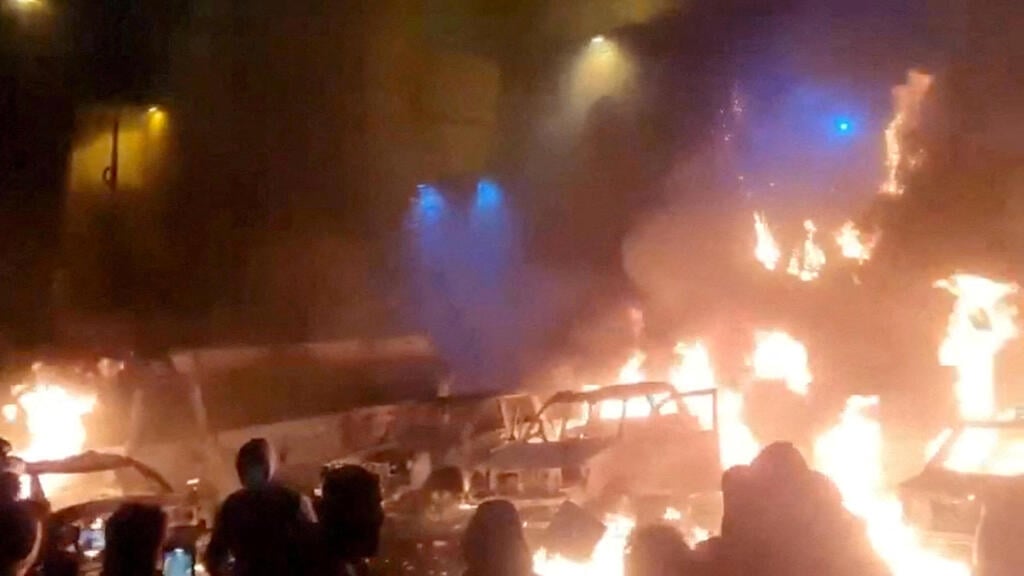
Documentation of the riots in Tehran over the weekend
(Photo: Social Media/via Reuters)
This evokes a historical parallel: in 1979, the Shah of Iran heeded U.S. President Jimmy Carter’s demand not to open fire on protesters during the revolution. That decision cost him his rule.
The second step, taken in parallel by order of Supreme Leader Ali Khamenei, was a renewed appeal to the United States to restart negotiations—suspended since last June—on Iran’s military nuclear program and its ballistic missile project. Talks last spring were halted after Tehran refused even to consider removing uranium enrichment from its territory and categorically rejected any discussion of restrictions on long-range missile production. That failure led President Donald Trump to give Israel the green light to initiate Operation Rising Lion.
The Iranian approach in the past day, with an offer to resume negotiations, signals that there is now a basis for talks. In other words, the regime is now willing to negotiate more or less according to the framework and topics previously proposed by Washington.
This move gives Iran’s regime two advantages. First, if Trump agrees to negotiate, he is unlikely to carry out his threat of military intervention against symbols of the regime or the security forces protecting it. Second—and more importantly—if the U.S. announces its willingness to return to the table, this could provide hope to the protesting public, many of whom (traders, bazaar merchants, workers and others) have taken to the streets primarily over economic hardships.
Fire at protests in Isfahan, Iran


Successful negotiations could lead to the lifting of sanctions, enabling Iran to sell oil on the global market, strengthen its currency—which would then gain real value in dollar terms—and curb rampant inflation.
One of the regime’s main problems during this wave of unrest has been its lack of leverage, incentives or gestures that could help calm the protesters’ anger. Negotiations with the United States, if they do begin, offer at least the potential for such a gesture.
There is another fact that surely has not escaped the notice of protesters: the regime’s security forces—the multi-layered protective armor surrounding the regime—have remained loyal. Unlike in Egypt, Tunisia and other countries during the Arab Spring, where the security apparatus ultimately refused to fire on civilians, Iran's forces have shown no such hesitation.
This loyalty stems in large part from the regime's religious-jihadist character. The Arab regimes that fell during the Arab Spring were all secular. In contrast, Iran’s regime is a jihadist theocracy whose loyalists are driven by extreme Islamist ideology—making them willing to do what their counterparts in, for example, Egypt would not.
Still, a new and significant phenomenon has emerged during this current wave of protests—something not seen in previous uprisings since 2009: a large number of security forces have been killed. This may be an indication that someone is backing or organizing the current unrest.
 Ron Ben YishaiPhoto: Courtesy
But the popular uprising in Iran is not over yet. Its fate depends largely on what happens in the streets in the coming days: Will the number of protesters match or exceed last week’s turnout? Will security forces continue to shoot to kill? And will the regime this time agree to the White House’s demands—and will the Americans be willing to negotiate?
These are still open questions. The answers will determine whether the protest is fading or whether it continues to pose a real threat to the regime.
For now, Trump’s threat is serving not only as a potential military tool to destabilize the regime, but also as a warning to Tehran that the U.S. will not allow it to stall talks, as it has done for decades. His message is clear: You have a narrow window of opportunity. If you don’t seize it—we will continue efforts to bring down your regime.