

In recent days, we have witnessed the unraveling of the framework agreements drawn up by the United States on the various fronts: the 20-point agreement on Gaza, led by Steve Witkoff and Jared Kushner, the 14-point agreement on Iran, led by JD Vance, and the 14-point agreement on Lebanon, led by Marco Rubio.
All three share a clear common denominator: They are framework agreements or memorandums of understanding, wrapped in gold packaging bearing the White House's embossed logo. Beneath the wrapping, however, lie vague language, partial commitments and, above all, a lack of effective mechanisms for dealing with violations. There is almost no discussion of what happens when one side simply fails to fulfill its commitments, or what price it will pay for doing so.
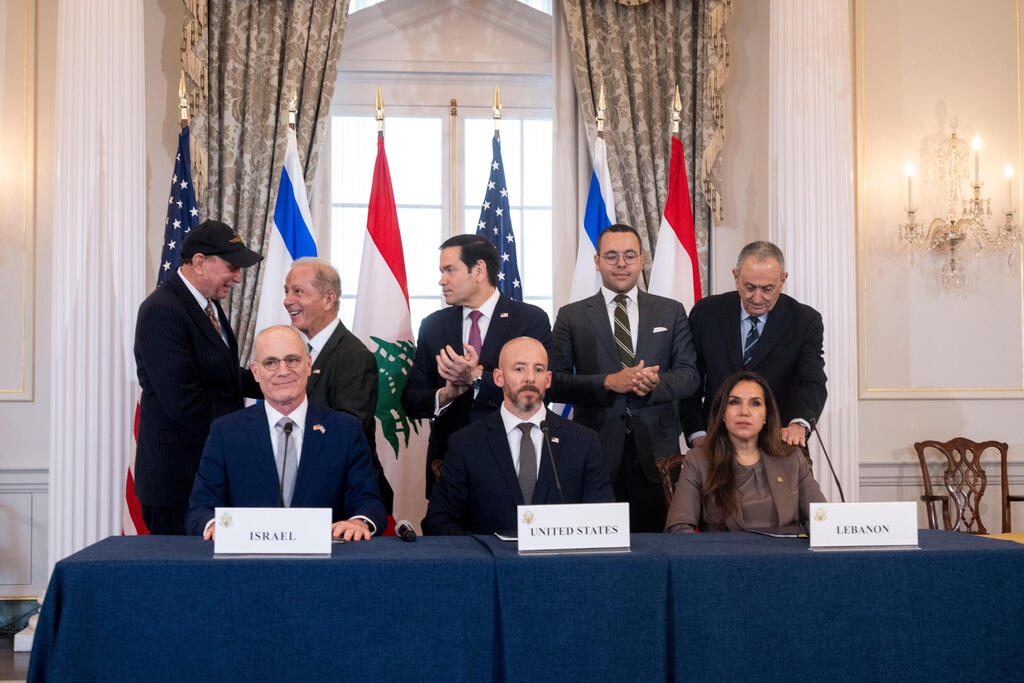
The signing of the agreement between Lebanon and Israel
(Photo: AP Photo/Kevin Wolf)
By the measure of results, the "axis of evil" — the Islamic Revolutionary Guard Corps, Hezbollah and Hamas — achieved its immediate objective: halting the large-scale use of force by Israel and the United States. In return, however, the price paid by these organizations was only partial. They were hit but survived, made limited commitments and gained time.
Iran is perhaps the clearest example. The Iranians agreed to the memorandum of understanding advanced by JD Vance because they received what they needed at that moment: a ceasefire and an agreement to open the Strait of Hormuz — an agreement that in practice lasted only a few days. No agreement was reached on the nuclear issue, they refused to discuss ballistic missiles and the same was true regarding the funding and arming of proxy organizations.
In practice, Tehran bought its most valuable resource: time. Time to survive, reorganize and recover from the blows it had suffered. In return, its main commitment was to enter into 60 days of negotiations, a period that passed without a continuous and effective process developing on the core issues.
The most successful of the agreements
The 20-point Gaza agreement is, ostensibly, the most successful of the agreements. Israel received all 20 living hostages and the remains of 28 hostages — an enormous and important achievement in its own right. But here, too, the full balance of concessions must be examined: Israel released about 1,900 prisoners, including 250 of the most serious offenders, out of about 270 who were being held in prison on the eve of the deal.
Hamas also achieved significant gains. The intensive fighting stopped, most of the prisoners it had demanded be released even before Oct. 7 were freed and it did not agree to reveal its leadership or disarm. Its agreement to eventually transfer civilian rule to other Palestinian actors is not new; it has made similar statements in the past.
The picture in Lebanon is similar. The agreement was negotiated with the Lebanese state and Hezbollah, while Israel finds itself largely in the position of an observer to the implementation process. The agreement received considerable attention, at times almost as if it were the first step toward a peace deal. Some had already imagined the day when Israelis would eat hummus in Beirut.
But on the ground, the picture is far more modest. The intensive fighting has stopped, but implementation of the agreement's provisions still appears far removed from reality.
Perhaps some of the problem begins with the name. If these agreements had been called what they really are — ceasefire agreements — they might have been less glamorous and less suited to White House ceremonies, but far more accurate. Above all, it would have provided a clearer understanding of Israel's strategic position in the region.
Deep-seated failures
It is customary to think that an agreement collapses primarily because of its content, because of the gap between the written text and what each side thought had been agreed. Often that is indeed the case. But in all three current cases, deeper failures run through the process, involving the way the negotiations themselves were structured and managed.
First, who is on the other side of the table? Is this really the right party, with the authority, power and mandate to fulfill the commitments?
Second, who is the mediator? Is the mediator effective, credible and transparent? Is it capable of applying pressure to both sides and, above all, does it have the ability to enforce the agreement once the cameras are gone?
Third, what is the right negotiating tactic? Is it right to conduct intensive negotiations until a comprehensive agreement is reached on the core issues, or is it enough to settle for a partial and general memorandum of understanding that leaves the difficult disputes for the next stage?
Above all these questions is the issue of leverage. What is the right level of pressure to apply? Is there a credible alternative to having no agreement? Does the other side believe that the price of blowing up the negotiations will be higher than the price of violating the agreement?
 Doron Hadar
There are also deeper questions: Can money replace strategic interests? Can identity be bought, or ideology sold? What matters more — the appearance of an achievement or its substance? And what place do long-term alliances have when the desire to reach a quick "deal" becomes an end in itself?
Donald Trump, who published his book "The Art of the Deal" in 1987, has long been seen as a believer in hardball negotiations: maximum pressure, the use of psychological leverage, setting grandiose goals and creating the impression that the other side faces a choice from which there is no escape.
But now he himself finds himself in a strategic bind.
To get out of it, a change in approach will be required — not only in the wording of the agreements but in the definition of their objectives. The aspirations to replace the regime in Iran, completely remove Hezbollah from Lebanon or exile Hamas from Gaza may sound good in headlines, but they cannot on their own serve as the basis for a viable policy.
Israel will have to formulate frameworks based first and foremost on clear, measurable and enforceable security principles. The United States will have to incorporate Israel's demands into the agreements themselves rather than settle for general declarations about the "day after."
And Trump, if he ultimately wants to reduce U.S. involvement in the Middle East and withdraw his forces from the region, will have to understand that the way to do so does not run through another glitzy signing ceremony. It runs through agreements that have substance.
Lt. Col. (res.) Doron Hadar is a former commander of the IDF DF Crisis Management & Negotiation Units