


The full details of the agreement signed this evening (Friday) between Lebanon and Israel at the U.S. State Department have not yet been released. There is no implementation timeline, if one exists at all, and it is still unclear what the scope of the enclaves or pilot zones is from which the IDF is expected to withdraw. It is possible these details have not yet been finalized and that this is, in fact, only a framework agreement.
But the real value of this agreement lies in the principles on which Lebanon and Israel declare they agree. This consensus is particularly significant at present, given Iran’s efforts to reassert control over Lebanon through Hezbollah and restore Lebanon’s status as an Iranian proxy state, as it was for many years.
The moment of signing the framework agreement between Lebanon and Israel
(Video: Reuters)


The first principle emerging from the agreement is mutual respect for sovereignty. This means that a Lebanese citizen—even a Hezbollah operative—has no legitimacy to enter Israeli territory or fire on Israel without explicit authorization from the Lebanese government.
Israel, for its part, by recognizing Lebanese sovereignty, is effectively stating that once the threat emanating from southern Lebanon ceases, it will evacuate the area and withdraw to the international border. It would also be prepared to discuss with the Lebanese government the 13 disputed points along the frontier. This does not amount to peace or normalization between the two countries, but mutual recognition of sovereignty is the first step toward ending a state of war.
The Iranian demand — and the Israeli condition
The second principle, which is even more significant at this stage, is that Israel’s withdrawal from southern Lebanon is conditional on Hezbollah not returning to the area and on the disarmament of the region from Hezbollah’s weapons. If the area is not cleared of Hezbollah’s military presence, both heavy and light weaponry, Israel is entitled to continue holding the security zone it currently maintains.
Iran is demanding Israel’s withdrawal from Lebanon as a condition for its own agreement with the United States. In contrast, in the agreement between Israel and the Lebanese government—under the explicit sponsorship of the United States and Secretary of State Marco Rubio — Israel and Lebanon are effectively telling Tehran: Lebanon is not your domain; do not interfere in matters that are not yours. This directly contradicts Iran’s intent to restore Lebanon and Hezbollah to the status of a full Iranian proxy and represents a clear decoupling of regional arenas, aligned with Israeli policy and opposed to Iran’s strategy.
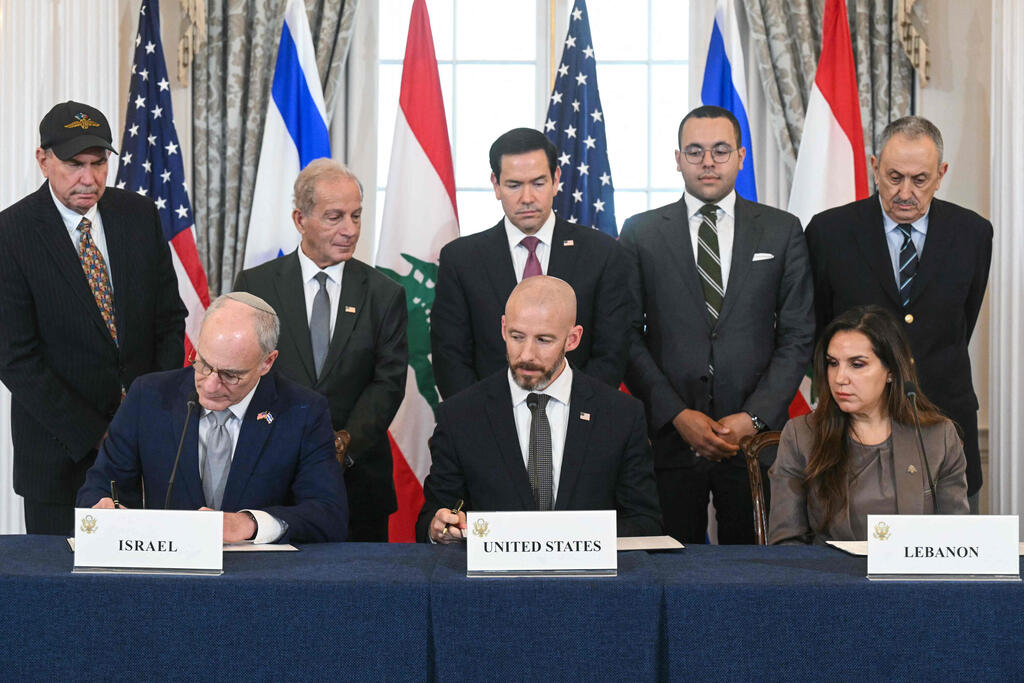
The third principle is that Israel’s withdrawal from the security zone south and east of the “yellow line” is not automatic, but conditional on the performance of the Lebanese Armed Forces and the American oversight mechanism that will supervise disarmament and certify implementation, along with the broader monitoring framework to be established for the entire process.
In other words, Israel is not committing—neither in principle nor in practice—to withdraw from the security zone it currently holds in southern Lebanon. Instead, this is a conditional process that could also serve as a precedent and pilot for what may happen in Gaza and possibly Syria.
In this agreement, Hezbollah loses the legitimacy it claims as the “defender of Lebanon.” In effect, Lebanon’s sovereign government is telling Hezbollah: you are an obstacle to the return of nearly one million Shiites to their villages, and you bear responsibility for the destruction and devastation their communities have suffered.

Hezbollah loses the legitimacy it claims as the 'defender of Lebanon'
(Photo: AFP)
So much for the merits of the agreement. But I vividly remember reporting from Beirut in 1983 on the signing of a peace agreement between Israel and Lebanon, after negotiations between then–Foreign Ministry Director General David Kimche and Lebanon’s leader at the time from the Gemayel family, who had replaced his assassinated brother Bachir.
That peace agreement was never approved by the Lebanese government, nor ratified by the Lebanese parliament, and as far as I recall, not even by the Israeli government. It remained a document on paper only, and today few even remember that such an agreement ever existed.
Even United Nations Security Council Resolution 1701, which ended the Second Lebanon War, largely became a dead letter. Perhaps now, finally, due to direct American involvement, something different will happen. But for now, it is wise to lower expectations and wait to see whether both the Israeli and Lebanese governments will be able to give this framework agreement practical substance.