

President Donald Trump has announced that the United States will end its annual military aid to Israel, saying he reached the decision together with Prime Minister Benjamin Netanyahu. To portray this as a triumph of Israeli independence would be to fundamentally misunderstand what has happened.
This is a colossal diplomatic failure. Instead of transforming American assistance into a mutually beneficial economic partnership, Israel has suffered a humiliating blow that illustrates how far its standing has fallen in American politics, from a blue-chip stock to a junk stock. The next Israeli government will be left to pick up the pieces.
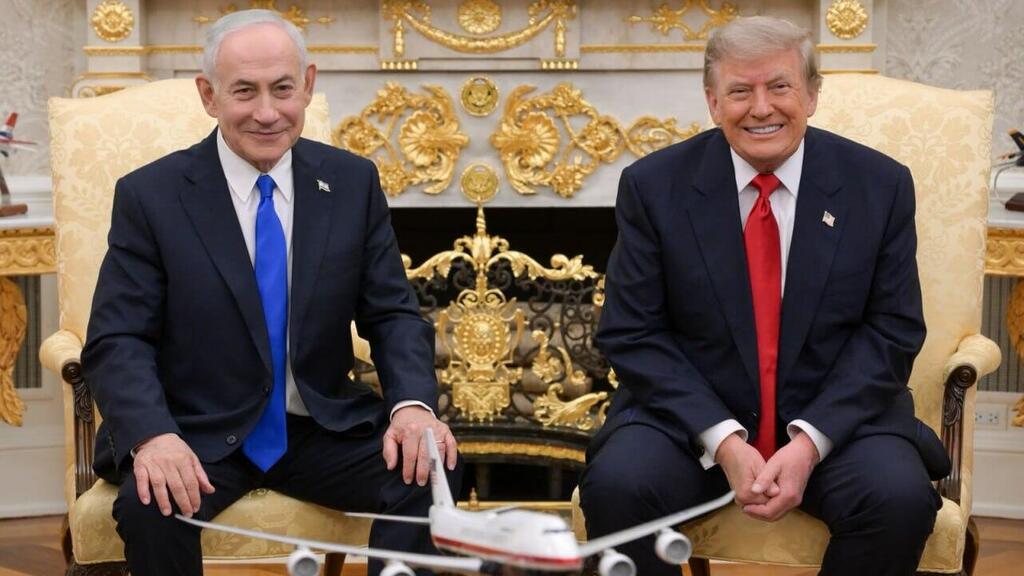
Prime Minister Benjamin Netanyahu and US President Donald Trump
(Photo: GPO)
A little history is in order. American assistance to Israel dates back to 1952, when President Harry Truman's administration provided $75 million in civilian aid to help absorb refugees. Over the decades, Washington's support has taken different forms, sometimes military, sometimes civilian and sometimes a combination of both. The current arrangement is rooted in the memorandum of understanding signed under President Barack Obama, which was supposed to remain in effect through 2028.
The warning signs were already there. During a visit to Trump's Mar-a-Lago estate earlier this year, Netanyahu raised the prospect of gradually ending Israel's dependence on American military assistance. In an interview with The Economist, he said his intention was to eliminate that dependence entirely within a decade, describing the process as already underway. But political reality, particularly in Washington, rarely follows the timetable its architects envision. On Election Day, Trump announced that the assistance would end at the close of 2026, years ahead of the existing agreement's scheduled expiration.
Beyond the enormous financial challenges this creates for an Israeli economy already struggling under considerable pressure, the more troubling question is how Israel's enemies will interpret the decision. There is also the very practical matter of how Israel will finance the resulting shortfall in its defense budget.
It did not have to end this way
Over the past year, I met with senior officials in the Israeli government and members of the Knesset to present an alternative that could have benefited both countries. My proposal was to transform the existing memorandum of understanding from a model of largely one-sided assistance into a $12 billion annual strategic economic partnership, with Israel itself financing two-thirds of the arrangement.
The framework had three components, each worth $4 billion annually.
The first was what I called "America First" legislation: a historic change to Israel's public procurement laws that would guarantee at least $4 billion in government purchases each year, explicitly prioritizing American-made products.
The second involved Israel's sovereign wealth fund, which would invest $4 billion annually in the Nasdaq index and American debt funds over the next decade. Rather than simply receiving American assistance, Israel would become a substantial investor in the U.S. economy.
We are likely to discover very soon that, even after the American funding stops, Israel's critics will not disappear. On the contrary, I believe their attacks will intensify
The third component would preserve and modestly expand the existing American commitment, maintaining approximately $4 billion in annual support within a much broader economic partnership.
For Trump, this could have been an enormous political and economic victory. Instead of defending foreign aid, he could have presented an agreement that strengthened American manufacturing, supported U.S. jobs and attracted billions of dollars in investment, all under his signature "America First" agenda.
The entire political narrative could have changed. Israel would no longer be portrayed simply as a recipient of American taxpayer money, but as a strategic economic partner whose relationship with Washington generated tangible benefits for American workers and businesses. Unfortunately, the people who should have embraced this solution did not. We are now left with the consequences and an extraordinary number of unanswered questions.
Ending aid will not end the attacks
Some will argue, perhaps with good reason, that ending American assistance could reduce antisemitism or make Israel less vulnerable to political attacks over its dependence on Washington. I disagree.
The arrangement I proposed would have achieved the same underlying objective of reducing dependence while keeping money flowing through the American economy and prioritizing American products and investments. Instead, we are likely to discover very soon that, even after the American funding stops, Israel's critics will not disappear. On the contrary, I believe their attacks will intensify.
For those determined to undermine Israel's standing, the decision will be interpreted as proof that sustained political pressure works. If Washington can be persuaded to withdraw financial support, why stop there?
One of the most revealing developments of the past week unfolded in Michigan, where a bitter U.S. Senate race between Democratic candidate Dr. Abdul El-Sayed and Republican Mike Rogers became entangled in the increasingly toxic debate over American support for Israel.
At the center of the controversy was an advertisement circulated by progressive activists and amplified by Cenk Uygur of The Young Turks, a media organization deeply critical of Israel. The advertisement brought together familiar themes that, in my view, draw on deeply antisemitic stereotypes, portraying American taxpayers as victims of their government's support for Israel.
Its central message suggested that American money sent to Israel was coming directly at the expense of ordinary citizens, including Michigan residents struggling to pay for health insurance. Never mind that American assistance to Israel accounts for roughly 0.05% of the U.S. federal budget. The implication was that Israel was somehow responsible for the economic difficulties confronting American families.
It is a familiar and ugly accusation: whatever the problem, Israel and the Jews are somehow to blame.
The political consequences became apparent in the confrontation between El-Sayed and Democratic Rep. Haley Stevens. Stevens demanded that El-Sayed publicly disavow the offensive advertisement as a condition for her support, ahead of an appearance at a predominantly Black church in Detroit where he was struggling to consolidate backing.
Rather than distancing himself from the advertisement, El-Sayed chose to forgo Stevens' support and explicitly pointed to the money she had received from the American Israel Public Affairs Committee, or AIPAC.
The episode raised an obvious question. Why would a candidate fighting for his political survival turn away potential voters just a week before an election instead of trying to bring them into his coalition?
My answer is that El-Sayed was making a much broader point about Israel's changing position in American politics. Israel is no longer a blue-chip stock. It has become a junk stock.
For decades, support for Israel was widely understood as an asset in American politics, something that brought political benefits and enjoyed considerable bipartisan legitimacy. Increasingly, however, politicians appear to believe that distancing themselves from Israel carries fewer costs than embracing it.
Does anyone seriously believe that once the United States stops transferring even a single cent to Israel, we will suddenly witness an extraordinary surge of public support for the Jewish state? The reaction to Trump's announcement suggests otherwise. Within an hour, Uygur himself welcomed the decision while making clear that, as far as he was concerned, it was only the beginning.
The belief that withdrawing American military assistance will satisfy Israel's opponents is therefore not merely misguided. It risks encouraging precisely the political forces it is supposedly intended to neutralize.
Netanyahu's attempt to appease the crocodile
A famous saying often attributed to Winston Churchill describes an appeaser as someone who feeds a crocodile in the hope that it will eat him last.
That is precisely how I view Netanyahu's decision and, perhaps even more importantly, the way he chose to present it publicly.
I fully accept that Israel is in a different position today than it was decades ago. Its economic and technological strength could allow it to move beyond a relationship defined by American financial assistance and toward one based on genuine strategic and economic partnership. There is nothing inherently wrong with that ambition.
But that is not what happened. Instead, we have witnessed a spectacular diplomatic collapse in a relationship cultivated for more than 80 years, through Democratic and Republican administrations alike, including periods when American presidents were considerably less sympathetic to Israel than the current occupant of the White House.
The next Israeli government will have to begin repairing the relationship with Congress and rebuilding a coalition of support on both sides of the political aisle.
Over the years, some American presidents were more receptive to Israeli concerns than others. Yet Israel consistently understood the importance of its relationships on Capitol Hill, where bipartisan support provided an essential foundation for diplomatic initiatives and the broader U.S.-Israel alliance.
That foundation has been dangerously weakened. Israel cannot afford to make its relationship with the United States dependent on the political fortunes of a single party or president. Its national security interests demand something far more durable.
It is profoundly sad to consider that this may become the closing chapter of Netanyahu's political legacy.
If a new government emerges under a figure such as Gadi Eisenkot, history may record that Netanyahu's strategy of relying almost exclusively on the Republican Party reached its ultimate breaking point under the very president widely regarded as among Israel's strongest supporters.
The bitter irony is that the Republican president most closely identified with support for Israel could ultimately be remembered as the one who brought an end to a defining pillar of the special relationship between the two countries.
And instead of leaving behind a stronger, more independent alliance, Netanyahu may leave his successor with the task of rebuilding one.
- Dr. Kobi Barda is a senior research fellow at the Jewish People Policy Institute (JPPI) and a lecturer at the HD Multidisciplinary School at the Holon Institute of Technology (HIT).