

Imagine dragging your suitcase along the crowded sidewalks of Lower Manhattan, looking up, and instead of seeing the Oculus, Wall Street, or yet another generic Marriott hotel, you're confronted by a breathtaking, otherworldly structure soaring 360 meters (1,180 feet) into the sky. It was meant to become the tallest and most extraordinary hotel in the United States, and perhaps, the world.
Catalan master architect Antoni Gaudí designed it in 1908, but the building, known as Hotel Attraction, was never constructed. Now, in the centenary year of Gaudí's death, an artificial intelligence project has breathed new life into his lost sketches, allowing us to see in vivid color what the world of architecture and tourism ultimately missed.
Gallery
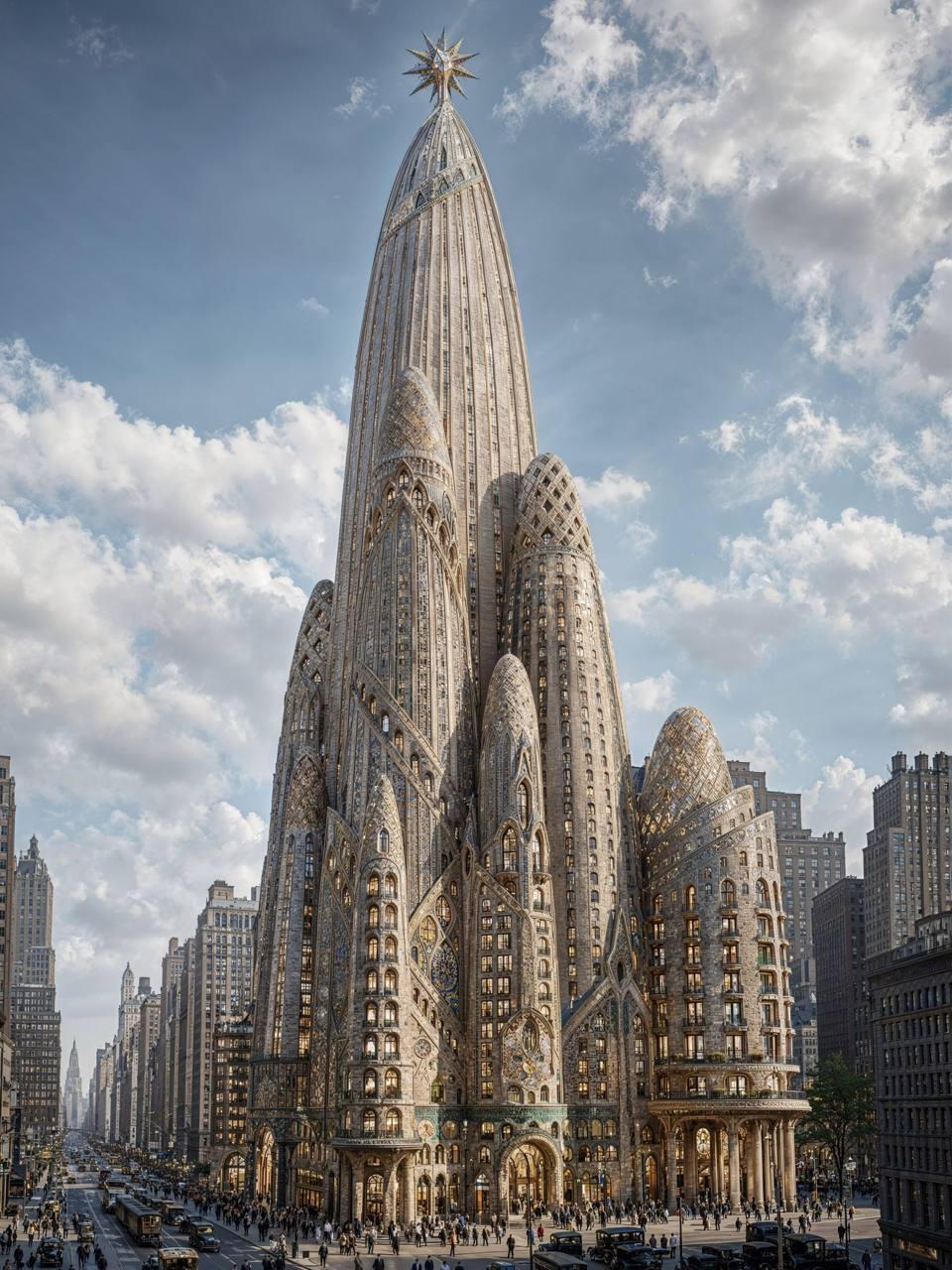
It was meant to become the tallest and most extraordinary hotel in the United States, and perhaps, the world
(Illustration: Thierry Lechanteur/AI)
A vertical city unlike anything else
The little-known story begins in May 1908, when two unidentified American businessmen crossed the Atlantic to meet Gaudí in Spain. They were not looking for another conventional building, but for something entirely different: an exclusive destination that would become New York's premier attraction for the city's wealthy elite.
Gaudí's proposal was nothing short of monumental. He envisioned an immense tower composed of nine distinct spires, sculpted in flowing organic forms with sweeping curves reminiscent of Barcelona's famous Sagrada Família. At a time when box-shaped skyscrapers were beginning to define the American skyline, Gaudí instead planned to combine iron, cement, stone and brick, finishing the structure with colorful mosaics and glass domes.
The enormous hotel was conceived as "a journey around the world under one roof." Beyond its guest rooms, Gaudí designed a vertical city made up of five massive halls stacked one above the other, each representing the culture of a different continent.
To complete the fantasy, the complex was to include six floors of restaurants, a theater and lecture hall, multiple galleries and a vast interior exhibition space rising approximately 125 meters (410 feet).
At its heart was an almost cathedral-like hall called Homage to America, which would even feature a 10-meter (33-foot) Statue of Liberty. But the true centerpiece was the observation deck at the top of the central tower: a star-shaped platform known as the Space Tower, designed to accommodate 30 visitors at a time and offer an unprecedented panoramic view from higher than any other building in the world.
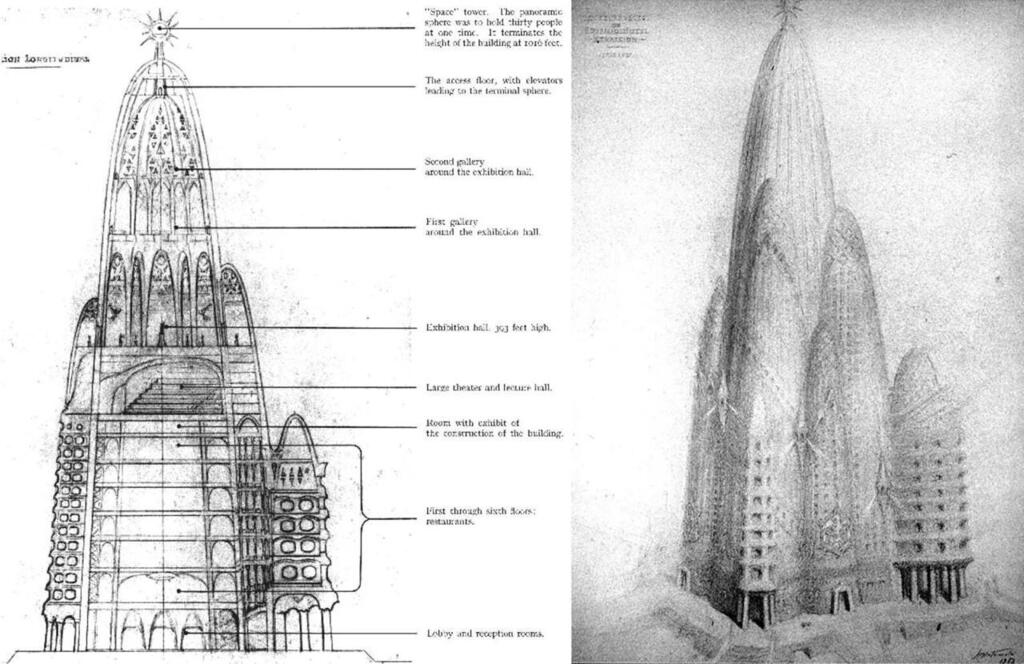
Gaudí's proposal was nothing short of monumental
(Illustration: Joan Matamala)
From megalomania to conspiracy: why was it never built?
So why did 20th-century travelers never check into this architectural marvel?
History offers several explanations.
Some argue the project was simply too ambitious — perhaps even impossible to engineer with the technology available at the time. Others point out that Gaudí contracted Malta fever in 1909 and was forced to abandon work on the project. Historians also cite his growing commitment to completing the Sagrada Família, as well as the logistical challenges posed by the distance between Barcelona and New York.
The most colorful theory, however — and one favored by architectural conspiracy enthusiasts — suggests that Gaudí himself ultimately rejected the project. A deeply religious man with strong social convictions, he is said to have recoiled from his American clients' vision of a luxury hotel serving only New York's wealthy capitalist elite, abandoning the commission on principle.
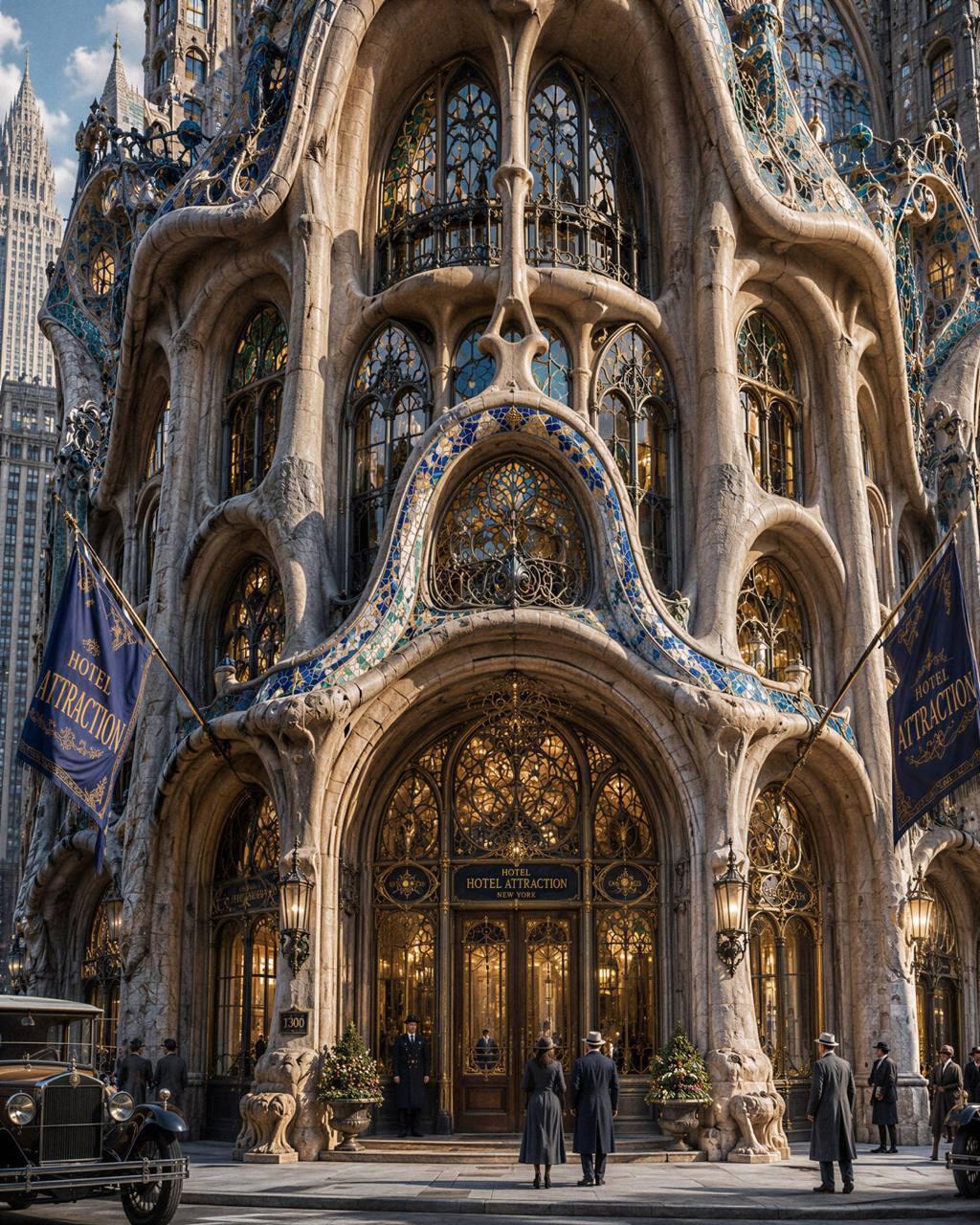
The enormous hotel was conceived as 'a journey around the world under one roof'
(Illustration: Thierry Lechanteur/AI)
A project almost lost forever
In fact, the hotel's very existence remained virtually unknown for decades and might have disappeared from history altogether, owing both to Gaudí's unconventional working methods and to the tragedy that later befell his archive.
Gaudí rarely produced detailed architectural plans on paper. Instead, he preferred building intricate three-dimensional models from clay and string while directing craftsmen verbally.
Then, in 1936, ten years after his death, anarchists stormed his workshop at the Sagrada Família during the Spanish Civil War, looting and burning it. Most of his models, documents and the few surviving sketches were destroyed.
The man who rescued Gaudí's forgotten New York dream was sculptor Joan Matamala, the son of one of Gaudí's closest collaborators, who had worked as a young apprentice in the master's studio. Gifted with an extraordinary memory and remarkable drawing ability, Matamala painstakingly reconstructed the lost designs from memory and from the handful of surviving sketches.
For decades, the project remained little more than rumor until 1956, when Matamala published a detailed report titled When the New World Called Gaudí.
The document revealed the drawings and recounted the mysterious meeting with the American businessmen, whose identities remain unknown to this day.
Some historians dismissed the account as fabrication. But engineering experts who examined the drawings discovered calculations for catenary arches — Gaudí's signature structural innovation and one so technically sophisticated that Matamala, a sculptor rather than an engineer, was highly unlikely to have invented it himself.
To many researchers, that was the decisive proof: the project truly belonged to Gaudí.
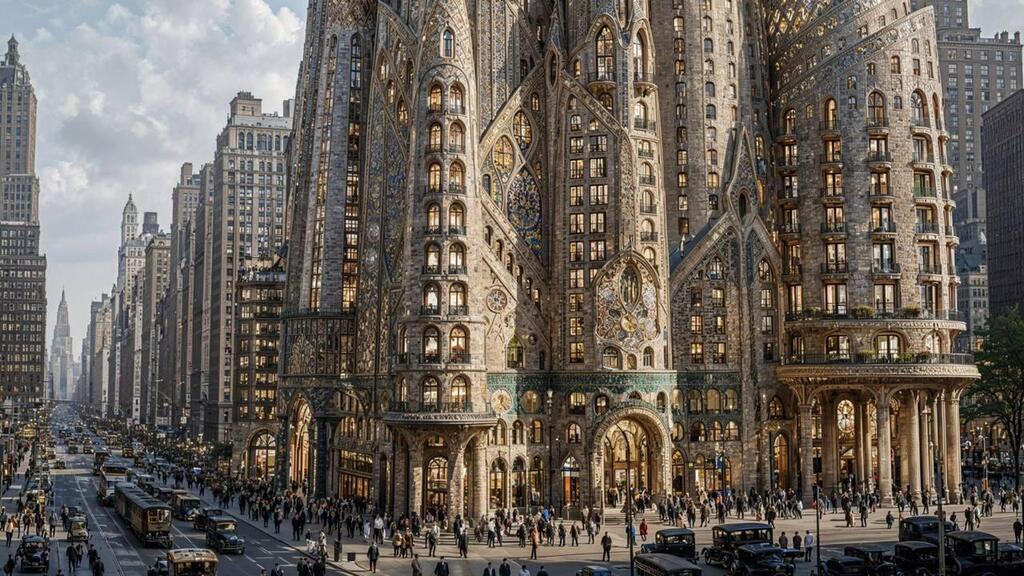
Some argue the project was simply too ambitious — perhaps even impossible to engineer with the technology available at the time
(Illustration: Thierry Lechanteur/AI)
AI brings the vision back to life
Now, exactly 100 years after the legendary architect, who died after being struck by a tram in Barcelona, Belgian artist Thierry Lechanteur has taken Matamala's reconstructed drawings and used advanced AI tools to bring them to life.
The result is a series of striking visualizations that have captivated audiences online.
Rather than producing a dry technical reconstruction, Lechanteur created a poetic, imaginative interpretation of Gaudí's architectural language.
"You know how much I love Gaudí," he wrote when unveiling the images. "Through these pictures, I wanted to pay tribute to him on the centenary of his death and bring one of his most fascinating projects back to life. This building never existed. It remained only a drawing, a vision, an unfulfilled promise. It is nostalgia for a future that never happened."
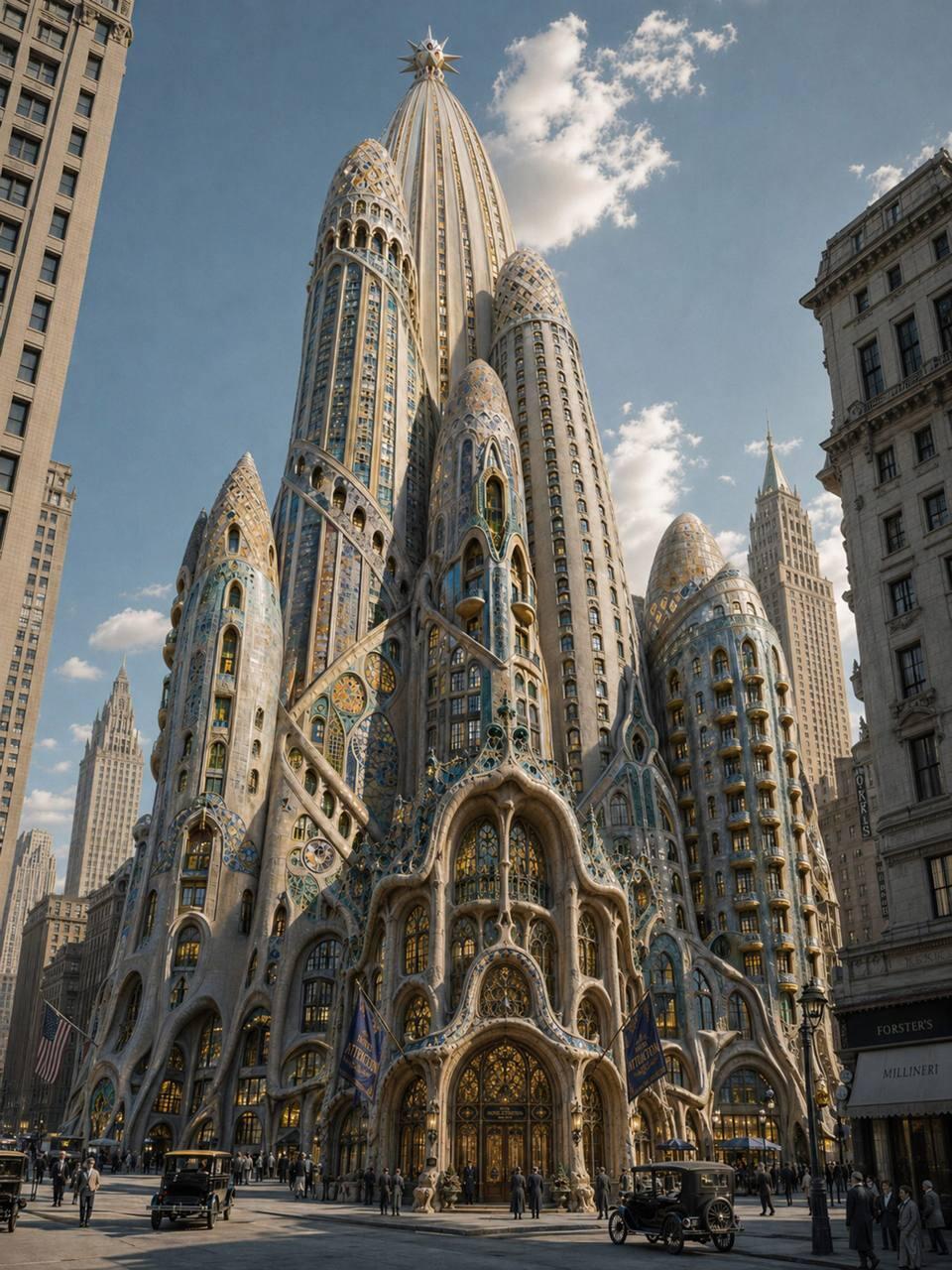
Rather than producing a dry technical reconstruction, Lechanteur created a poetic, imaginative interpretation of Gaudí's architectural language
(Illustration: Thierry Lechanteur/AI)
A second chance after 9/11?
Surprisingly, the fantastical project nearly enjoyed a second life in the early 2000s.
A group of architectural historians and architects proposed Hotel Attraction as part of the international competition to redevelop the Ground Zero site in Manhattan—a location that some believe was originally intended for the hotel back in 1908.
The idea of placing a Catalan fairy-tale palace at the heart of New York's deepest wound was undeniably romantic. But it quickly collided with the realities of post-9/11 America.
The site's new purpose demanded a complex mix of commercial office space, a major transportation hub and a national memorial—requirements that simply could not be reconciled with a century-old design for a luxury hotel.
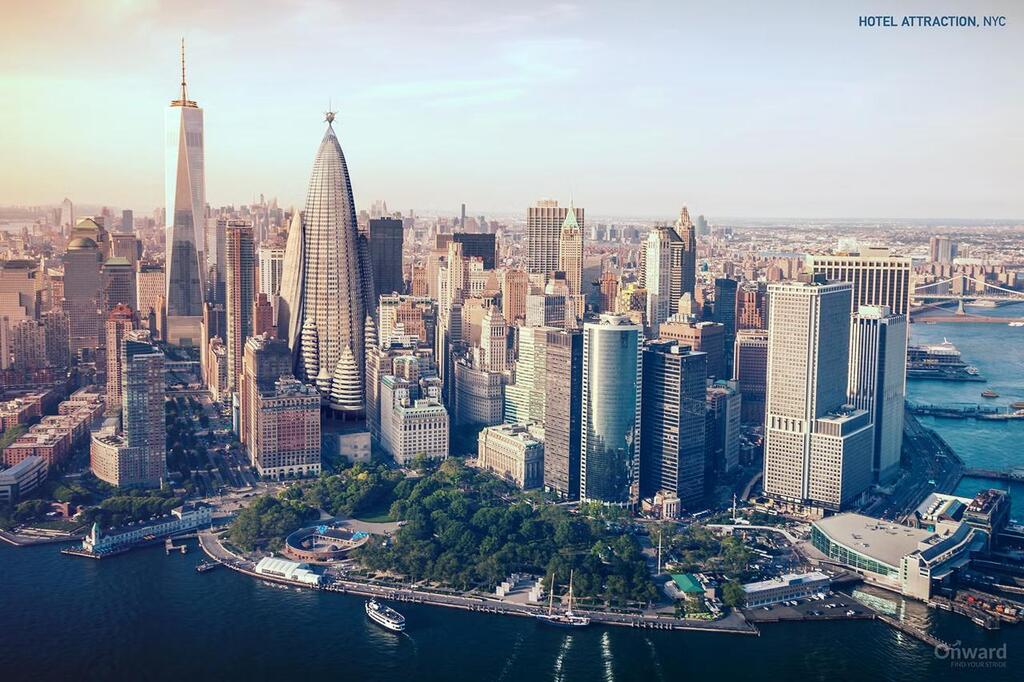
The site's new purpose demanded a complex mix of commercial office space, a major transportation hub and a national memorial
(Illustration: Thierry Lechanteur/AI)
Moreover, adapting Gaudí's century-old sketches to meet modern engineering standards and stringent safety regulations was widely viewed as impossible.
The selection committee was looking for a contemporary symbol of resilience, not what some regarded as nostalgic "ghost architecture."
The competition ultimately went to architect Daniel Libeskind.
Still, Gaudí's unrealized dream found an unexpected afterlife on television. In Fringe, J.J. Abrams' science fiction series, Hotel Attraction finally appeared in all its glory—towering over the Manhattan skyline in a parallel universe.