

For an athlete chasing the Olympics, a few thousand dollars can separate a missed opportunity from a breakthrough.
Israeli judoka Izhak Ashpiz learned that in 2025, when he was still trying to establish himself on the senior international circuit. His earlier results had fallen short of the Israel Judo Association’s funding criteria, leaving him without financing for the Grand Prix in Lima, Peru.

The trip would cost about 12,000 shekels ($4,000), a significant sum for a young athlete still trying to prove he belonged among the world’s best.
The Paltchik Foundation paid for the trip.
Ashpiz went to Lima and won gold — his first senior international medal. His world ranking jumped 333 places.
It proved to be the start of something much bigger.
Over the following season, Ashpiz won Grand Slam gold medals in Tbilisi and Budapest, bronze medals in Paris and Ulaanbaatar and a bronze medal at the senior European Championships. By Sept. 19, 2026, he was ranked No. 2 in the world in the under-60-kilogram category.
He also became Israel’s youngest judoka to win senior Grand Prix gold and its youngest senior Grand Slam champion. He was the youngest male judoka in the world to win a Grand Slam since Japan’s Hifumi Abe, who went on to become a two-time Olympic champion.

Izhak Ashpiz
(Photo: Giorgi ARJEVANIDZE/ AFP)
There is no way to know whether Ashpiz’s career would have followed the same trajectory had he stayed home from Lima. But his experience illustrates a problem familiar to many young elite athletes: Long before the medals, sponsorships and Olympic spotlight arrive, someone has to pay for the journey.
The expensive years before the Olympics
Israel’s leading young athletes can spend years training full time, traveling to international competitions and structuring their lives around their sport. Yet those who have not reached the required rankings or results for significant institutional funding can find themselves caught in an awkward stage: expected to compete like professionals without the financial security of established professionals.
Some rely heavily on their families. Others take on part-time work. In some cases, the expense of competing abroad can determine whether an athlete gets the chance to advance at all.
It is a predicament Peter Paltchik knows firsthand.
Before becoming one of Israel’s most successful judokas, Paltchik worked temporary jobs and, at times, slept in his car while trying to finance his athletic career.
He eventually became a two-time Olympic medalist, world bronze medalist and European champion. After experiencing the financial uncertainty of elite sport himself, he established the Paltchik Foundation in 2024 to help younger athletes through the same period.
Now in its second year, the foundation supports 10 Israeli athletes in judo, gymnastics and swimming.
Each receives a monthly scholarship of 4,500 shekels, or 54,000 shekels a year. For athletes whose days revolve around training, recovery and competition, the money is intended to reduce the need for outside work and help cover the basic costs of pursuing an international career. The foundation also helps athletes access training, equipment and medical support through outside partners.
Paltchik and the foundation’s board serve on a voluntary basis, with no salaried positions or administrative overhead.
“The foundation helped me at the beginning of my journey,” Ashpiz said. “Whenever I needed help or someone to listen, I knew I had someone to turn to. I know they are always there for me.”

Peter Paltchik
(Photo: Oz Mualem)
Betting on athletes before they become household names
Ashpiz is the foundation’s most dramatic success story so far, but its roster reflects a broader strategy: supporting athletes while they are still emerging rather than waiting until they have already established themselves internationally.
Among those receiving support are World Cup gymnastics medalists Yahli Shoshani and Noam Berkovitz, World Championships swimming finalist Daniel Krichevsky, world No. 11 judoka Yuli Mishiner and youth world judo medalist Tom Simchaiv.
For Mishiner, the value of the program is not limited to paying expenses.
“An Olympic campaign means dedicating myself completely to judo,” she said. “The foundation gives me confidence that someone sees the entire journey, believes in me and has chosen to become a partner in my greatest goals.”
Galit Shoshani, the mother of gymnast Yahli Shoshani, said her daughter’s selection gave her a significant boost in confidence.
“It was much more than financial support,” she said. “It was an expression of belief that helped her believe in herself and in her ability to fulfill her dreams.”
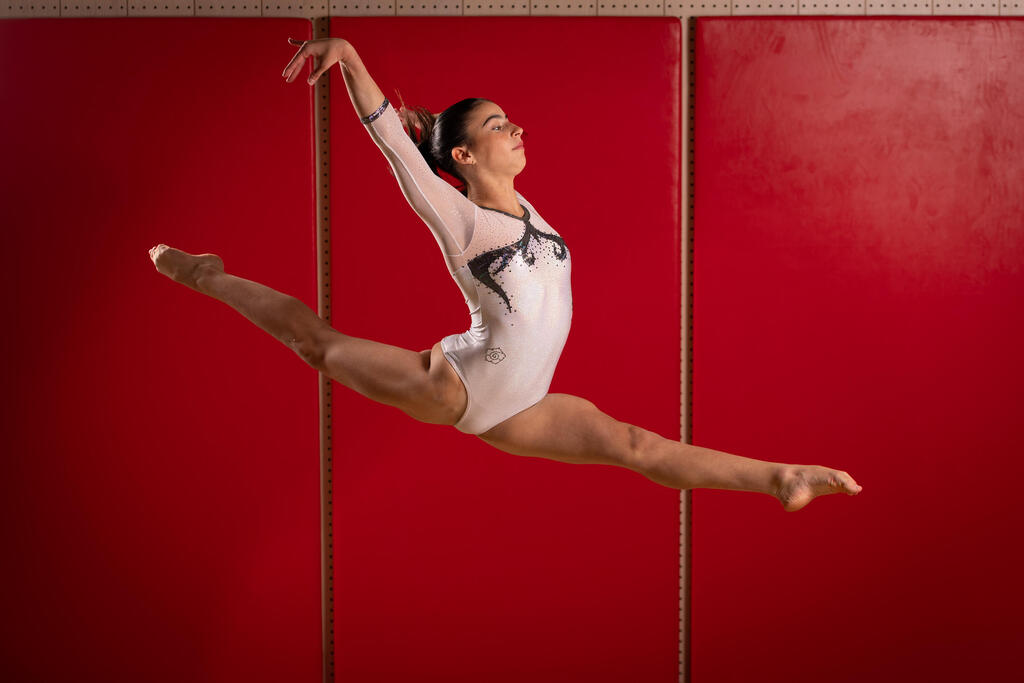
Yahli Shoshani
(Photo: Oz Mualem)
That belief can matter in sports where careers are often determined by narrow margins. A single competition can change an athlete’s ranking, qualification prospects and access to future funding. Conversely, missing an event because of its cost can mean losing an opportunity that may not return.
Looking beyond Los Angeles
The foundation is now changing the way it decides how long to support athletes.
Beginning in 2027, it plans to continue assisting selected athletes through their first Olympic Games rather than ending its support once they qualify for an official Olympic funding program.
The idea is to provide continuity during the years when an athlete is making the transition from promising prospect to Olympic competitor.
Its planning also extends beyond the next Games. The foundation says it intends to work two Olympic cycles ahead, currently focusing on athletes who could compete at Los Angeles 2028 and Brisbane 2032. After the Los Angeles Games, its horizon will shift toward Brisbane and the 2036 Olympics.
According to its projections, athletes currently supported by the program could eventually account for roughly 10% of Israel’s delegation to the 2028 Los Angeles Games.
For Paltchik, the effort is also a way of translating his own Olympic career into something that lasts beyond his medals.
“My medals represent what I achieved as an athlete,” he said. “The foundation represents what I want to leave behind. My legacy will be measured by the athletes who reached the world stage because someone believed in them when they needed it most.”
There is also a broader Israeli dimension to the project. International sporting events are among the relatively few places where athletes compete visibly under the national flag before large global audiences. For Israelis and many Jewish communities abroad, a medal ceremony featuring the Israeli flag and the national anthem can carry significance well beyond the result itself.
But those moments begin years earlier, far from packed arenas and television cameras, with training sessions, plane tickets and competitions that few people are watching.
For Ashpiz, one of those competitions was in Lima.
It cost 12,000 shekels to get him there.
He came home with a gold medal — and a career that suddenly looked very different.
The Paltchik Foundation accepts tax-deductible donations in the United States through JNF-USA. More information is available at PaltchikFoundation.org