

Nvidia has established a new research group in Israel aimed at using artificial intelligence to accelerate medical and scientific breakthroughs, Calcalist has learned, marking another expansion of the chip giant’s research and development operations in the country.
The group was created by Nvidia Chief Technology Officer Michael Kagan and operates from the company’s Israeli development center as part of its global CTO office, which Kagan leads. A co-founder of Israeli networking company Mellanox, which Nvidia acquired in 2020, Kagan is one of the company’s most senior Israeli executives and reports directly to founder and CEO Jensen Huang.
Gallery
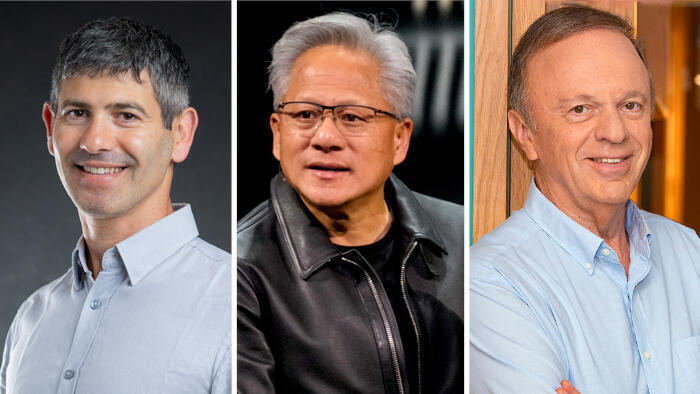
From right: Nvidia CTO Michael Kagan, Nvidia founder and CEO Jensen Huang, and new group head Nati Daniel
(Photo: Nati Daniel; Kent Nishimura/Bloomberg)
The new unit, called Applied AI Architecture, currently employs several researchers in Israel. Nvidia plans to recruit dozens more over the coming year and has already posted several research positions for its Tel Aviv offices.
The group is headed by Dr. Nati Daniel, who holds a doctorate in artificial intelligence from the Technion – Israel Institute of Technology and previously held senior positions at Intel, GE and Huawei.
AI aimed at long-term scientific discovery
The group’s mandate is broader than developing products for immediate commercial use. Nvidia intends it to explore how AI can become a practical engine for scientific and medical discovery, with long-term research eventually feeding into technologies that could be incorporated into the company’s systems.
Nvidia already operates research teams at several sites worldwide, but the Israeli group is unusual because it was established within the company’s global CTO office, signaling the importance Nvidia is placing on the initiative.
Its operating model is also expected to differ from that of some other research groups. Alongside internal work, Kagan’s team will collaborate directly with medical institutions and other outside research partners.
Israel was chosen in part because of its concentration of advanced AI and medical research. Sheba Medical Center, for example, recently became the first hospital outside the United States to sign a collaboration agreement with OpenAI giving it access to specialized AI models for medical applications.
Nvidia is believed to be developing additional collaborations in Israel that could be announced in the coming months.
Sheba and Mount Sinai join genomic AI project
The new Nvidia group is already working with Sheba Medical Center and Mount Sinai in New York on a genomic foundation model, or gFM, designed to help researchers study the roughly 98% of the human genome that remains far less understood than the small portion scientists have examined most intensively.
The project is intended to uncover new approaches to disease prevention, improve diagnostic capabilities and advance personalized treatments.
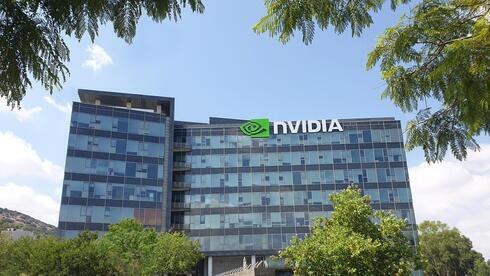
Nvidia offices in Yokneam
(Photo: Nvidia Israel)
The Israeli team is also involved in Nvidia’s global collaboration with pharmaceutical giant Eli Lilly. The two companies plan to invest about $1 billion over five years in applying AI to drug discovery and development.
That work combines genomic and sequence data with chemistry, biology and cellular context in an effort to shorten the path from basic research to new drugs and treatments.
AI for discovering new materials
Another project involving the group is GENMAT, an international research initiative launched several months ago with a grant of about 6 million euros from the European Union’s Horizon program.
The project brings together companies, universities and research institutes from across Europe to develop AI tools that can accelerate the discovery and development of new materials.
Participants include companies developing advanced materials for the aerospace, automotive and pharmaceutical industries.
For Nvidia, the Israel initiative also fits into a much broader expansion of its presence in the country. The company has steadily increased its workforce and R&D activity since acquiring Mellanox, making Israel one of its most important development hubs outside the United States.
That growth could have consequences well beyond Nvidia itself. Further expansion by one of the world’s largest technology companies could affect Israeli technology exports, economic output and tax revenues, particularly if Nvidia continues to increase both hiring and investment at its local operations.
For now, however, the new group is focused on a longer horizon: using AI not simply to improve existing products, but to help researchers uncover scientific and medical advances that may take years to mature into usable technologies.