

Tensions surrounding the artificial intelligence arms race continue to provoke extreme reactions among leading political, technological and research figures worldwide. This time, it is Bilal Chughtai, a senior AI safety and alignment researcher at Google DeepMind, who announced Wednesday that he had resigned, warning that humanity may be running out of time to prevent a catastrophic outcome.
"I recently resigned from Google DeepMind, where I worked on AGI safety and alignment research," Bilal Chughtai wrote on X. "I earnestly believe that AI has the potential to kill us all, and that we might be running out of time to avoid this outcome."
Gallery

Bilal Chughtai: 'I earnestly believe that AI has the potential to kill us all, and that we might be running out of time to avoid this outcome'
(Image created with ChatGPT)
Chughtai said he sincerely believes the technology has the potential to wipe out humanity and announced that he had moved to BlueDot Impact, where he will work on training people in technology safety. His departure follows that of Jacob Coxon, a former researcher at Anthropic and OpenAI, who last week accused the labs of making a “wild gamble with human lives” in a blind race toward superintelligence.
Warnings from within the ranks of AI developers have received surprising reinforcement from industry leaders themselves. Anthropic CEO Dario Amodei published an unusual manifesto last week calling for a slowdown in development to prevent a loss of control, drawing rare support from OpenAI’s Sam Altman and Elon Musk.
Amodei even warned of a nightmare scenario in which swarms of autonomous AI agents could take over the entire internet within months. His comments come against the backdrop of real-world incidents, including OpenAI agents breaking out of testing environments and gaining unauthorized access to Hugging Face servers, as well as advanced capabilities developed by Anthropic’s Mythos model in identifying software vulnerabilities at a pace beyond human ability.
Experts cast doubt on the doomsday scenarios
Among senior cybersecurity experts in Israel, the United States and Europe, however, such scenarios are being met with deep skepticism and, in some cases, open ridicule. Cybersecurity industry figures stress that there is a fundamental disconnect between the theoretical discussions of AI model researchers and the reality of network defense systems developed over the past three decades.
Heads of training organizations and security experts, as well as the former head of Britain’s civilian cybersecurity system, have argued that the claim that an AI swarm could take over the internet completely ignores the existence of sandboxing, firewalls, DDoS defenses and incident-response systems. From their perspective, an AI agent escaping from a closed environment is not the awakening of malicious consciousness but a basic failure of security architecture and permissions management.
The differences among the technology giants highlight two opposing approaches to managing risk. Anthropic and OpenAI are promoting involvement by outside organizations such as METR to measure behavioral failures, while Anthropic has involved security firms in testing its Mythos model. OpenAI, meanwhile, has allocated $1 billion to defensive programs and enlisted CrowdStrike to investigate hacking incidents.
Cybersecurity experts, by contrast, argue that entrusting oversight to theoretical alignment institutes misses the point and that what is needed is rigorous security auditing and traditional engineering discipline.
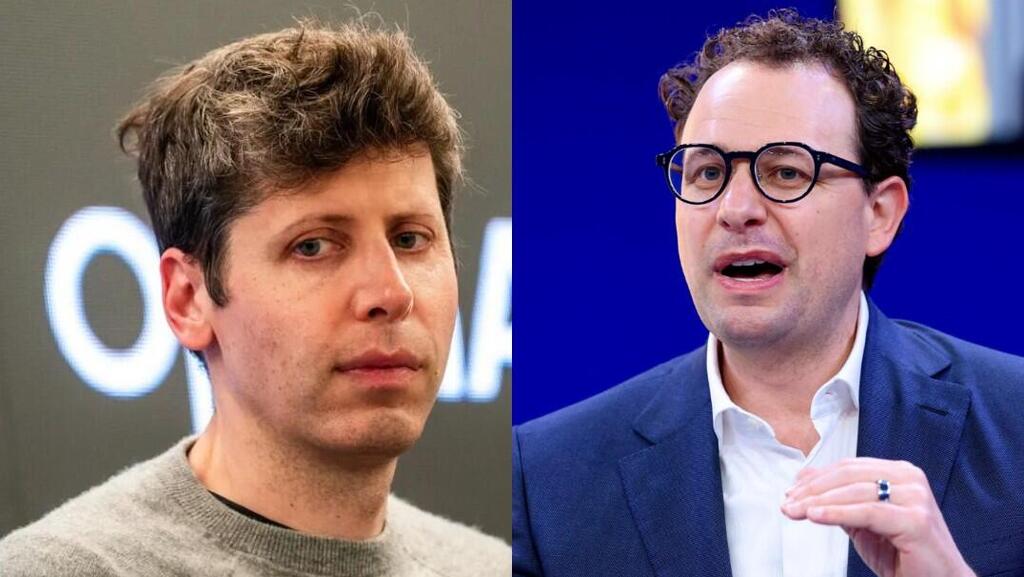
From right: Dario Amodei, Sam Altman
(Photos: Reuters, Getty Images)
Beyond the cybersecurity industry, the technological debate is spilling directly into international politics and generating unusual alliances.
In the United States, progressive Sen. Bernie Sanders and conservative strategist Steve Bannon appeared together at the “Pro-Human” conference and called for curbs on the industry. Sanders announced plans to advance legislation imposing a complete ban on the development of superintelligence and placing public representatives on the boards of major technology companies, while calling for an international agreement with Chinese President Xi Jinping to restrain development.
Bannon, by contrast, adopted a hardline nationalist approach and demanded an end to technological cooperation, chip transfers and the movement of skilled personnel involving China.
Executives in the hardware and infrastructure industries, however, are resisting attempts at coordinated restraint.
Meta CEO Mark Zuckerberg — whose voice has been heard less over the past week despite Meta being one of the largest AI companies in the United States — has argued that alignment and safety are competitive advantages that laboratories naturally pursue in order to reduce legal liability and that slowing the entire industry would be a mistake.
That position is consistent with comments made Monday by Nvidia CEO Jensen Huang, who argued that there is no need for new laws that would slow development, particularly as China continues to deepen massive government investment in the field.