


A comprehensive study published Wednesday by Israeli disinformation watchdog FakeReporter paints a troubling picture of the false information that flooded social media on election day, generating more than 3 million cumulative views. Among its findings were AI-generated images shared by Prime Minister Benjamin Netanyahu, the misuse of the image of the late Shiri Bibas and an online network linked to Iran.
Together, these incidents turned Election Day into a digital battleground filled with manipulation. The report identified a series of false campaigns designed to influence public opinion, intimidate voters and undermine confidence in the election results. According to the findings, misleading content was spread by politicians, social media influencers and media outlets.
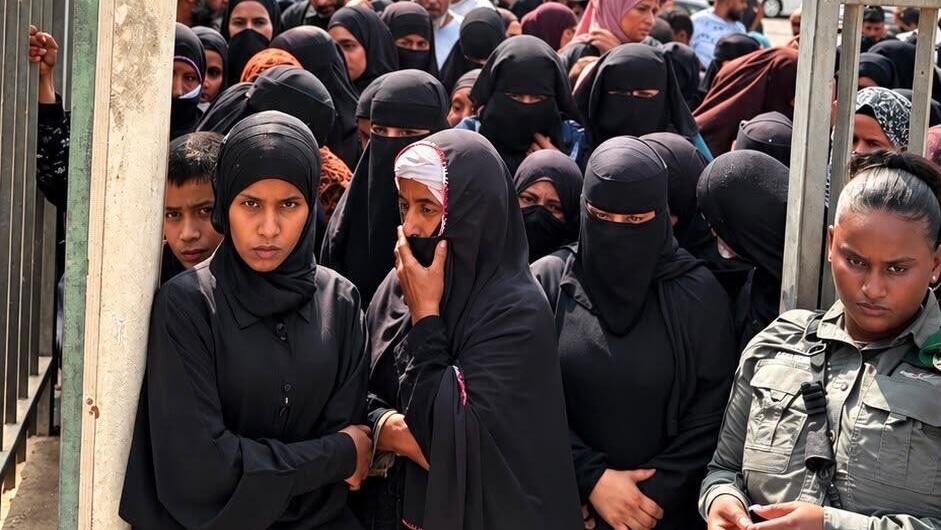
Image said to show Arabs lining up at the polls on Election Day is photo of women going up to pray on the Temple Mount in February 2026
(Photo: Social media)
'Arabs are flocking to the polls': The AI version
One of the report's central findings concerns a coordinated fear campaign surrounding voter turnout in Arab communities, which was portrayed as a threat.
Prime Minister Benjamin Netanyahu shared a Channel 14 report on X claiming "unusual congestion at polling stations in the Arab sector," accompanied by an image purportedly showing crowds of voters at a polling station in Sakhnin.
FakeReporter researchers determined that the image was entirely fabricated using an AI image generator. The post was subsequently amplified by coalition lawmakers, including Almog Cohen, and media personalities such as Yinon Magal, accumulating more than 2 million views on its own.
At the same time, the anonymous Telegram channel "Israel News Uncensored," which has 123,000 followers, spread an unfounded claim that senior members of the Ra'am party had transported a truck carrying 8 million shekels in cash to distribute to voters in envelopes.
Another X account, "Melukadim News," recycled a previously debunked story claiming that Sheikh Mowafaq Tarif, the spiritual leader of Israel's Druze community, had instructed Druze voters to support Likud. The claim distorted an old message in which Tarif thanked Netanyahu for assistance provided to Druze communities in Syria.
Another prominent area of disinformation involved attempts to delegitimize the democratic process itself. Netanyahu shared another Channel 14 report alleging that ballot slips belonging to right-wing parties had been deliberately damaged, alongside a photograph of a crumpled ballot and a call for voters to check their ballots.
The post received hundreds of thousands of views, but the Central Elections Committee quickly clarified that a comprehensive examination had found no evidence of systematic ballot tampering and that isolated incidents were being addressed immediately.
Suspected foreign interference
The report also raises serious concerns about possible foreign interference. Researchers identified a website circulated in WhatsApp groups supporting the government that portrayed Gadi Eisenkot as enjoying widespread Palestinian support and working to establish a Palestinian state. The site featured manipulated images of Eisenkot alongside Palestinian symbols and at pro-Palestinian demonstrations.
A technical analysis of the website led researchers to TikTok and Instagram accounts, one of which had been flagged as operating from Iran.
The campaign follows another serious incident before the election, in which a fabricated deepfake video exploited the likeness of the late Shiri Bibas, portraying her as urging Israelis to vote for the Democrats party.
FakeReporter's findings reflect a global trend that has attracted growing attention from news organizations and intelligence agencies in the United States, Europe and Asia.
In the United States, major news outlets and monitoring organizations such as Graphika and NewsGuard have documented the increasing use of generative AI to promote stolen-election narratives and suppress minority voting, tactics similar to those observed in Israel surrounding Arab voter turnout and allegations of ballot tampering.
In Europe, organizations such as EU DisinfoLab have examined foreign influence operations involving cloned websites, a tactic associated with the so-called Doppelganger campaign and resembling the fake website created against Eisenkot. Chinese influence networks known as Spamouflage have also used virtual avatars and coordinated TikTok accounts to deepen political polarization in democratic countries.
Nir Rosen, CEO of FakeReporter, said the findings demonstrate the scale and speed at which false information can spread during elections. "Election Day illustrated the extent to which false and misleading information spreads across social media, and how quickly such posts can reach millions of views," Rosen said.
"What these cases have in common is the use of unsubstantiated information or manipulated content in ways that can mislead the public and undermine its ability to make decisions based on reliable information. During sensitive periods such as election day, identifying, verifying and exposing false information is especially important," he said.
How technology transformed election disinformation
Political disinformation campaigns on election day are nothing new, but the technology behind them has advanced dramatically over the past decade.
One of the most recognizable examples came during the 2015 election, when Netanyahu warned in a recorded video that "Arabs are flocking to the polls in droves," claiming they were arriving by bus. That election also saw anonymous text messages spreading fabricated turnout figures or false reports that candidates had withdrawn from the race.
The tools used at the time were relatively basic, relying primarily on the rapid distribution of text.
During the repeated election cycles between 2019 and 2022, the disinformation environment evolved into coordinated networks of fake profiles using stolen avatars on X, then known as Twitter, and Facebook. These accounts amplified political messages and attacked opponents, while pseudo-news Telegram channels operating without editorial oversight became increasingly prominent.
Today, artificial intelligence tools make it possible to generate convincing images within seconds of enormous lines at polling stations that never existed. The same technology can animate people in deepfake videos and make them appear to deliver political messages they never actually made, as happened with the fabricated video featuring Shiri Bibas.
Such content can now be produced at virtually no cost and with a level of realism that makes it increasingly difficult for the human eye to identify manipulation in real time.