

The handheld gaming market continues to evolve, with manufacturers searching for the perfect balance between performance, comfort and battery life. MSI is now entering the race with an upgraded version of its Claw gaming handheld, the MSI Claw 8 EX AI+, powered by Intel's new flagship Arc G3 Extreme processor.
Interestingly, handheld gaming PCs remain a relatively niche market in Israel. While Nintendo's Switch 2 has gained considerable popularity, the same cannot be said for Windows- and Linux-based handhelds such as the Steam Deck and Lenovo Legion Go.
These devices offer impressive graphics capabilities and the ability to run demanding PC games away from home, but their size and weight make them considerably less portable and convenient to use on the go.
MSI previously entered this market with the Claw 8 AI+, a model that was barely marketed in Israel. Despite its limited exposure, it was actually an impressive device that, in some respects, outperformed competitors such as the Legion Go 2.
That was largely thanks to Intel's Lunar Lake processor, a comfortable ergonomic design and a large 80Wh battery.
Now comes the Claw EX, which aims to build on those strengths, primarily through major improvements in performance and power efficiency.
The biggest upgrade is under the hood
The most significant change in the Claw EX is its processor. The new handheld is equipped with Intel's Arc G3 Extreme, based on the Panther Lake architecture, delivering substantial improvements in both performance and power consumption compared with its predecessor.
The previous model relied on Intel's Core Ultra 7 258V from the Lunar Lake family, a processor also used in conventional laptops.
The upgrade is particularly significant in a market where many competing handhelds still rely on AMD's Ryzen Z1 and Z2 Extreme processors.
Beyond the new chip and a few design changes, however, MSI has left much of the hardware untouched.
The EX retains an 8-inch IPS display, an 80Wh battery, two USB-C ports, a headphone jack and a microSD card slot. Storage capacity also remains unchanged at 1TB, although the new model uses a faster drive.
The display is one area where MSI missed an opportunity.
It is certainly a good IPS panel, offering high brightness, excellent colors, a refresh rate of up to 120Hz and support for variable refresh rate (VRR), a technology that synchronizes the display's refresh rate with the game's frame rate to reduce screen tearing.
But it still lacks HDR support, and competing handhelds are already available with OLED panels and higher refresh rates.
Design: More comfortable to hold, but still bulky
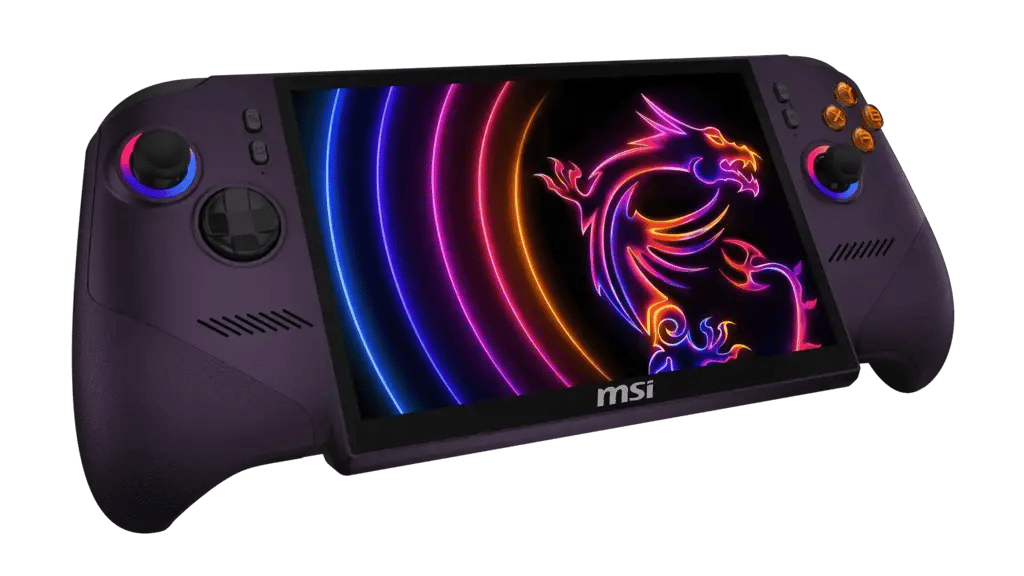
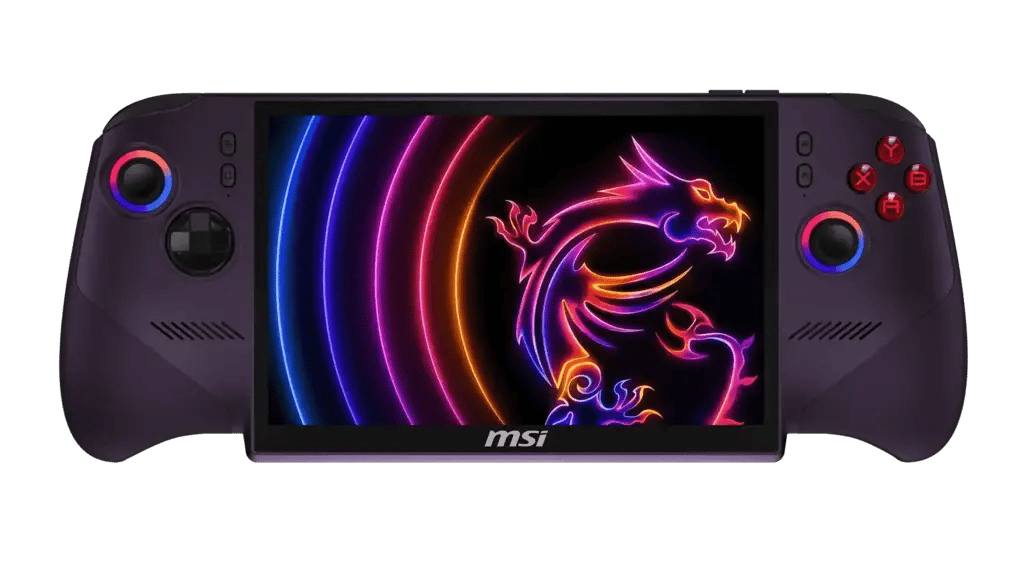
MSI has also made several changes to the handheld's design, most notably a wider body with elongated grips.
The result is a device that feels considerably more comfortable to hold than its predecessor, although it still falls short of the comfort offered by the ROG Xbox Ally.
Not every design decision is successful, however.
(Photo: MSI)
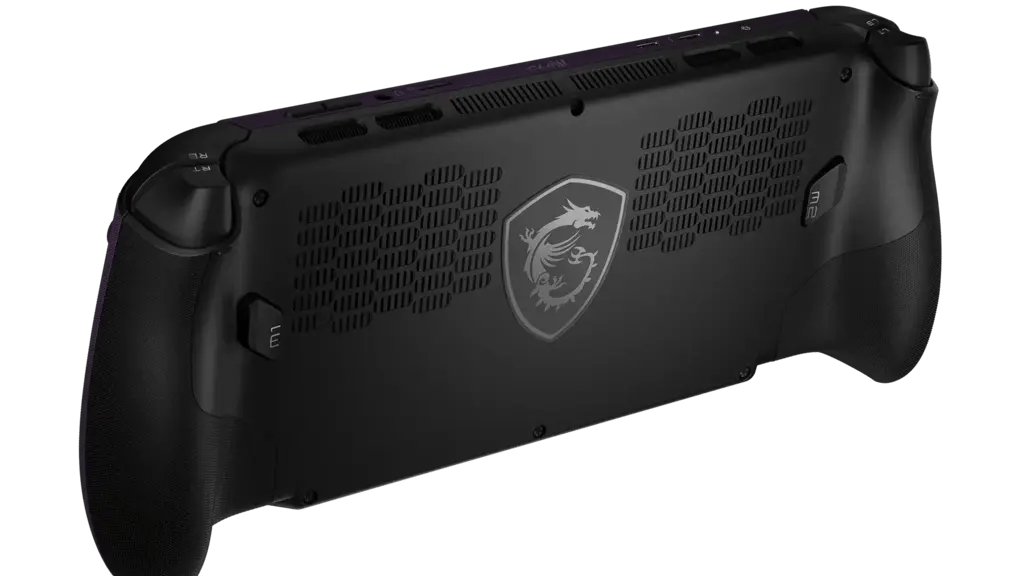
For reasons that are difficult to understand, MSI has designed the device so that the bottom edge of the screen protrudes beyond the main body. It is an awkward choice that adds little to the overall appearance.
I'm also not particularly fond of the purple finish, which is currently the only available color.
Despite the redesigned body, the weight has barely changed. The EX weighs 785 grams, just 10 grams less than its predecessor.
In practice, it does not feel excessively cumbersome, and the grip is extremely comfortable. Nevertheless, its considerable size comes with a drawback: it takes up plenty of space and requires a relatively large carrying case, reducing its portability.
As for noise, the EX's cooling fan is slightly louder than the previous model's, but it remains one of the quieter handheld gaming PCs on the market.
That is particularly noticeable when operating at 25 watts or less, which is likely where most users will spend the majority of their gaming time.
Performance and battery life: A major leap forward
If there is one compelling reason to consider the new Claw EX, it is performance.
Intel's Arc G3 Extreme delivers a substantial leap over the previous generation, not only in raw graphics power but also in energy efficiency and battery life.
To understand just how significant the improvement is, it helps to start with the older Claw 8 AI+.
That device already offered performance comparable to, and sometimes better than, AMD's Ryzen Z2 Extreme, which powers devices including the Legion Go 2. It therefore provides a useful baseline for evaluating the new model against the competition.
(Photo: MSI)
In my testing, the EX delivered improvements of around 40% even in some of the less impressive results. In certain games, the performance gap exceeded 70%.
In titles such as Hogwarts Legacy, Cyberpunk 2077 and Resident Evil 9, performance improved by at least 30% to 40%, depending on the game and the power level at which the handheld was operating.
But the real advantage is that users do not necessarily need to take advantage of all that additional performance.
Thanks to its improved power efficiency, the EX can deliver performance similar to the previous model while consuming less electricity, translating into longer gaming sessions without recharging.
In relatively lightweight games such as Hollow Knight: Silksong and Hades II, I was able to play at maximum graphics settings and 120 frames per second while still getting around four hours of battery life, and sometimes even more.
That is an especially impressive result, surpassing the Nintendo Switch 2 in both performance and battery life under those conditions.
On the other hand, players who want to extract every last bit of performance can increase the power limit to 35 watts.
Doing so, however, can reduce battery life to less than two hours.
The important point is flexibility. Players can decide whether they prefer maximum performance or longer battery life and adjust the device accordingly.
How much faster is the Claw EX, really?
To measure the performance improvement in real-world gaming, I ran several titles on both generations of the Claw using different graphics settings.
The first was Forza Horizon 6, Microsoft's latest racing game, which places considerable demands on the hardware running it.
I tested the game at medium graphics settings, a resolution of 1200p and Intel's XeSS upscaling technology set to Balanced mode.
The EX showed significant performance improvements at every tested power level.
At 15 watts, for example, the older model struggled to deliver a smooth gaming experience, while the EX performed substantially better.
In fact, the new device was able to deliver performance comparable to what the previous model achieved only at 25 watts.
That means players can enjoy roughly the same level of performance while consuming considerably less electricity, potentially extending battery life by around two additional hours.
The EX also supports a maximum power level of 35 watts, compared with 30 watts on the previous model.
However, the performance improvement when increasing power from 30 to 35 watts is relatively small compared with the gain achieved by moving from 25 to 30 watts.
In practical terms, there is little reason to push the EX beyond 30 watts unless it is connected to a charger.
Older games benefit, too
The next title I tested was Middle-earth: Shadow of War, an older game that remains highly enjoyable, particularly on a handheld.
This time, I decided to push the hardware much harder, using Ultra graphics settings at 1200p.
The differences between the two models were even more pronounced.
At 15 watts, the EX delivered a particularly substantial improvement in performance without sacrificing battery life.
Even when I increased the power limit to 30 watts, the console provided at least two hours of gaming while delivering approximately 71% higher average frame rates than the previous model.
That is a remarkable improvement for a device that has retained essentially the same battery capacity.
Black Myth: Wukong puts Intel's new chip to the test
For my final comparison, I turned to Black Myth: Wukong, this time using a slightly different approach.
On the older Claw, I enabled Frame Generation, a technology that uses artificial intelligence to create additional frames between those rendered by the graphics processor.
On the EX, I left the feature disabled.
At first glance, this might seem like an unfair comparison, since the older device benefits from artificially generated frames that can substantially increase the displayed frame rate.
Despite that advantage, however, the EX still managed to perform better.
The difference was especially noticeable at higher power levels of 30 and 35 watts.
This suggests that the older model's processor may have reached a performance ceiling that Intel's new chip is able to overcome.
The result highlights just how much more powerful the new hardware is, even before taking advantage of additional technologies designed to boost frame rates.
The verdict: Excellent hardware, painful price
The MSI Claw 8 EX AI+ excels in the two areas that matter most for a handheld gaming PC: performance and battery life.
It gives players the flexibility to prioritize whichever matters most at a given moment, whether that means maximizing graphical performance in a demanding game or extending battery life during a longer session.
MSI has also made the device more comfortable to hold, although the external design has not changed dramatically. There is still room for improvement, particularly when it comes to the display and some questionable aesthetic choices.
Unfortunately, the biggest drawback has nothing to do with the gaming experience.
The Claw EX costs around $1,800 internationally, approximately $800 more than its predecessor. Much of that increase is linked to the severe shortage affecting the memory market.
In Israel, the device is already available for around 7,000 shekels.
That is an extraordinarily high price for a portable gaming console, even one with such impressive performance and excellent battery life.
And that is what makes the Claw EX so frustrating.
It is an excellent device that delivers precisely the improvements handheld gaming enthusiasts have been waiting for. Yet at its current price, it is likely to remain a niche product for enthusiasts willing to pay a substantial premium.
We can only hope that, over the next few years, hardware this capable will make its way into more affordable devices.