

In a dramatic escalation of its efforts to crush civil unrest, Iran’s clerical regime has reportedly crossed a new red line in recent days, moving beyond conventional internet blackouts and, for the first time, deploying military-grade jamming to disrupt access to Elon Musk’s satellite internet service, Starlink.
Starlink, which provides internet via low-Earth orbit satellites, has long been considered a digital lifeline for activists and civilians in authoritarian states like Iran or war zones such as Ukraine, where regimes or conflict can shut down national internet networks with the flip of a switch.
Near-total disconnection
According to IranWire, despite estimates that tens of thousands of Starlink terminals have been smuggled into Iran and are operating illegally across the country, the recent disruption has impacted the majority of them. Initial reports indicated a 30% drop in connectivity, but within hours, the figure surged to more than 80%.

The scale of Starlink’s deployment in Iran is reportedly far greater than previously believed, despite the fact that Tehran never authorized the service, making its possession and use illegal under Iranian law.
Starlink terminals rely on GPS to locate themselves and connect to satellites. Since the 12-day war with Israel in June, Iran has been actively jamming GPS signals domestically. This enables the regime to block access in specific areas where it suspects protests are being organized.
The result is a fragmented connectivity map, a patchwork of zones where Starlink still functions, alongside areas, including symbolically significant sites, where the service has been nearly wiped out.
Amir Rashidi, of the Miaan Group, which monitors internet freedom in Iran, told TechRadar the disruption is unprecedented. “In over 20 years of research, I’ve never seen anything like it,” he said. Data tracking supports his claim: analysis of network packets shows a sharp drop in Starlink traffic, confirming field reports of widespread satellite service outages.
When the regime shoots its economy in the foot
The blackout, analysts say, also carries steep economic costs. Simon Migliano, an international expert on internet shutdowns and digital censorship, told TechRadar the move reflects a regime under immense pressure. “This is a clear sign of distress — the government is willing to pay a heavy economic price to suffocate dissent,” he said.
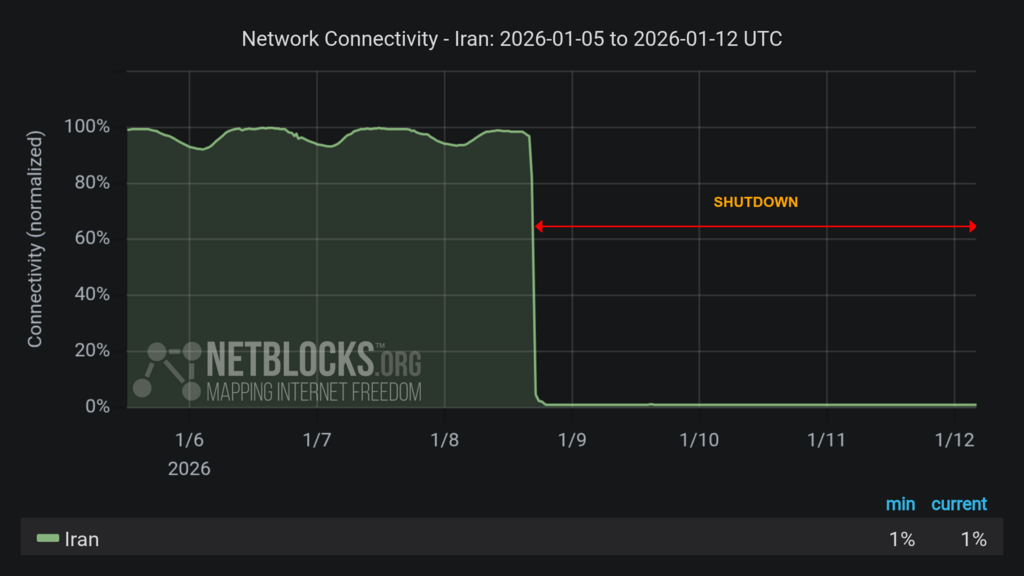
Internet blackout in Iran
(Photo: Netblocks)
That price is estimated at roughly $1.56 million in lost economic activity for every hour the internet remains down. According to monitoring group NetBlocks, Iran’s current internet disruption has surpassed 80 hours, with nationwide connectivity levels hovering at just 1% of normal traffic.
For Iranian citizens, journalists and activists, the consequences are dire. As the regime clamps down on every avenue of free communication, even their last digital refuge is disappearing. Organizing protests will become far more difficult, and documenting the regime’s abuses and sharing them with the outside world nearly impossible.