
There is a big difference between a beverage that tries to imitate milk and real milk protein produced without a cow. That distinction is at the heart of Remilk, the Israeli food-tech company seeking to transform one of the world’s largest food industries. Instead of raising a cow, feeding it and milking it, the company uses yeast to produce one of milk’s key proteins. That protein can then be used to create beverages and dairy products with the taste, texture and properties associated with conventional milk. By early 2026, that technology had already made the leap from the laboratory to supermarket shelves in Israel.
Remilk was founded in 2019 by Aviv Wolff and Dr. Ori Cohavi. Wolff entered entrepreneurship after eight years of service as an officer in an elite military unit and a career in cybersecurity, but was looking for a field in which he could make a broader impact. Milk also had a personal connection for him: his grandfather was a dairy farmer, and part of his family grew up in Israel’s agricultural north.
Cohavi, a biochemist with experience in biotechnology companies, brought the scientific expertise. The two joined the first cohort of the JumpTAU accelerator program at Tel Aviv University’s Entrepreneurship Center, where the company took shape around the idea of turning the cow from an essential biological factory into something that could be bypassed.
The beginnings were far more modest. In a 2020 interview with ynet, when Remilk was still in its early stages and was presenting mozzarella as a proof of concept, Wolff explained that the goal was not to create yet another beverage for vegans.
“Most people will think that we want to offer an alternative for vegans, but that is really not what we want,” he said at the time. In the same interview, he was already setting a far more ambitious goal: if the company could reproduce taste, nutritional value and functionality at an affordable price, “we believe it’s game over for using the cow.”
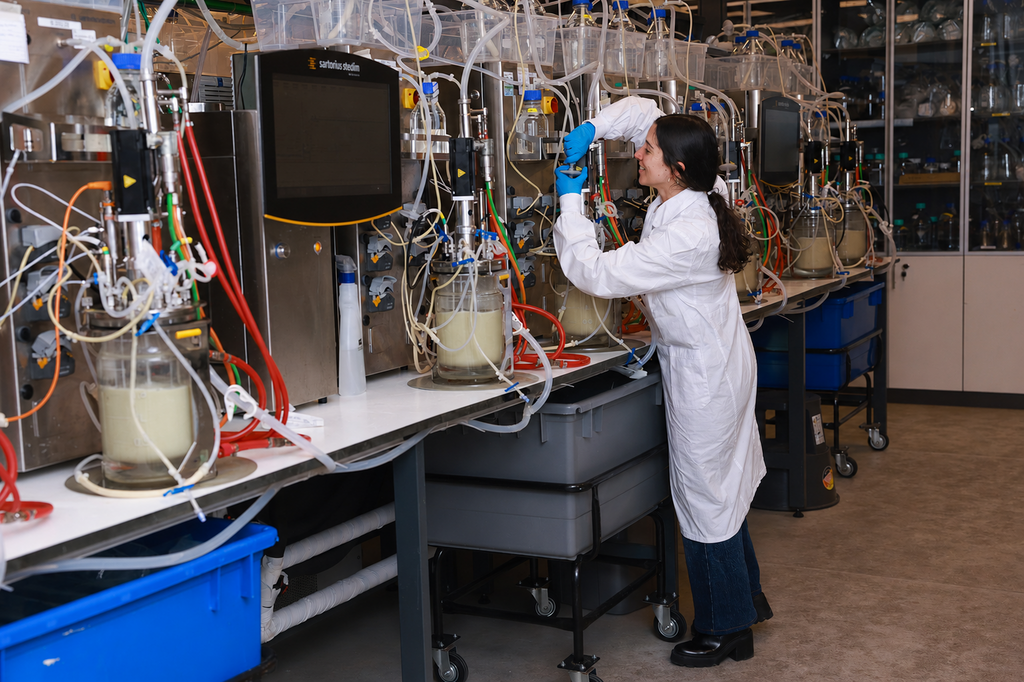
The technology itself is known as precision fermentation. Researchers take the genetic sequence containing the instructions for producing beta-lactoglobulin, a major whey protein, and introduce it into yeast. Inside fermentation tanks, where the yeast is supplied with sugar and nutrients, it produces the protein. The protein is then separated from the yeast, filtered and dried into a powder that can be used to formulate a variety of products.
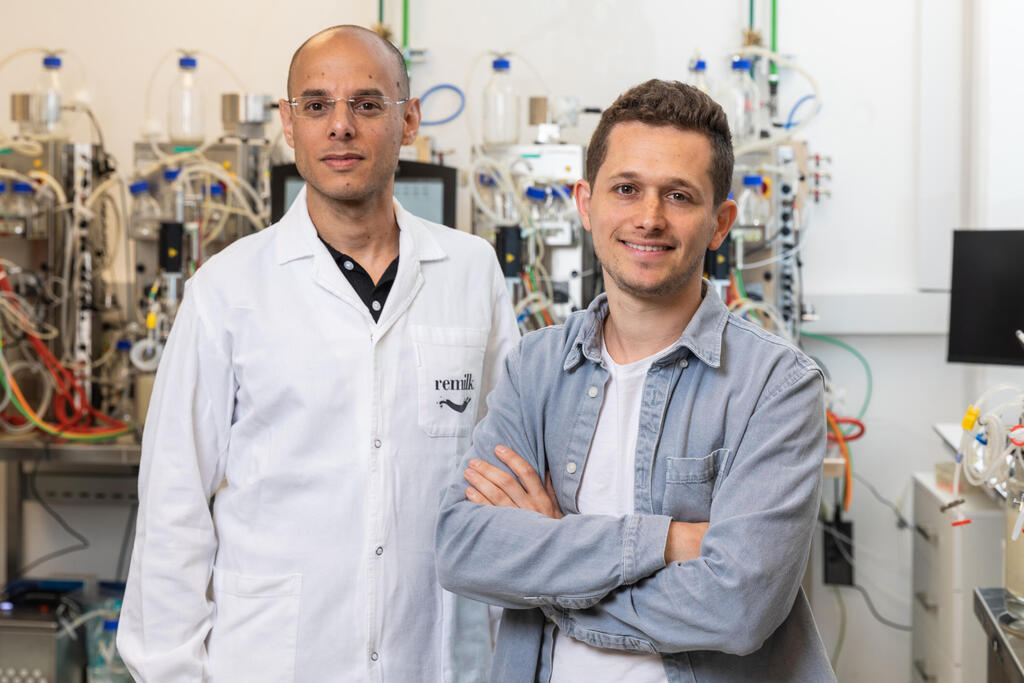
Remilk founders Dr. Ori Cohavi and Aviv Wolff
(Photo: Eyal Toueg)
The resulting protein is identical to the protein derived from cows, meaning it can provide properties that are difficult to achieve with plant-based alternatives, including frothing, texture and the functionality needed as a base for cheese products. There is, however, an important distinction: because this is real milk protein, the products are not suitable for people with milk allergies, even though they are lactose-free and have received pareve kosher certification.
The journey from laboratory to supermarket shelf has not been without obstacles. Remilk raised more than $150 million and planned to build what was expected to become the world’s largest precision-fermentation facility in Denmark, but that plan was put on hold and the company opted instead to use existing production capacity in Europe.
A planned partnership with Israeli dairy company Tara also ultimately did not move forward. Instead, Remilk established a joint venture with Gad Dairies, with the protein manufactured through a third-party producer in Spain and distribution in Israel relying on Gad’s infrastructure.
That strategy led to the launch of “The New Milk” in cafés, restaurants and hotels in late 2025, followed by its arrival in supermarket chains in early 2026. By June 2026, approximately 600,000 bottles had already been sold, generating around NIS 7 million in revenue, while the product accounted for roughly 72% of Israel’s cow-free milk category. In practical terms, those figures move Remilk beyond the stage of technological promise and provide evidence that consumers are willing to buy the product—and come back for more.
Remilk’s protein has already passed the required regulatory pathways in the United States, Israel, Singapore and Canada. The next step is to expand the category beyond the beverage itself, including yogurts, cheeses and other dairy products, while also working toward entering the U.S. market. As of August 2026, a full commercial launch in the United States has yet to be announced.
If the company can demonstrate that its model works in larger markets as well, the implications could extend far beyond a new bottle of milk. It could represent a fundamental shift in how one of the world’s most basic foods is produced—and perhaps, one day, even make it possible to send the cows into retirement.