

U.S. President Donald Trump may currently be ruling out a broad ground operation to retrieve Iran’s “nuclear dust” — meaning the highly enriched uranium that gives the ayatollah regime the ability to potentially break out toward a nuclear bomb in the future — but amid renewed escalation he threatened to bomb a nuclear site that has remained untouched during the two recent wars with the Islamic Republic: Pickaxe Mountain in the Zagros Mountains, very close to Iran’s Natanz nuclear facility.
Deep inside the mountain, Iran has been excavating for six years an underground facility that experts estimate could withstand even the most powerful bunker-busting bombs.
Trump's threat to attack the Pickaxe Mountain facility


Trump made the dramatic threat Monday night in an interview with conservative broadcaster Hugh Hewitt, who reminded him that while the U.S. had already attacked Iran’s three main nuclear sites last year in Operation Midnight Hammer — Natanz, Fordow and Isfahan — the Pickaxe Mountain facility had not been targeted, neither during Operation Rising Lion or Operation Roaring Lion.
“You destroyed three of their nuclear sites, but they have a fourth site, maybe at Pickaxe Mountain. Before you enter into another agreement, would you insist that nuclear inspectors enter this very, very deep tunnel and discover whether they have a doomsday machine down there?” Hewitt asked.
Gallery
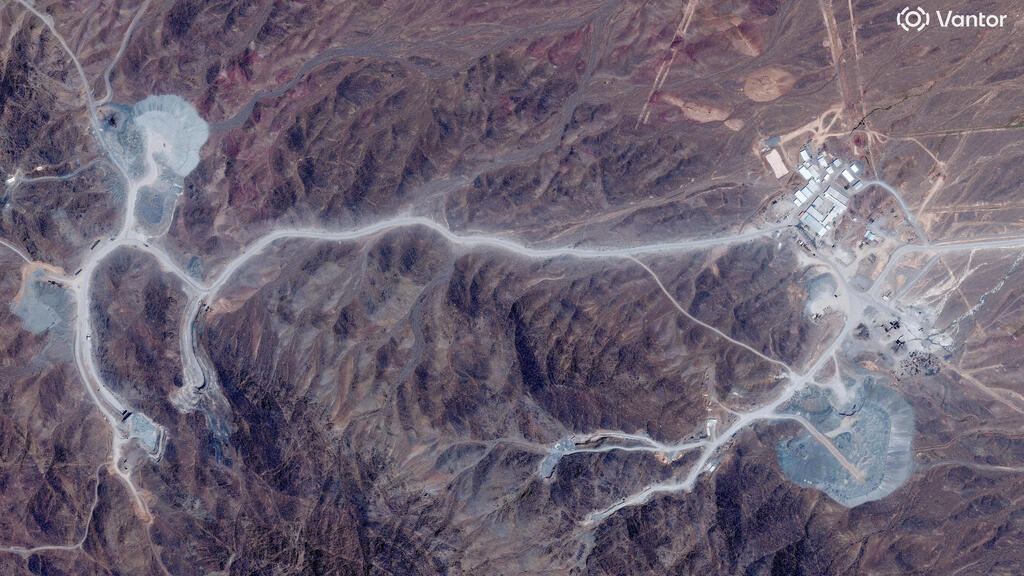
Pickaxe Mountain in a satellite image from late last month
(Photo: Vantor/Handout via Reuters)
Trump quickly said Iran does not have such a machine there, while emphasizing that the United States is “watching closely” activity around the facility through satellites and that there is no evidence of any activity there.
“Pickaxe is a possible target for a nice, big, fat shot right near the front door. Maybe you'll see that,” Trump said in the interview. He later sounded as though he believed an attack would indeed take place.
“We're going to take out Pickaxe Mountain. Tell the Iranians to be ready,” he said, adding that the attack would happen “probably relatively soon.”
In response, an Iranian security official threatened Tuesday that the ayatollah regime would respond harshly if the U.S. attacked the mountain.
“If Trump carries out his threats, we will respond destructively — and the price will be paid by American soldiers and his regional allies,” the unnamed Iranian official said.
The official, like Trump himself, claimed there is no nuclear activity at the site.
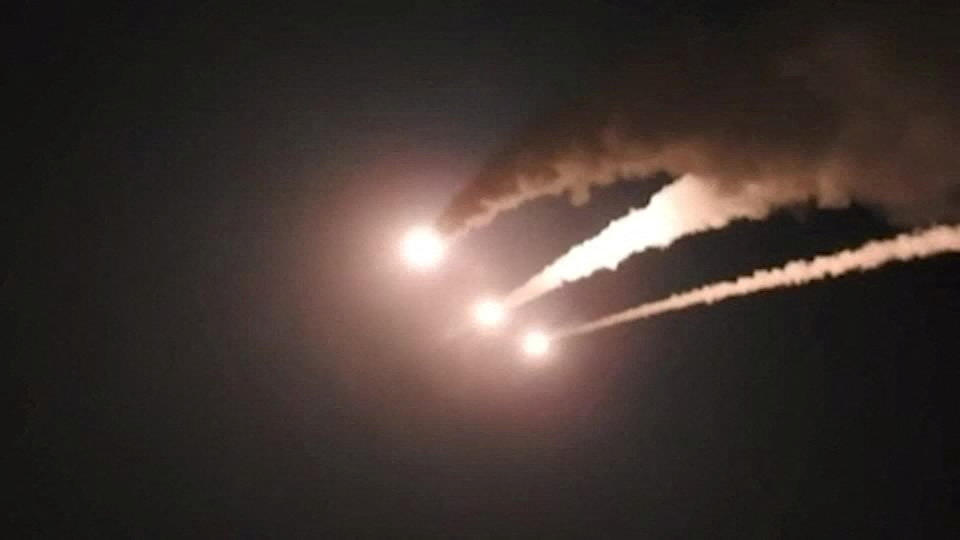
Missile launch from Iran last month: Tehran threatened a 'devastating response' if Pickaxe Mountain was attacked
(Photo: WANA (West Asia News Agency)/ via Reuters)
Even if there is currently no actual nuclear activity at the complex, satellite images revealed last month indicate that work at the site has continued. The Washington-based Institute for Science and International Security (ISIS) recently published a detailed analysis of satellite images from late June showing that activity at the mountain is ongoing.
According to the institute, “vehicle movement can be seen on roads leading to the western tunnel entrances, indicating that work inside the tunnel complex, as well as reinforcement of the entrances, is still continuing.”
ISIS noted that the memorandum of understanding signed between the U.S. and Iran requires Tehran to maintain the status quo regarding its nuclear program. Therefore, according to the institute, construction work at any nuclear-related facility, including Pickaxe Mountain, would constitute a violation of the agreement.
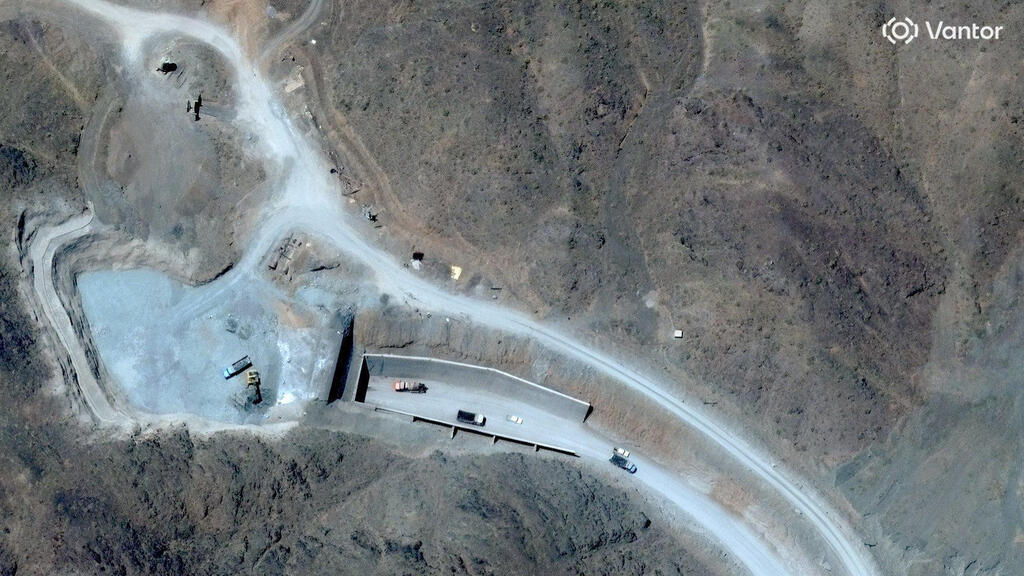
One of the entrances to Pickaxe Mountain facility, in a satellite image from last month
(Photo: Vantor/Handout via Reuters)
“Pickaxe Mountain,” also known as “Hammer Mountain” (in English Pickaxe Mountain and in Persian Kuh-e Kolang Gaz Lah), is located about 1.5 kilometers south of the Natanz nuclear complex. Excavation began there in 2020, at a time when Iran significantly expanded its nuclear program in defiance of Trump’s 2018 decision to withdraw from the nuclear deal signed during the Obama administration.
According to Reuters, the facility includes two extremely deep tunnel complexes that experts say may be beyond the reach of even the massive GBU-57 bunker-busting bombs, the most powerful such weapons in the world, which the U.S. used against underground facilities in Fordow and Natanz. Isfahan was attacked only with Tomahawk missiles, although it also contains deep underground facilities.
Although there is no official confirmation of these claims, experts warn that the Pickaxe Mountain facility may be located 80 meters to 100 meters underground — a depth that could pose a challenge for bunker-penetrating weapons.
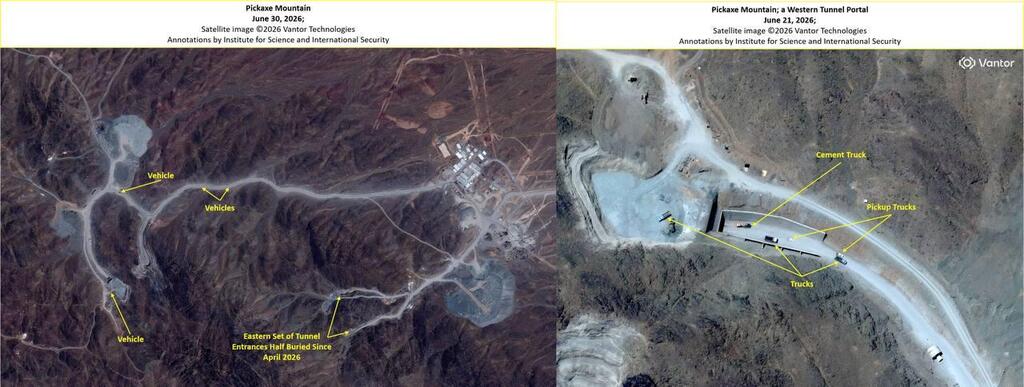
From the American ISIS Institute's report on the activity on Pickaxe Mountain
(Photo: From the social network X)
In describing the capabilities of the GBU-57 bomb, the U.S. Air Force has previously said it can penetrate up to 60 meters underground.
“Pickaxe Mountain is deeper, larger and more fortified than Fordow,” said Blaise Misztal, vice president for policy at the Jewish Institute for National Security of America (JINSA), a Washington-based research organization. “This may be the place where they plan to make the jump to uranium enrichment at military grade.”
Iran itself said when construction began that the facility was intended to be used for building uranium enrichment centrifuges, not for enrichment itself. However, it has never allowed inspectors from the International Atomic Energy Agency (IAEA) to conduct inspections there to determine what exactly is happening at the site.
As a result, many experts suspect that the facility is intended to serve as a protected location for the advanced stage of uranium enrichment required to develop nuclear weapons — 90%.
Iran has already accumulated a stockpile of about 440 kilograms of uranium enriched to a high level of 60%. The path from 60% to 90% is considered relatively easy and fast, and there is also significant uncertainty over the location of this material, which Trump has described as “nuclear dust.”
According to IAEA Director General Rafael Grossi, at least half of this material is buried at Isfahan. Reports also indicate that enriched material is stored at Fordow and Natanz. However, The New York Times reported in April that the possibility cannot be ruled out that enriched material has already been transferred to the Pickaxe Mountain facility.
A similar possibility was raised in an analysis published about a week ago by the U.S.-based ISIS institute.
“The smaller tunnel complex at the Pickaxe Mountain site remained sealed as of mid-May,” the report said. “The contents of the complex that led to its sealing are unknown. It may contain enriched uranium or centrifuges. Alternatively, Iran may simply be attempting to limit potential damage to a tunnel complex long associated with the Natanz enrichment site.”
The institute also addressed why the facility had not yet been attacked, writing that the second tunnel complex at the site did not yet appear operational and was not considered “of the highest importance” to Iran.
“This may help explain why both the United States and Israel have not attacked the site so far,” the report said.
However, Trump himself — despite his statement Monday that there is no activity at the site — referred to it in a speech he delivered around the war in April. He argued that the activity, which continued there even after nuclear facilities were attacked last June, proved that Iran had not abandoned its ambitions to develop a nuclear bomb.
Now he is threatening to bomb the site, but there are doubts over whether the U.S. can destroy it from the air using bunker-busting bombs. Several experts have previously said that destroying the facility would require a dangerous ground operation, possibly involving U.S. forces raiding the site and attaching explosives to its inner walls.
One expert argued that even that might not be enough. Mark Dubowitz, CEO of the Foundation for Defense of Democracies, who welcomed Trump’s threat to destroy the facility, said according to The New York Times that the mission might require the use of some type of chemical agent to make the site “inaccessible to humans for the next 100 years.”