

U.S. President Donald Trump overnight between Sunday and Monday intensified the pressure he is applying to assemble an international coalition to secure the Strait of Hormuz from Iranian missile and drone attacks — attacks that are blocking the world’s busiest oil transit route in an attempt to pressure the United States to end the war. Trump said he is demanding that “about seven” countries help secure the strait — though he did not name them — and warned that if the United States does not receive assistance, the future of the NATO alliance could be at risk.
Trump had already called over the weekend for countries around the world to help secure the strait, mentioning China, France, Japan, South Korea and Britain, which he said have been particularly affected by the closure of the passage through which about a fifth of the world’s oil supply flows.
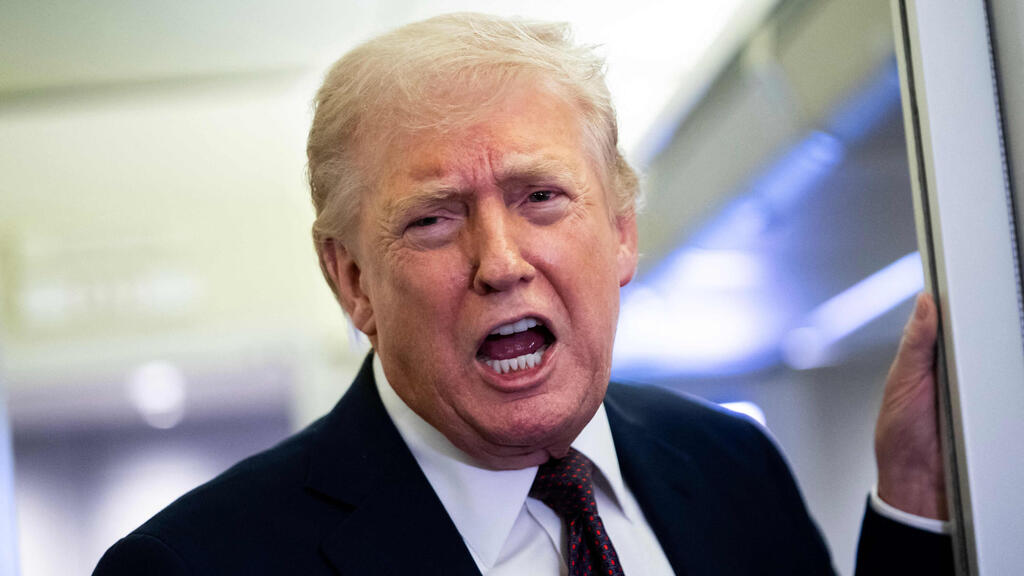
US President Donald Trump speaks to reporters on Air Force One
(Photo: Nathan Howard / Getty Images of North America / AFP)
“Many Countries, especially those who are affected by Iran’s attempted closure of the Hormuz Strait, will be sending War Ships, in conjunction with the United States of America, to keep the Strait open and safe. We have already destroyed 100% of Iran’s Military capability, but it’s easy for them to send a drone or two, drop a mine, or deliver a close range missile somewhere along, or in, this Waterway, no matter how badly defeated they are. Hopefully China, France, Japan, South Korea, the UK, and others, that are affected by this artificial constraint, will send Ships to the area so that the Hormuz Strait will no longer be a threat by a Nation that has been totally decapitated. In the meantime, the United States will be bombing the hell out of the shoreline, and continually shooting Iranian Boats and Ships out of the water. One way or the other, we will soon get the Hormuz Strait OPEN, SAFE, and FREE! ,” he wrote Saturday in a post on his social media platform, Truth Social.
Overnight, the Financial Times published an interview with Trump in which he warned that if America’s allies do not help reopen the strait, NATO’s future could be in jeopardy. “If there is no answer or if it is negative, I think it would be very bad for the future of NATO,” he said.
by TaboolaPromoted LinksYou might also be interested in
Reason to party: The new Seat Ibiza and Arona have landed in Israel
SEAT
Not just Esther and Mordechai: The famous Jewish tombs in Iran
Judaism
Yad Eliyahu in Tel Aviv: A new residential complex on a par with northern Tel Aviv
channel22 real estate
Trump's threat to Europe: "Without help in Hormuz - NATO's future will be very bad"
The president demands that 7 countries send warships to secure the Strait of Hormuz from Iranian attacks, and warned NATO allies of the consequences of a "negative answer." Regarding Israel, he said vaguely that "it is working with us" on the Hormuz issue - and praised Netanyahu and the IDF: "A very good army, it has our weapons and missiles."
Ynet and the agencies |
04:14
7 comments
Tags
Operation Harry's Roar
Europe
Strait of Hormuz
China
Donald Trump
Iran
NATO
oil
IDF
US President Donald Trump increased the pressure he is exerting tonight (Sunday-Monday) to form an international coalition to secure the Strait of Hormuz from Iranian missile and drone attacks – which is blocking the world's busiest oil shipping route in an attempt to pressure the US to end the war. Trump stated that he is demanding that "about seven" countries help secure the Strait – but did not name them – and also threatened that if the US does not receive help, the future of the NATO alliance will be in danger.
• This has become the War of Hormuz / Nadav Eyal
2
Viewing the gallery
US President Trump speaks to reporters on Air Force One
Trump speaks to reporters on Air Force One tonight( Photo: Nathan Howard/GETTY IMAGES NORTH AMERICA/AFP )
by TaboolaSponsored Links.
Registration is open: The Ministry of Foreign Affairs' cadet course is underway
Foreign Office
Even for the most stubborn pigmentation
La Roche-Posay
Ackerstein's advanced protection solutions for the home and public spaces
Ackerstein
Trump, we will recall, already called on countries around the world to help secure the strait over the weekend, mentioning China, France, Japan, South Korea and the UK, which he said were particularly affected by the closure of the strait, through which a fifth of the world's oil production passes. "The countries of the world that receive oil through the Strait of Hormuz must take care of this passage. We will help a lot. The US will coordinate with these countries so that everything works quickly, smoothly and well. This should be a group effort, and it will be," he wrote on Tuesday in a post on his social network Truth Social.
Last night, the president's interview with the financial newspaper "Financial Times" was published, in which he threatened that if the US's allies do not help it reopen the strait, the future of NATO would be in danger. "If there is no answer or it is negative, I think it would be very bad for the future of NATO," he said. This threat comes in the shadow of a series of statements issued by Trump since his return to the White House last year, which have aroused great concern in Europe, over the possibility that the US under the Republican president would neglect its historic commitment to defending the continent, within the framework of the North Atlantic Alliance. These tensions reached a peak when the president threatened to take over Greenland, an autonomous territory of Denmark, by force, an ambition that for now appears to have been abandoned.
Oil tankers attacked by Iran in Iraq, last week
(Video: Reuters)


The threat comes amid a series of statements Trump has made since returning to the White House last year that have raised concern in Europe about the possibility that the United States under the Republican president could abandon its historic commitment to defending the continent under the North Atlantic alliance. The tension reached a peak when Trump threatened to take control of Greenland by force — an autonomous territory of Denmark — a goal he now appears to have dropped.
Since the war began, Trump has also expressed considerable frustration with the conduct of Spain and Britain, both NATO members. Regarding Spain, which refused to allow the United States to use its bases for the war against Iran, Trump announced a severing of trade ties. As for British Prime Minister Keir Starmer — who initially also refused to allow the use of British bases but later reversed course — Trump sharply criticized him and promised that the United States would “remember” his conduct, arguing that Britain delayed sending a warship to the region and did so only after Iran had already been severely hit.
In the interview with the Financial Times, Trump again criticized Britain, saying: “Britain may be considered ally No. 1, and when I asked for them to come, they didn’t want to come.”
He did, however, have praise for another country overnight. Speaking with reporters aboard Air Force One on his way back from Florida to Washington, Trump was asked what Israel is doing to help secure the Strait of Hormuz and gave a somewhat vague response: “They’re doing it, they’re working with us.”
He then went on to praise Prime Minister Benjamin Netanyahu while denying a report that the two had argued. “We get along well. He will tell you that we are leading everything. You can say it or not say it, it doesn’t matter. But my relationship with Bibi Netanyahu — I would say it’s exceptional.”
Trump was also asked whether the United States and Israel have different objectives in the war. “I think we have similar objectives, but maybe they’re a little different,” he replied. “You know, they’re there and we’re very far away, but we probably have fairly similar objectives with Israel. The relationship has been very good, the militaries are very coordinated — ours is the strongest in the world, by far, and they have a very good military. They have a lot of our weapons, they have our planes, our missiles, our Patriot systems, a lot of our weapons. We have the best weapons in the world.”
Trump added that he has demanded that “about seven” countries send warships to the Strait of Hormuz. He did not specify which countries he approached, and so far none has committed to assisting the United States. Australia, in fact, explicitly announced overnight that it will not send a ship to the strait.
“I’m demanding that these countries come in and protect their own territory, because it is their own territory,” Trump told reporters aboard Air Force One, referring to his argument that the entire world benefits from maritime traffic through Hormuz and therefore the United States should not be the only country defending the route. “This is where they get their energy from. And they have to come and they have to help us protect it.”
The president also called on China to help defend the strait, claiming that it receives 90 percent of its oil through Hormuz. Trump is scheduled to visit Beijing next month — the first visit by a U.S. president to China since 2017 — but in the Financial Times interview he said he first wants to know Beijing’s position on the issue. “We may postpone,” he said about the trip.
Iranian Foreign Minister Abbas Araghchi, meanwhile, said in an interview with CBS Sunday that Tehran is currently allowing ships from several countries — which he did not name — to pass through the strait.
Trump also claimed that Iran wants to negotiate “desperately.” Araghchi himself said in the interview that there is currently no reason for negotiations with the United States. The American president, however, said he does not believe Tehran is ready for talks. Over the weekend he already declared that he does not think this is the right time for negotiations, and in the Financial Times interview he said the United States is striking Iran hard.
“They have nothing left except to cause some trouble in the strait,” he said, warning that the United States could strike oil infrastructure on Kharg Island, home to Iran’s main oil terminal through which it exports about 90% of its oil to the world. The United States already carried out strikes on the island over the weekend, but only against military infrastructure and avoided hitting oil facilities. “We can hit it in five minutes. And there’s nothing they can do.”