


Prime Minister Benjamin Netanyahu's office on Friday issued its first response to U.S. President Donald Trump's surprise announcement that the United States would end its annual military assistance to Israel beginning next year, portraying the move as a transition toward a more equal strategic partnership between the two countries.
"The transition by Prime Minister Netanyahu and President Trump from assistance to partnership demonstrates the strength and sophistication of our relationship, as well as its ability to adapt and remain resilient over time," Netanyahu's office said in a statement.
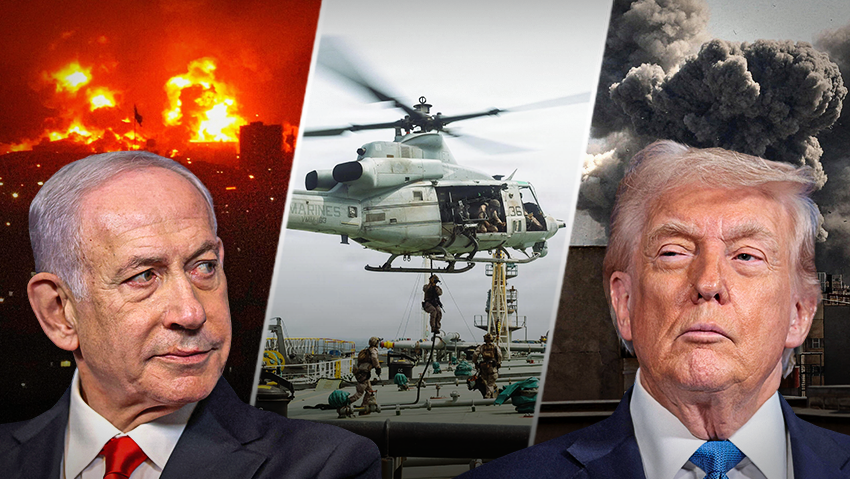
Prime Minister Benjamin Netanyahu, US President Donald Trump
(Photo: Ahmad Hasaballah/REUTERS, Majid Asgaripour/WANA via REUTERS, JOE RAEDLE/AFP, REUTERS/Jonathan Ernst, AP Photo/Vahid Salemi)
"U.S. assistance to Israel has always been a bipartisan agreement. Israel has used it both to defend itself and to confront enemies that threaten America and the West," the statement added. "Today, Israel has a strong and stable economy."
The response came after Trump disclosed in a Fox News interview on the morning of Tuesday's U.S. midterm elections that he and Netanyahu had agreed months earlier to terminate American military assistance to Israel, currently worth approximately $3.8 billion annually.
The announcement caught senior Israeli officials by surprise. Neither the Defense Ministry nor the Finance Ministry had been informed of the agreement Trump described, despite the potentially far-reaching consequences for Israel's defense budget and military procurement plans.
"I made a deal with Netanyahu that we're going to stop giving Israel $4 billion a year. We're not going to pay Israel anymore," Trump said.
The existing U.S.-Israel military assistance agreement, signed in 2016, was originally scheduled to remain in effect through 2028. It provides Israel with approximately $3.8 billion annually, primarily for purchasing American-made military equipment and supporting missile defense cooperation.
Trump's remarks indicated that the arrangement could end a year earlier than expected, potentially leaving Israel to cover billions of dollars in planned military expenditures from its own national budget.
Diplomatic officials sought to clarify the situation, saying Netanyahu's message was that Israel was "in the process of transitioning from an era of assistance to an era of partnership, and Trump's announcement is part of that process."
As for the discrepancy between Trump's proposed 2026 cutoff and the existing agreement's 2028 expiration, officials said the matter would be settled between Netanyahu and Trump.
"No final decision has been made. The issue is still under discussion, and no one is going to harm Israel," the officials said.
They added that the goal was to reach a new agreement before the current U.S. Congress ends its term on Jan. 3, 2027, establishing a framework for the next decade of bilateral relations. The agreement would define the amount of U.S. assistance Israel would receive and provide for its gradual reduction.
Under the proposed arrangement, funding would be directed toward joint projects, research and development, and military technologies benefiting both countries. "However, no agreement has been reached yet," the officials emphasized.
Trump says Netanyahu proposed ending the aid
Trump said Netanyahu himself had raised the possibility of terminating American assistance, suggesting that the Israeli leader recognized the political controversy surrounding U.S. financial support for Israel.
The president linked the decision directly to the U.S. midterm elections, specifically the Senate race in Michigan between Republican Mike Rogers and Democrat Abdul El-Sayed, a vocal critic of Israel.
"Why should we put up with El-Sayed's nonsense when they don't need it?" Trump said.
"Bibi Netanyahu came to me, and we've been talking about this for several years because it's a tremendous amount of money. And can I be honest with you? He brought it up. He brought it up," Trump said, referring to Netanyahu by his nickname.
"He said, 'I think it would be appropriate if we didn't receive aid,' because he understands that this is one of their points of contention," Trump added, referring to political divisions in the United States over support for Israel.
The announcement appeared intended to address criticism of American military assistance to Israel during the election campaign, although Republicans subsequently suffered heavy electoral setbacks.
Netanyahu had hinted at reductions, not a complete cutoff
Netanyahu had suggested in recent months that American military assistance to Israel could be reduced as the two countries reconsidered their long-term defense relationship.
He had also acknowledged publicly, for the first time, the possibility that Israel could lose American support.
However, the prime minister had not previously indicated that U.S. military assistance would be eliminated entirely, particularly as early as next year.
Israeli and American officials had been negotiating a successor to the current military assistance agreement, which was due to expire in 2028.
Among the possibilities under discussion was replacing the traditional financial aid framework with a broader strategic cooperation arrangement, similar to the partnership model Netanyahu's office described Friday.
Such an arrangement could potentially involve closer defense cooperation without the same level of direct American financial assistance.
The timing and scope of the agreement described by Trump, however, had not been publicly disclosed before his Fox News interview.
Israel faces billions in additional defense costs
An abrupt end to U.S. military assistance would have immediate implications for Israel's defense establishment, which relies on American funding to finance major weapons purchases.
Under the existing arrangement, much of the annual assistance is used to purchase U.S.-made aircraft, ammunition and other military equipment.
Without those funds, the Defense Ministry would need to identify alternative financing for procurement contracts worth billions of dollars.
That would require allocating a larger share of the national budget to military purchases that had previously been financed through American assistance.
The change could force defense officials to reassess procurement programs, establish new spending priorities and potentially spread the costs of major acquisitions over longer periods.
It could also create pressure on other areas of government spending as Israel seeks to maintain its military capabilities while absorbing the additional financial burden.
The implications extend beyond conventional military equipment.
Missile defense cooperation also at stake
A portion of American military assistance is allocated to joint development and production of missile defense systems, an area in which Israel and the United States have maintained particularly close cooperation.
The two countries have worked together on systems designed to intercept rockets, ballistic missiles and other aerial threats, including Israel's multilayered missile defense network.
An end to American funding could affect both the scale and pace of joint missile defense projects, depending on the terms of any replacement agreement negotiated between the countries.
Continued cooperation could be preserved under a new strategic partnership framework, but the financial arrangements supporting those programs would need to be clarified.
For Israel, the transition would come as its defense establishment faces substantial procurement and replenishment requirements following years of regional conflict.