

Without any previous international model in the world, with a bitter lesson drawn from UNIFIL in southern Lebanon and between cautious optimism and slight pessimism, six steering and think‑tank teams meet every morning on the third and top floor of the U.S. Civil-Military Coordination Center (CMCC). There are representatives from 21 countries, and they attempt to determine the future face of the Gaza Strip. Most are motivated, but they await a decision that will come far from the industrial zone of Kiryat Gat. It is clear to everyone: if the plan runs aground or is delayed, Hamas will be the big winner.
“Within weeks to a few months” is the timeframe estimated by the IDF until the U.S. decides to establish the multinational force, without which Phase II of the cease‑fire agreement with Hamas will not proceed. While legal officials from the UN discuss with their peers from the U.S. Army Central Command (CENTCOM) about the force’s authority, six working groups in Kiryat Gat debate preparing the field so it can be rapidly deployed. They plan which weapons it will have, exactly where it will operate and under what mandate, how to prevent cross‑fire with the IDF and which special communication gear will serve the foreign soldiers arriving in the enclave.
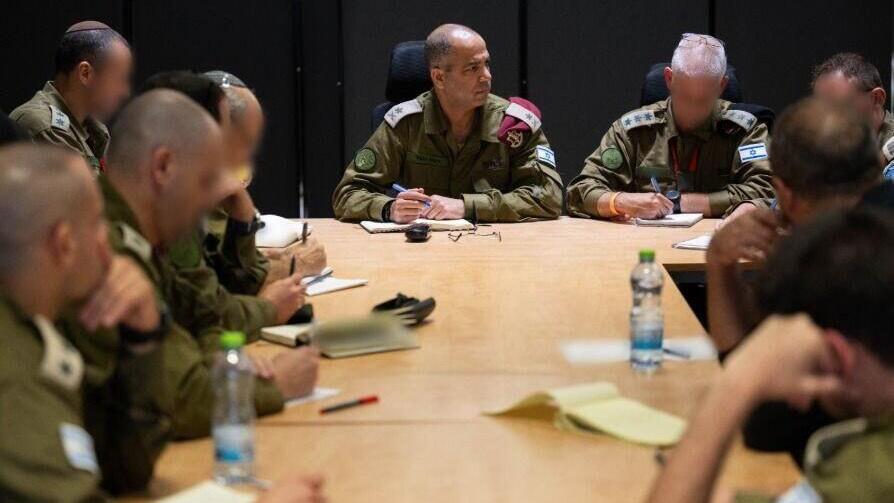
Even the name of the force is being discussed in the headquarters, and so are the uniform colors of the soldiers who will replace the IDF fighters — even in tasks as volatile as locating the many terror tunnels remaining in the Gaza Strip, destroying them and collecting more than 20,000 Hamas terrorists' weapons, by consent or by force.
Ynet and Yedioth Ahronoth have learned that, contrary to various reports, the multinational force — if it is indeed established and countries (especially Muslim‑majority ones) agree to send troops — will be based within Gaza territory, and not on Israeli soil. The defense establishment insists on this, yet the decisions of the countries with which negotiations are ongoing will carry weight, should they worry too much for their troops.
Last week, the Americans chose to reveal to the media how the command center looks, hoping that the publication of its activity, even though mostly theoretical, would gain positive momentum and the words would turn into facts and actions. Meanwhile, dozens of staff in the compound — coming from countries such as Egypt, the UAE, the UK and New Zealand — enjoy the momentum of the historic Resolution 2803, which was adopted last week by the UN Security Council to move toward new governance in Gaza, without Hamas.
Coordination that proves itself
Representatives of the Palestinian Authority are not present in the headquarters, nor are the Turks or Qataris — but their spirit is felt in every discussion: the large money and the central support, and mostly the influence over Gaza’s reconstruction, are supposed to come from the two capitals that brought the war to an end, Ankara and Doha. The IDF keeps warning of Turkey’s and Qatar’s involvement, given that they belong to the Muslim Brotherhood movement to which Hamas is affiliated.
Small coordination mechanisms are already proving their worth. There are no formal liaison officers, but when Hamas terror operatives, including armed men, exit every few days to search — even on the IDF side of the Yellow Line — for hostages, the IDF does not strike them thanks to the tactical coordination between the parties.
“Everything is beginning to become easier,” an IDF official said. “Up until two years ago, for example, we had to prove to the world and to the U.S. that Hamas controls humanitarian aid, in several complex incidents. Today the Americans are physically in the humanitarian command center that moved here from the Al‑Taymūm field base, and they see it happening every day.”
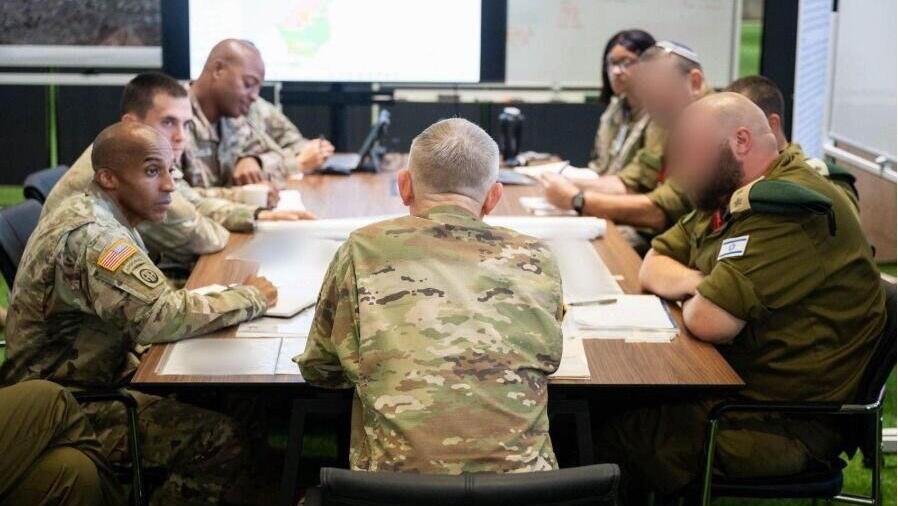
Troops inside the U.S. Civil-Military Coordination Center (CMCC)
(Photo: IDF Spokesperson's Unit)
This difference proves, precisely, what hasn’t changed: the terror organization receives thousands of tons of food, fuel, gas and medicines every day from the 600 trucks Israel allows into Gaza, to once more control the Strip and live week to week.
One of the most interesting teams is the Intelligence Group. In order to prepare the multinational force for operational activity, Israeli military intelligence officers at the headquarters present foreign officers daily with reports and briefings to teach them how Hamas functions as a military organization: what its tunnels look like from the inside, how long it takes to build or repair a shaft after bombing, what the structure of a Hamas platoon or company is, its weapons types and raid formations - mainly in guerrilla tactics combined with anti-tank and sniper fire, which its terrorists have been using, especially in the past year, against IDF forces
The goal is simple: that the force, which will land here after training at dedicated bases in Jordan and Egypt, probably alongside Palestinian police trained in parallel for similar missions, will not be surprised in its first encounter with terrorists.
“There is no equivalent multinational force in the world. We searched for something to learn from, with emphasis on how not to act,” an IDF spokesperson explained.
“For instance, the UNIFIL peace force in Sudan is armed but tended to withdraw and not confront every time fire was opened at it. In many respects, the multinational force in Gaza will be the first of its kind in the world.”
The mission to physically establish the force was given to the unit responsible for special operations in CENTCOM, so it can be assumed that the soldiers will not resemble the relaxed Filipino or Italian monitors of UNDOF in the Golan or UNIFIL in southern Lebanon. Indeed, the term “UNIFIL” is repeatedly mentioned in the steering discussions—and in a negative sense: from the IDF’s perspective, the international force enforcing calm in southern Lebanon since the late 1970s is the exact opposite of what they want to see in Gaza. The failure of UNIFIL, especially in the past two years, is studied here as a negative lesson for Gaza: Hezbollah succeeded in terrifying the blue‑helmets in southern Lebanon, and they were afraid to enter private terrain to see the terror‑army’s buildup opposite the Galilee. From the IDF’s perspective, such fear will not be allowed in Khan Younis or Deir al‑Balah.
Trust between the sides is being built little by little from the command center: when an IDF force from the Nahal Brigade enters Bait Hanoun or part of Jabaliya to destroy a newly‑discovered tunnel on the Israeli side of the Yellow Line, the update is first passed to the American officers, who verify that the operation is carried out according to the rules of the ceasefire.
The same applies to the Golani Brigade’s activity on the Israeli side of Rafah, in the underground enclave where dozens of terrorists are still entrenched, some having surrendered or been killed attempting escape on Friday. Live‑streamed footage of such events is passed through drone and quad‑copter cameras to the foreign parties in Kiryat Gat, first and foremost, to build trust.
Prototype for new neighborhoods
The most active group is the one dealing with the humanitarian topic. The Americans recently declared they now assume responsibility for aid to Gaza — but in practice, the party controlling it, even within the same steering group, is Israel. The IDF inspects the aid trucks at the crossings, and the Israeli defense apparatus decides on key dilemmas like the continuing ban on dual‑use materials such as concrete and steel, intended for the reconstruction of thousands of destroyed homes but which can also serve to build tunnels.
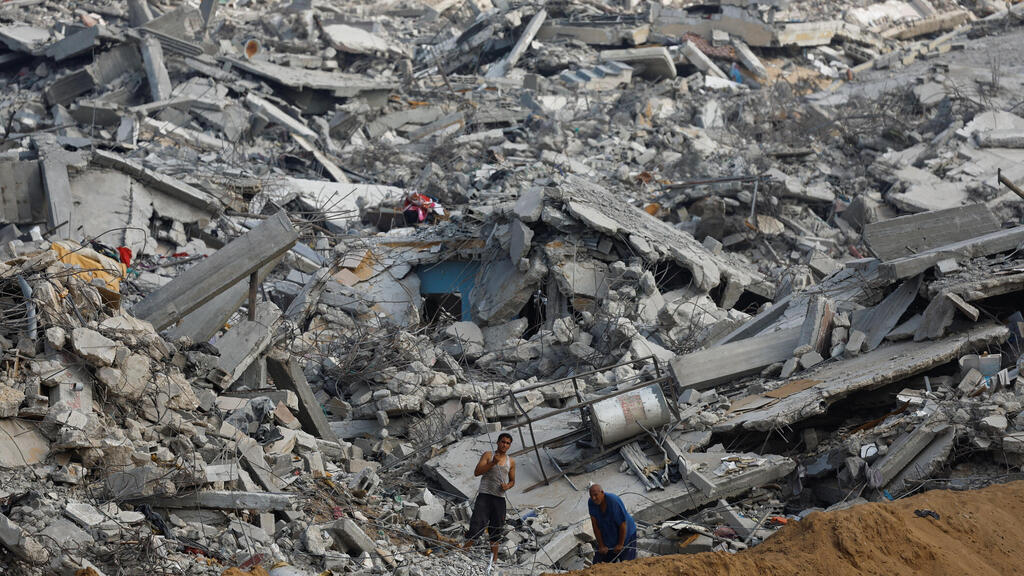
Rubble in Jabaliya
(Photo: Mahmoud Issa/Reuters)
This example illustrates well how the entire move is being marketed to the public to make it easier to swallow, especially within Israel: Israel is the one bringing the aid into Gaza and thus to Hamas, but the Americans present themselves as responsible, as though if the U.S. and Trump now take over Gaza, everything will supposedly be their responsibility or fault — Hamas will certainly be eradicated and calm secured for Negev residents.
Another team is already rolling out ideas and plans for new Palestinian neighborhoods in the Strip. For most Gaza inhabitants, about two million people, there is no home to return to. Most buildings were completely destroyed by the IDF in the war or badly damaged, such that living there again is impossible.
This team is creating prototypes for new Palestinian neighborhoods, dealing with questions like how to connect them to electricity. Will the neighbourhoods built in Beit Hanoun be electrically linked to a nearby Israeli power line, near Sderot? Or will they be connected to the southern Gaza power line arriving from Egypt?
The foreign participants in this team also discuss new water lines and fuel infrastructure to be deployed across the Gaza Strip, but primarily they are immersed in a task probably unrivalled since World War II, albeit on a Middle‑Eastern scale: removing vast amounts of construction waste created by two years of fighting.
There is still no estimate of how much construction waste is involved, but in any case it is thousands to tens of thousands of tons, after entire neighborhoods and buildings were wiped out — especially in eastern Khan Younis, Rafah, Shuja’iya and Beit Hanoun — down to rubble and dust.
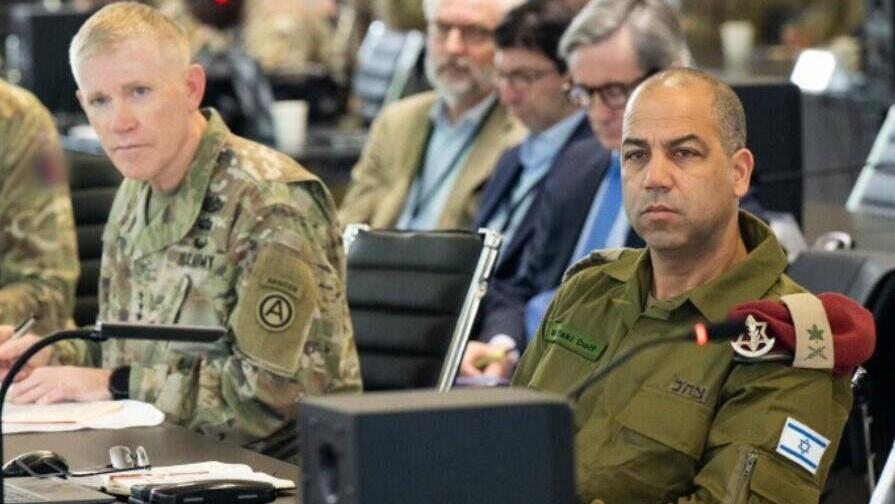
Some 150 IDF soldiers already serve in the international mechanism under the US command center
(Photo: IDF Spokesperson's Unit)
And there is the group focused on the long‑term: what the education system in the Strip will look like and what will be taught in schools and kindergartens. In this group, they go as far as training imams in mosques, hoping that in the future there will be no incitement from the mosque PA systems. This group takes into account a demographic fact that will be hard to ignore: the Gaza Strip will grow in the coming years by about 50,000 new Palestinians every year.
Some 150 IDF soldiers already serve in the international mechanism under the U.S. command center, aiming to safeguard Israel’s security interests in all these discussions. There are already operations officers, a brigadier‑general and a brigadier (i.e., one‑star and two‑star generals) appointed by the IDF for the initiative, and some of them express a positive impression.
The Italians, for example, and the British, show great interest in how Hamas’ tunnels will be destroyed — if and when — by the multinational force, after the British accumulated extensive military experience in various missions around the world, particularly under NATO, in complex engineering explosives. The Australians are also involved, while the Hungarians and Danes focus more on humanitarian aid routes.
The prevailing view in the defense establishment regarding Gaza’s future is that it will clearly include local Palestinian governance under oversight, involvement and temporary aid from the world, which may need to become permanent.