

In the American‑led Civil-Military Coordination Center (CMCC) in Kiryat Gat, established to oversee implementation of U.S. President Donald Trump’s 20‑point plan for the Gaza Strip, there are representatives from many armies and many countries around the world: from Canada, through Germany and the United Arab Emirates to Singapore.
However, a report by the New York Times, published on Tuesday, highlighted the criticism of diplomats and aid organizations regarding the lack of formal Palestinian representation at the center; an absence they say will render the president's efforts unlikely to succeed.
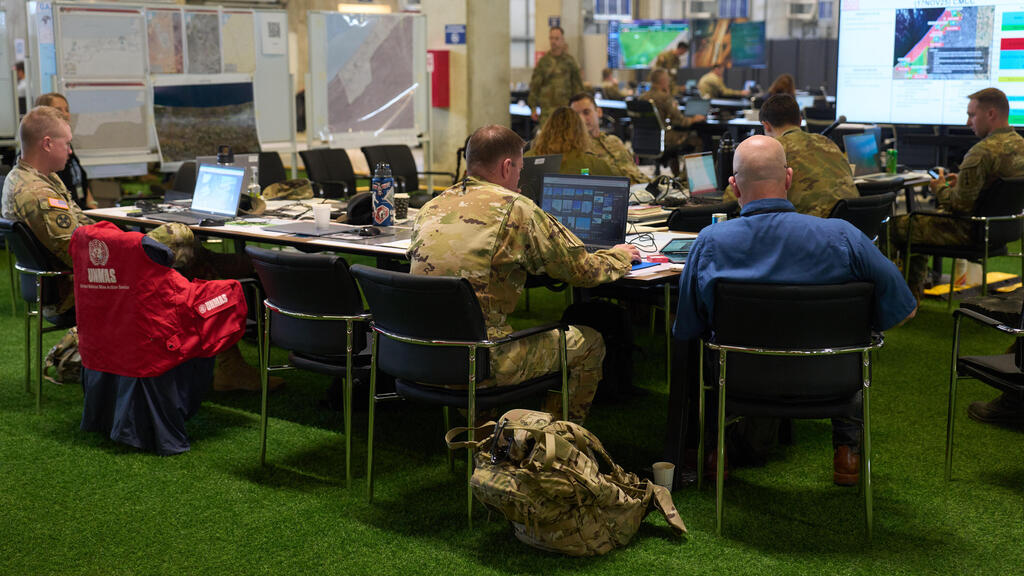
The report points out that the officers and staff members manning the center and working together come from very different backgrounds. Some have experience and familiarity with the Middle East; others do not, so much so that there were those who, when they first arrived at the center, were given a basic briefing manual titled: “What is Hamas?”
The New York Times detailed, based on interviews with 20 diplomats, other officials and aid workers operating in the center, the routine of work at the center in Kiryat Gat. According to them, many "whiteboard sessions" take place in which issues are raised and written on whiteboards, and "sometimes with light names for heavy topics."
For example, one of the working groups, dealing with civil governance in the territory, came up with the idea of naming each day of the week after the topic they would deal with. For example: “Wellness Wednesday” for health and education issues, and “Thirsty Thursdays” for water‑infrastructure issues.
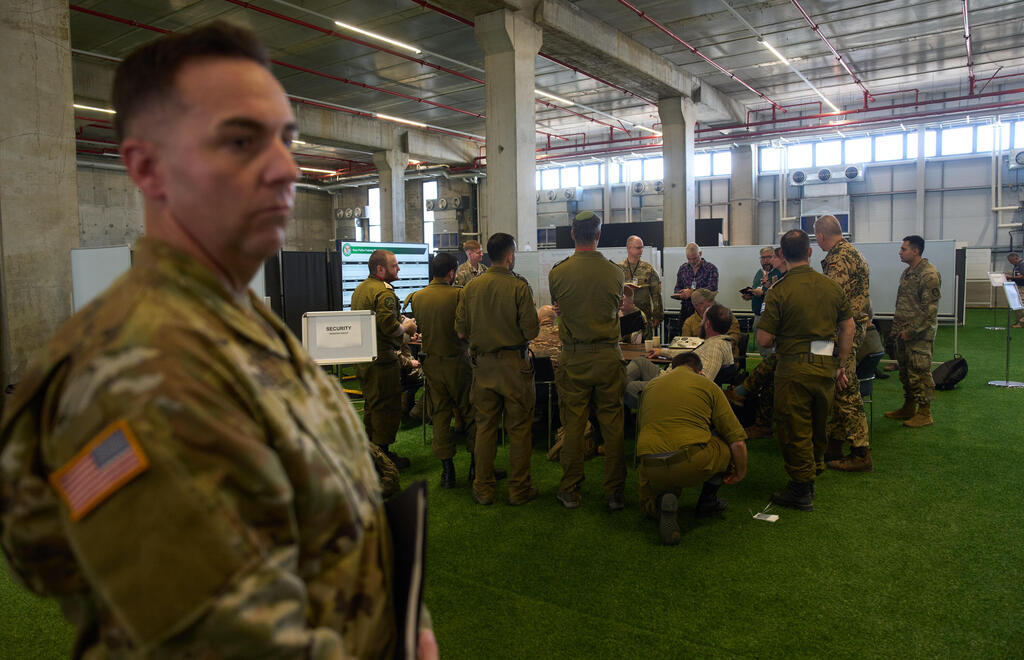
(Photo: Ariel Schalit/AP)
In that context, a Gaza‑based company called Abdul Salam Yassin Company, which operates water‑desalination plants and serves about half of Gaza’s population, announced Tuesday that it is ceasing its activity in protest over the detention of its employees by Hamas. "I know it is catastrophic but protecting our employees is a sacred issue," said Youssef Yassin, a board member of the company.
Some of the individuals who spoke to the Times said that the conduct at the center, where American officers and soldiers appear to be proposing ideas on how to rebuild the war-ravaged enclave, "evoke uncomfortable memories of other U.S.-led attempts at reconstruction, in Iraq and Afghanistan."
The command center in Kiryat Gat is structured so that Israeli officials operate on the first floor; international organizations and representatives of other countries work on the middle floor, and the U.S. military officers are situated on the third and top floor.
Brainstorming session at CMCC
(Photo: Ariel Schalit/AP)
The center’s activity is overseen by Aryeh Lightstone, an adviser to the Trump administration who currently resides in Tel Aviv and who is working on building a "big-picture strategy for the future of Gaza,” according to several diplomats and officials who spoke to the American newspaper.
Steven Fagin, former U.S. ambassador to Yemen, was appointed supervisor of the center for the U.S. State Department, alongside Gen. Yaakov Dolf from the IDF. The commander of the center is U.S. General Patrick Frank, commander of the U.S. Army in the Middle East, with a British general serving as his deputy.
Journalists who toured the center Monday described their impressions of the place, including seeing American soldiers briefing Israeli officers about the establishment of the Palestinian police force meant to operate in Gaza, in accordance with President Trump’s plan adopted Monday by the United Nations Security Council. Earlier this month, the Washington Post reported that the U.S. is taking the lead in overseeing the entry of humanitarian aid into Gaza, which appears to be part of a trend in which the Americans are seizing more of the reins.
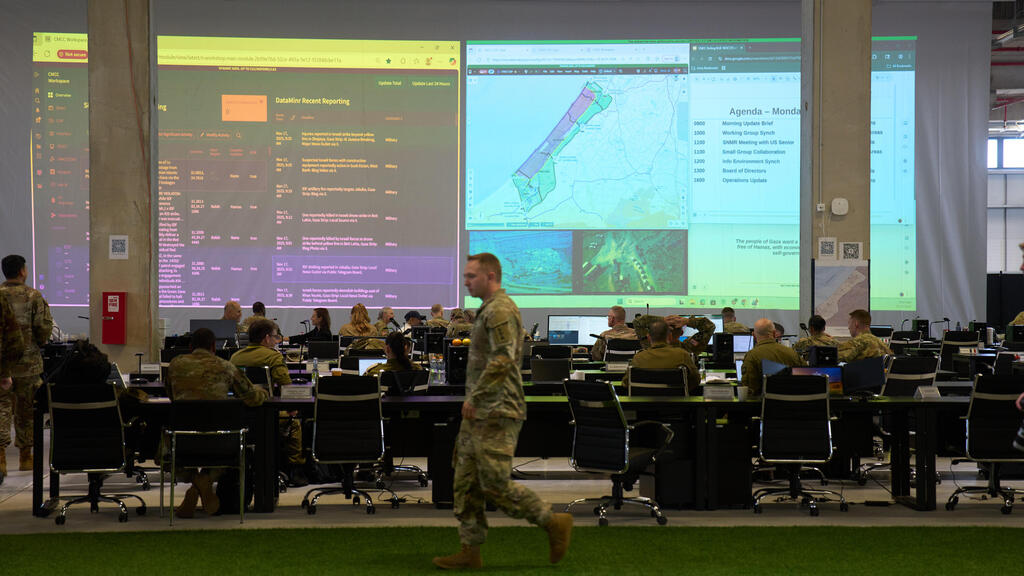
A Western diplomat who visited the Kiryat Gat center likened its open‑plan workspace to a “low-budget Google campus." Almost every morning, a senior officer leads a joint briefing for all participants, which, according to some of the sources, adds to a “start‑up feel."

US troops in the CMCC
(Photo: Ariel Schalit/AP)
The center was a destination for visits by senior officials of the Trump administration as part of what was called the “Bibi‑sitter” effort, or the U.S. administration’s effort to ensure that Prime Minister Benjamin Netanyahu and Israel fulfill their part of the agreement Trump brokered, and do not violate the fragile ceasefire in Gaza. Among the visitors were Vice President J.D. Vance, Secretary of State Marco Rubio, Special Envoy Steve Witkoff and the president’s son‑in‑law and advisor Jared Kushner.
On Monday night, the UN Security Council adopted the U.S. decision to endorse Trump’s plan for ending the war in Gaza, which promises a “path to a Palestinian state." Thirteen countries voted in favor, no country voted against, and two countries — Russia and China — abstained. The proposal was adopted as Resolution 2803 of the Security Council.
The United States, France, the United Kingdom, Algeria, Denmark, Greece, Guyana, Pakistan, Panama, South Korea, Sierra Leone, Slovenia and Somalia voted in favor of the resolution. Israel's ambassador to the UN, Dani Dannon, stated after the vote: “The disarmament of Hamas is a fundamental condition. There will be no future in Gaza as long as Hamas holds arms.”
President Trump welcomed the decision, and wrote on his social‑media platform Truth Social:
Congratulations to the World on the incredible Vote of the United Nations Security Council, just moments ago, acknowledging and endorsing the BOARD OF PEACE, which will be chaired by me, and include the most powerful and respected Leaders throughout the World. This will go down as one of the biggest approvals in the History of the United Nations, will lead to further Peace all over the World, and is a moment of true Historic proportion! Thank you to the United Nations, and all of the Countries on the U.N. Security Council, China, Russia, France, The United Kingdom, Algeria, Denmark, Greece, Guyana, South Korea, Pakistan, Panama, Sierra Leone, Slovenia, and Somalia. Also thank you to those Countries that weren’t on this Committee, but strongly backed the effort, including Qatar, Egypt, United Arab Emirates, The Kingdom of Saudi Arabia, Indonesia, Turkiye, and Jordan. The members of the Board, and many more exciting announcements, will be made in the coming weeks."
“Congratulations to the world on the amazing vote that recognizes and supports the Board of Peace, which will be led by me, and will include the strongest and most respected leaders worldwide. This will go down as one of the greatest approvals in UN history and will lead to further peace across the world. This is a true historic moment. My Council members, and many additional exciting declarations, will be announced in the coming weeks.”