


The United Nations Security Council approved Resolution 2803 overnight Tuesday, which mandates the establishment of an international "Board of Peace" to oversee the reconstruction and redesign of the Gaza Strip, and guarantees a “credible pathway" to a Palestinian state.
After U.S. President Donald Trump welcomed the decision, and so did Prime Minister Benjamin Netanyahu in a post on X in English only, the Palestinian Authority (PA) called for its immediate implementation, emphasizing its importance in “rebuilding life in Gaza, protecting the residents, preventing forced population displacement and returning the Strip to the framework of a united state."
UN Security Council adopts US-backed resolution on Trump's Gaza plan
(Video: Reuters)


The PA’s official spokesperson stressed its “full readiness to cooperate with the international community – the United States, the UN, Arab states and the European Union – to ensure the end of the suffering of the Palestinians in Gaza, in the West Bank and in East Jerusalem, and to strengthen the political track for a two‑state solution based on international law."
Terror organizations in Gaza, on the other hand, rejected the resolution outright – claiming that it imposes an “international trusteeship” over the enclave and severs it from the rest of the Palestinian territories. Hamas said it views the decision as “an attempt to impose a new order serving foreign interests, and harming the rights of the Palestinian people to resist the occupation and to manage the fate of Gaza themselves."
Palestinian Islamic Jihad (PIJ) said that the resolution “eliminates the prospect of resistance and turns humanitarian aid into a political lever, while infringing on basic rights enshrined in international law.” Senior Hamas figures such as Osama Hamdan warned that the decision sets a precedent in which “power overrides international law” and, by virtue of this resolution, “an international body is granted direct control in Gaza, instead of protecting its residents."
Gallery
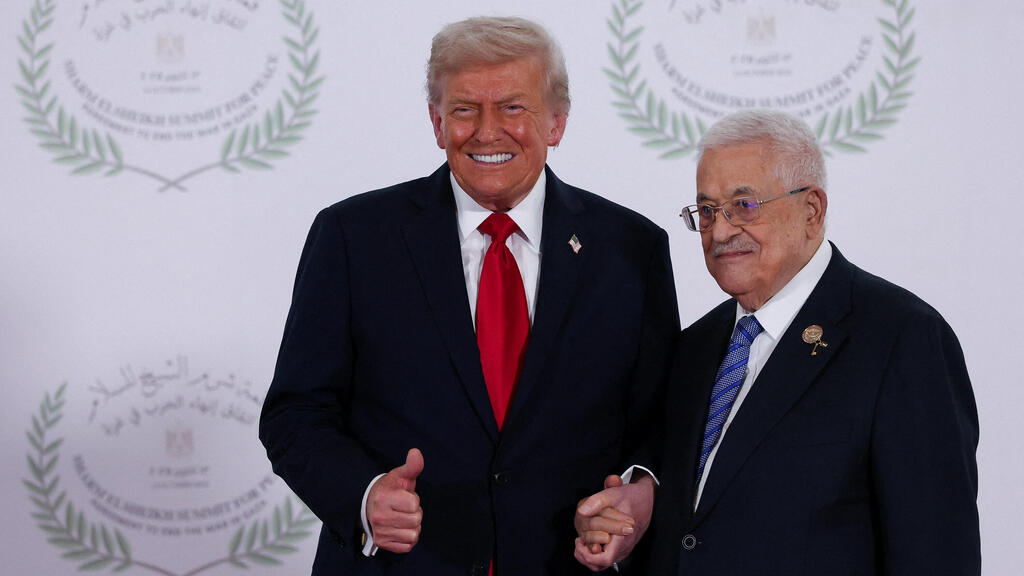
US President Donald Trump with Palestinian Authority Chairman Mahmoud Abbas
(Photo: Suzanne Plunkett/Pool/Reuters)
The resolution defines the Board of Peace as a temporary international body with management and financial guidance powers until the PA completes a series of reforms and establishes its governance in Gaza safely and efficiently. It also includes a call to restore Palestinians’ rights, promote a ceasefire and implement unfettered humanitarian aid programs, with the possibility of advancing a "credible pathway" toward a political future and the democratization of governance in the territory.
The gap between the PA’s and the terrorist organizations’ responses underlines the internal Palestinian schism: while the PA views the decision as an opportunity to further reconstruction and rebuild, to strengthen its international standing and to reconnect Gaza to a single, unified state, Hamas and PIJ see it as a threat to Palestinians’ basic rights and to the “mechanisms of resistance,” emphasizing their opposition to the imposition of an international framework over Gaza.
The decision was adopted by a majority of 13 member states: the United States, France, the United Kingdom, Algeria, Denmark, Greece, Guyana, Pakistan, Panama, South Korea, Sierra Leone, Slovenia and Somalia. Only China and Russia abstained.
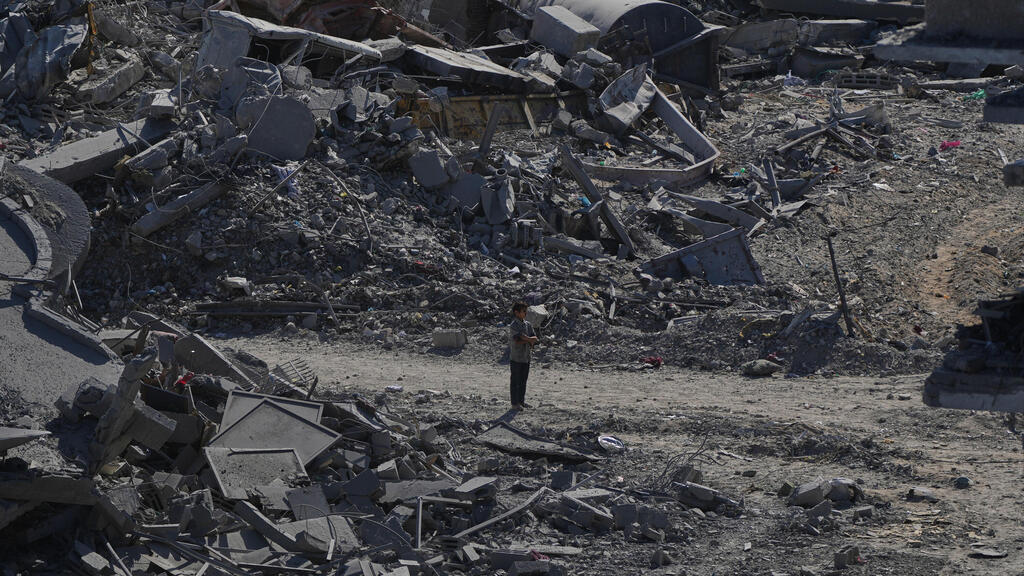
Displaced Palestinians walk among the ruins in Gaza
(Photo: Abdel Kareem Hana/AP)
Muslim support for the resolution sparked frustration and a sense of betrayal among Palestinians. Nabil Badawi, an activist from Gaza, described the decision as a result of “helplessness and Arab betrayal,” and said that it “leaves Gaza to cope alone with the mechanisms of occupation that try to break its will, but fail to do so.”
Political analyst Yassin Zain al‑Din added, “Unfortunately, Algeria betrayed us and voted in favor of the American decision. The Algerian government is taking an attitude of inaction, as other governments in the region, and all the talk about support for Palestine is just empty slogans.”
'Resounding failure'
Meanwhile, the Security Council decision drew sharp criticism across the Israeli political spectrum. In an interview with the ynet studio, Likud MK Amit Levi called it “horrific, not just for Israel but for the West at large." According to him, “the radical Islam model exploded in the face of Washington, London and Paris. It’s like a cancerous growth sending metastases. That’s what stands before us. It’s a pity that the West, even after October 7, failed to understand who the enemy is."
“What’s happening today in Gaza is radical Islamic rule; it’s a Palestinian state. Gaza’s plan to destroy Israel is still intact,” he added.
Yesh Atid MK Merav Ben Ari, in turn, attacked the government and said in an interview that “this is all the result of failed policy that brought us to this point. The failure of the F‑35 sale to Saudi Arabia, the significant American footprint in Gaza, a kind of takeover of us in Gaza, and it’s all normalized here. If there had been responsible handling, we wouldn’t be getting to this. The Americans will rule Gaza the day after and it’s a resounding failure of the government.”