

After residents in northern Israel were informed Thursday night that a powerful explosion would be heard overnight in the Ramim ridge area and the northern Golan Heights, the IDF said that several tunnels in the Beaufort area had been destroyed.
Prime Minister Benjamin Netanyahu and Defense Minister Israel Katz said in a joint statement that “powerful operation was carried out at this time following yesterday's blatant violation of the ceasefire agreement by the Hezbollah terror organization,” after the group launched a FPV drone toward IDF forces in southern Lebanon.
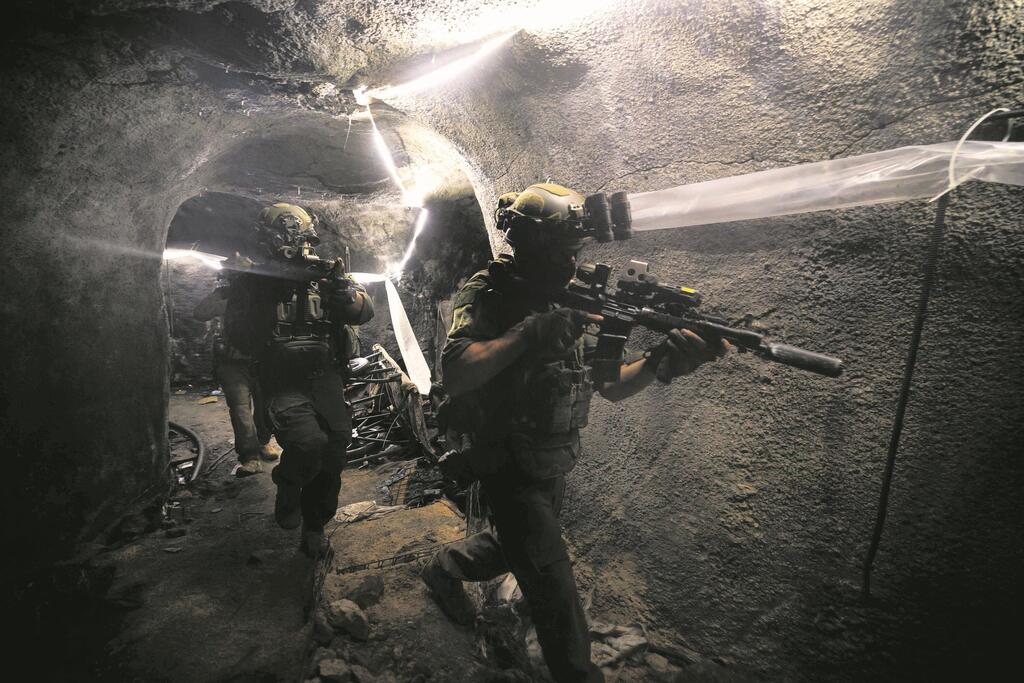
IDF said that several tunnels in the Beaufort area had been destroyed
(Photo: Ziv Koren)
“As part of a limited activity within the area of the Security Zone, IDF soldiers dismantled several key underground tunnels beneath the Beaufort ridge,” the IDF said. “The tunnel network served as a central command center from which Hezbollah terrorists and commanders managed combat and directed fire toward IDF soldiers and Israeli civilians.”
According to the IDF, “strategic Hezbollah stronghold, consisting of several underground levels that were built over the course of two decades. The network also served as a central terror command center for Hezbollah's Bader Unit in southern Lebanon.”
The infrastructure was located about 6 kilometers from Metula and the Galilee Panhandle and was used to launch dozens of unmanned aerial vehicles, FPV drones and anti-tank missiles.
“Tonight, the IDF destroyed a significant portion of the tunnel network in the area,” the military said. “Over recent weeks, IDF forces completed their hold on the Beaufort ridge area while controlling and clearing the underground infrastructure and preparing it for destruction.”
IDF forces are also continuing operations in the Ali Taher ridge area, where an explosive drone struck an engineering vehicle.
In recent weeks, IDF forces prepared the tunnel network for destruction and, after operational conditions were met, decided to destroy the central infrastructure beneath the Beaufort ridge. The operation was approved by IDF Chief of Staff Lt. Gen. Eyal Zamir, and preparations were made for various possible operational developments.
The tunnels were not being used as hiding places for Hezbollah operatives. Several additional underground routes remain in the area and are being monitored by the IDF. On July 13, IDF forces destroyed one tunnel from the network and after Thursday night’s operation, most of the tunnel network in the Beaufort area was destroyed.
Earlier, residents of the Hula Valley and northern Golan Heights were informed: “Due to the intensity of the explosions, residents of Metula and Misgav Am are requested to open windows to prevent them from shattering.”
Netanyahu and Katz said that, following their instructions, the IDF destroyed the tunnels, which were “a central part of the Hezbollah terror organization's invasion plan for the communities of the Galilee.”
Their statement added that “the tunnels were blown up using approximately 700 tons of explosives, as part of the IDF's systematic operation to destroy all of Hezbollah's terror infrastructure in southern Lebanon.”
The two said that “the State of Israel will not accept any violation of the cease-fire agreement. Any attempt by Hezbollah to harm IDF forces or Israeli civilians will be met with a harsh and powerful response that will exact a heavy price from the terror organization.”
Against the backdrop of the beginning of a pilot program, they added that “the IDF remains on high alert, and are prepared for both defensive and offensive scenarios.”
Following the strike on the engineering vehicle, the IDF said an investigation determined that Hezbollah had launched a FPV drone toward it.
“This is a blatant violation of the cease-fire agreement in Lebanon by the terror organization,” the IDF said. “The forces continue operating in the ridge area and will not allow terrorists to advance and carry out terror plans.”
A month ago, before the cease-fire, the IDF gained operational control of one of Hezbollah’s main centers of gravity in southern Lebanon — the Ali Taher ridge complex near the city of Nabatieh, considered a Hezbollah stronghold.
The site is a fortified underground complex built with Iranian assistance and is considered one of Hezbollah’s nerve centers in southern Lebanon.
According to security officials, fighting in the southern sector is managed from the site, fire systems are operated there and large quantities of weapons are stored there. Due to its depth and fortifications, the complex is considered extremely difficult to strike through air attacks alone.
“We must not withdraw from there,” a senior IDF officer said. “This is a mission of values whose purpose is to protect residents of the north.”