

Over the past year, since the ceasefire in southern Lebanon went into effect, Hezbollah’s military chief, Haytham Ali Tabatabai, focused on rebuilding the terror group. According to a report in The Wall Street Journal published Tuesday, this effort was a key reason behind his killing earlier this week in an Israeli airstrike that targeted a safehouse in Beirut’s Dahieh district—an operation was dubbed "Black Friday."
Tabatabai, considered Hezbollah’s second-in-command, held multiple roles within the organization. The report emphasized his importance to Hezbollah’s ongoing refusal to disarm, despite a Lebanese government mandate to centralize all arms under state control.
The Israeli strike on Hezbollah military chief Haytham Ali Tabatabai's safehouse in Beirut's Dahieh district


Under the ceasefire agreement with Israel, Lebanon is required to disarm Hezbollah south of the Litani River. The group is later expected to disarm in areas north of the river as well. However, Hezbollah has rejected the directive, claiming its weapons are necessary to “defend Lebanon’s sovereignty.”
In defiance of the disarmament order and amid continued Israeli military operations in Lebanon, Hezbollah has been smuggling weapons and recruiting new operatives. Tabatabai was described as the “head” of these efforts. As one of the most senior leaders remaining after a series of assassinations during the war, he was responsible for Hezbollah’s military operations.
Thousands recruited under a new strategy
Arab officials said Tabatabai focused on reinforcing Hezbollah forces in southern Lebanon—precisely the area where the group is supposed to disarm. He instructed operatives to function in small, decentralized cells to improve their chances of surviving a future confrontation with Israel.
Gallery
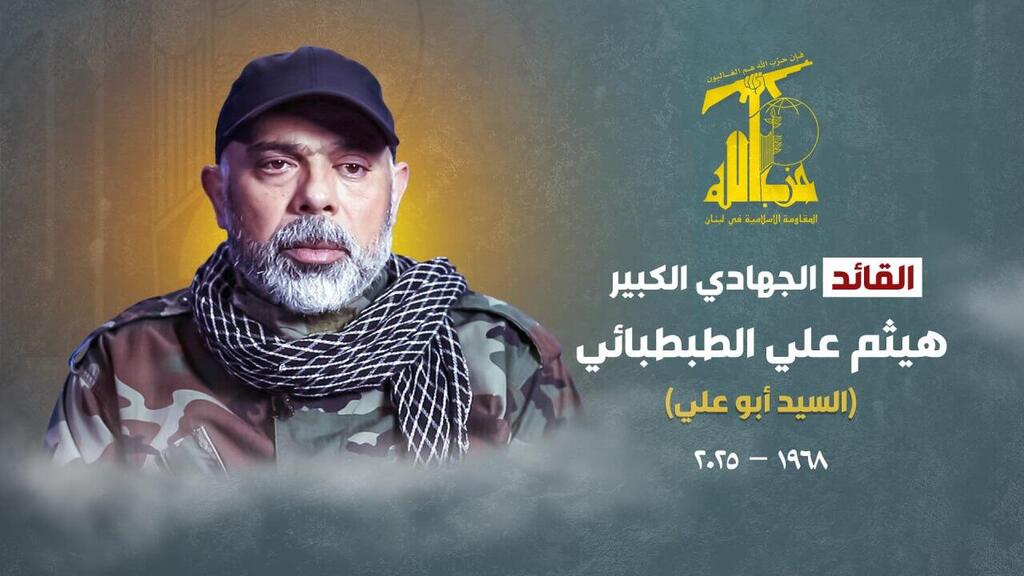
Hezbollah confirms the death of senior commander Haytham Ali Tabatabai, shown in a memorial image released by the terrorist group following his assassination in Beirut
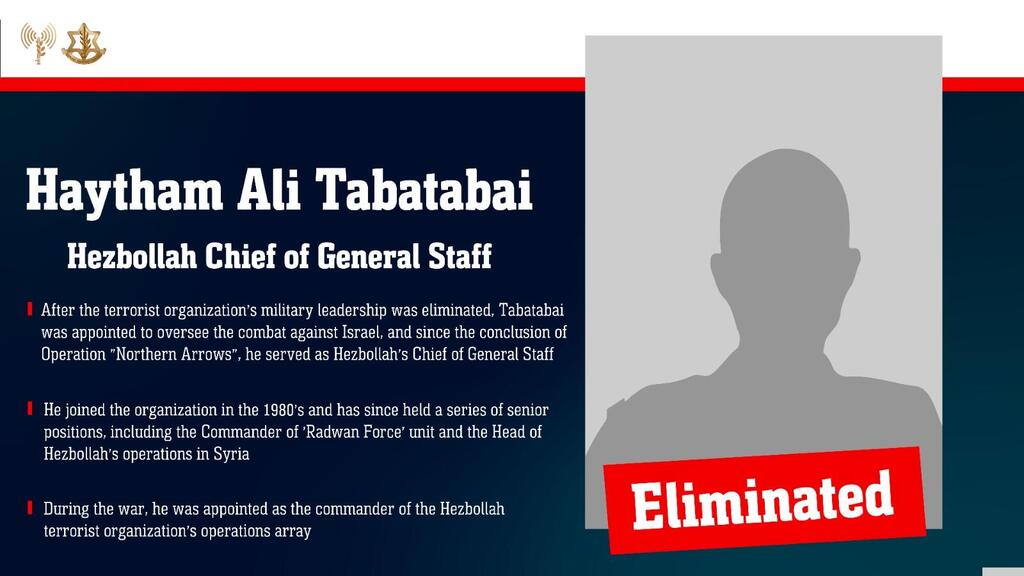
A profile of Hezbollah military chief Haytham Ali Tabatabai
(Credit: IDF)
Hezbollah suffered heavy losses during the war. In addition to several senior commanders—including the group’s secretary-general, Hassan Nasrallah—more than 2,500 armed fighters were killed in various engagements. But according to Israeli and Arab officials, Tabatabai’s efforts proved effective: Hezbollah has successfully replenished its ranks with thousands of new recruits.
Tabatabai's final mission, underway at the time of his death, was directly tied to Hezbollah’s rebuilding efforts. According to Arab officials cited by the Journal, Tabatabai was implementing a new organizational strategy under which each unit commander would train a designated successor. The goal was to ensure that units could continue operating even if their leaders were eliminated—a key weakness exposed during the recent war.
Before returning to Lebanon, Tabatabai had commanded Hezbollah’s special forces in Syria and Yemen, according to the U.S. government. His role was part of what Washington described as Hezbollah’s broader effort to “provide training, material and personnel to support destabilizing activities across the region.”
The Israeli strike on Hezbollah military chief Haytham Ali Tabatabai's safehouse in Beirut's Dahieh district
(Video: IDF)
The Alma Center, an Israeli research organization focused on security threats to the country’s north, noted that Tabatabai survived a 2015 Israeli assassination attempt in Quneitra, southern Syria, near the village of Hader. That attack prompted his move to Yemen, where he helped train Houthi militia forces—another Iranian-backed proxy.
Though Hezbollah has not yet responded militarily to Tabatabai’s assassination, Israeli and Arab intelligence sources report that the group continues its rebuilding efforts. These include replenishing its supply of rockets, anti-tank missiles and other munitions. Some of the weapons are reportedly arriving by sea or smuggled overland through Syria, despite Israeli efforts to disrupt these routes. The group is also believed to be restoring parts of its arsenal through domestic weapons manufacturing.
Tabatabai was designated a “Specially Designated Global Terrorist” by the United States on Oct. 26, 2016, under a presidential executive order. The State Department offered a $5 million reward for information about him. According to Hezbollah, he was 57 at the time of his death and joined the organization before the age of 18. He later helped establish the Radwan Force, a unit tasked in part with invading Israeli communities in the Galilee.
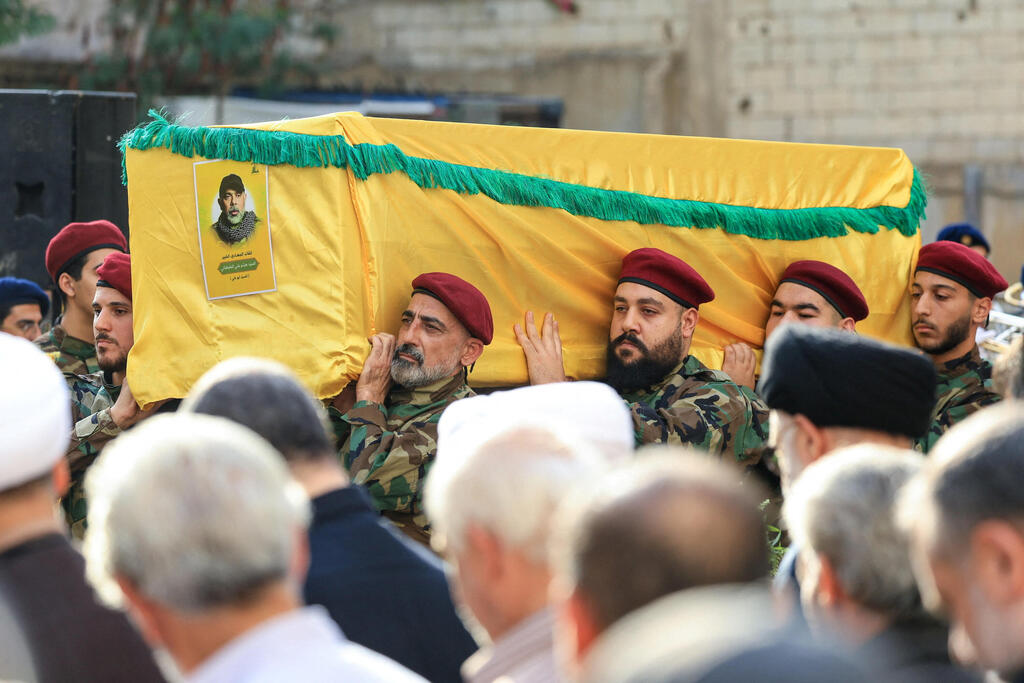
Tabatabai laid to rest in Beirut
(Photo: REUTERS/Mohamed Azakir)
He was killed alongside four other Hezbollah operatives and buried Monday in the Dahieh district of Beirut. Notably absent from the funeral was Hezbollah Secretary-General Naim Qassem, who has not spoken publicly since the strike. He is expected to deliver a speech Friday at 6 p.m. during a memorial event honoring Tabatabai and the others killed.
Hezbollah has not issued any explicit threats of retaliation. A source close to the group told the French news agency AFP that internal disagreements persist. “There are two opposing views within the organization,” the source said. “Some favor a response to the assassination, while others prefer restraint. For now, the leadership favors a diplomatic approach.”