

Government ministers on Monday approved a proposal by Likud MK Ariel Kallner, backed by Prime Minister Benjamin Netanyahu, to establish a political, non-state inquiry commission into the failures surrounding the October 7 Hamas massacre and the war that followed.
The only minister to vote against the plan was Minister Ze’ev Elkin (National Unity), who objected to a clause stating that if the opposition refuses to participate in appointing the commission’s members, Knesset Speaker Amir Ohana would choose them instead. The bill is expected to go to a preliminary Knesset vote on Wednesday.

At the cabinet meeting, Netanyahu said parts of the October 7 discussions reviewed by State Comptroller Matanyahu Englman raise “serious questions.” “I’d be glad if the public could see it — it would be shocking,” he said. Netanyahu said the panel should look into decision-making going back to the Oslo Accords, the Gaza disengagement, and include issues such as draft refusal and judicial reform. “I want a balanced committee with observers from bereaved families. I’m willing to be the first to be examined,” he said.
Debate over appointments
Elkin argued that giving the Knesset speaker the power to appoint opposition members would undermine the legitimacy of the inquiry. “We’re fooling ourselves that this could be a real government investigation,” he said. He also rejected an alternative, backed by Agriculture Minister Avi Dichter, under which President Isaac Herzog would appoint members in place of the opposition. “The president is also a political figure,” Elkin said.
Communications Minister Shlomo Karhi said he believes opposition MKs will eventually cooperate, and Cabinet Secretary Yossi Fuchs said the coalition wants a fair process and broad public backing. Elkin responded that the clause should be removed to build trust. “If we leave this clause in, we risk ending up with a one-sided panel and losing any influence over its mandate,” he said.
Diaspora Affairs Minister Amichai Chikli said the inquiry should also examine the Supreme Court, refusal to serve, and the Shalit prisoner deal. Elkin replied that the issue is not what to investigate, but who gets to decide.
Opposition: inquiry is politically controlled
Opposition Leader Yair Lapid (Yesh Atid) repeated his call for a state commission of inquiry, based on a March proposal by President Herzog, in which Chief Justice Yitzhak Amit would appoint members in consultation with Supreme Court Justice Noam Sohlberg. “For the sake of bereaved families and national healing, I agreed to the president’s compromise,” Lapid said. “Under Netanyahu and Kallner’s plan, the government controls the agenda, the witnesses, and the process. This isn’t an inquiry — it’s a death certificate for the truth.”
The proposal has triggered strong backlash from bereaved families and survivors of the October 7 attack. Members of the October Council held a demonstration outside the Prime Minister’s Office and joined Knesset committee meetings, calling for a state-led investigation.
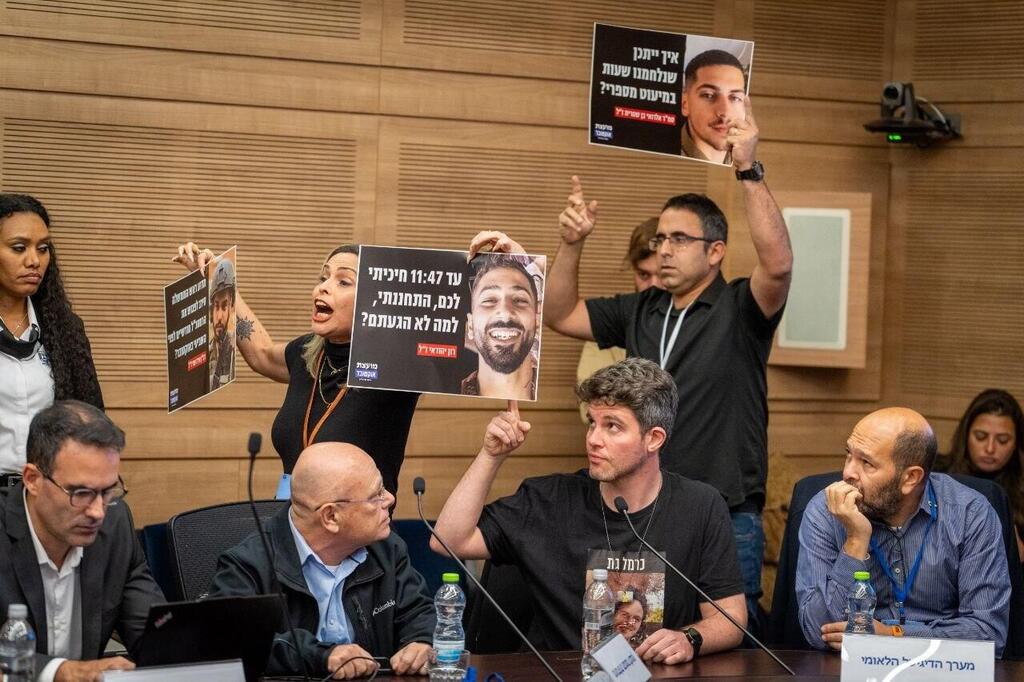
Bereaved families and survivors of the October 7 attack call for state inquiry
(Photo: Shalev Shalom)
Former Beit She’an Mayor Rafi Ben Shitrit, father of Staff Sgt. Alroy, who was killed in Nahal Oz, tore up a copy of the bill at a press conference. “This law is designed to silence criticism, erase evidence, dodge accountability and manipulate the public,” he said.
Structure and possible changes
The proposed commission would include six members. At first, the Knesset would have 14 days to appoint them by consensus with the support of 80 MKs. If that fails, the coalition and opposition would each appoint three members. If the opposition declines to take part, the speaker would select all six — including those meant to represent the opposition.
Sources in the coalition told ynet that Netanyahu is open to an alternative: allowing Chief Justice Amit to step in and appoint opposition members, if necessary, rather than the speaker.
Justice Minister Yariv Levin rejected that suggestion, saying the chief justice’s position is disputed and that the court itself should be examined by the commission, not given a role in forming it. Environmental Protection Minister Idit Silman added: “There’s a crisis of trust in the judicial system — and they earned it.”
Despite mounting criticism, the coalition is expected to push the bill forward in the Knesset this week.