

One day after Hezbollah violated the ceasefire, Israel has still not decided how it will respond. Defense officials are preparing a series of possible responses against the terror group, but the assessment is that there is currently no desire to completely collapse the framework of the agreement and the pilot program that began about a week and a half ago. Meanwhile, Prime Minister Benjamin Netanyahu and Defense Minister Israel Katz have remained silent.
“We will respond to Hezbollah’s violation and when it happens, people will know about it," a security official said. "No one is holding a stopwatch to decide when to respond. The timing will suit us, there will be a response and there are several ways to do it.” They added that if the agreement collapses, “we will respond accordingly.”
Destruction of an underground Hezbollah headquarters
(Credit: IDF Spokesperson)


The incident occurred overnight between Tuesday and Wednesday in the Ali Taher ridge area, where forces from the IDF’s 36th Division are operating. During a military patrol as part of operational activity, a Hezbollah FPV drone struck an engineering vehicle. The vehicle was unmanned and there were no casualties. It was the most serious incident since the ceasefire took effect.
Later, Thursday evening Israel time, residents of northern Israel were notified Thursday evening to expect a powerful explosion between 11 p.m. and 1 a.m. in the Ramim ridge area, the Hula Valley and the northern Golan Heights. Residents of the border communities of Metula and Misgav Am were instructed to open their windows to help prevent them from shattering due to the force of the blast. No special instructions were issued for other communities.
The officials explained that there is an American mechanism for reviewing incidents and responses and that it is important for everything to be coordinated. According to them, a review of the map of threats and the possible actions that can be taken in the area shows a wide range of options — from strikes in Beirut or Baalbek, which currently appear less likely, to the destruction of terror infrastructure that the IDF has held off on targeting due to sensitivities.
The pilot program, which began about a week and a half ago, will also be examined in another two to three weeks. A decision will then be made on whether to expand it to additional areas or halt it. So far, the Lebanese army has been attempting to carry out operations in the villages included in the pilot program, but it is still difficult to determine whether it is succeeding. If it does succeed, officials stressed, the pilot program will be expanded to additional locations.
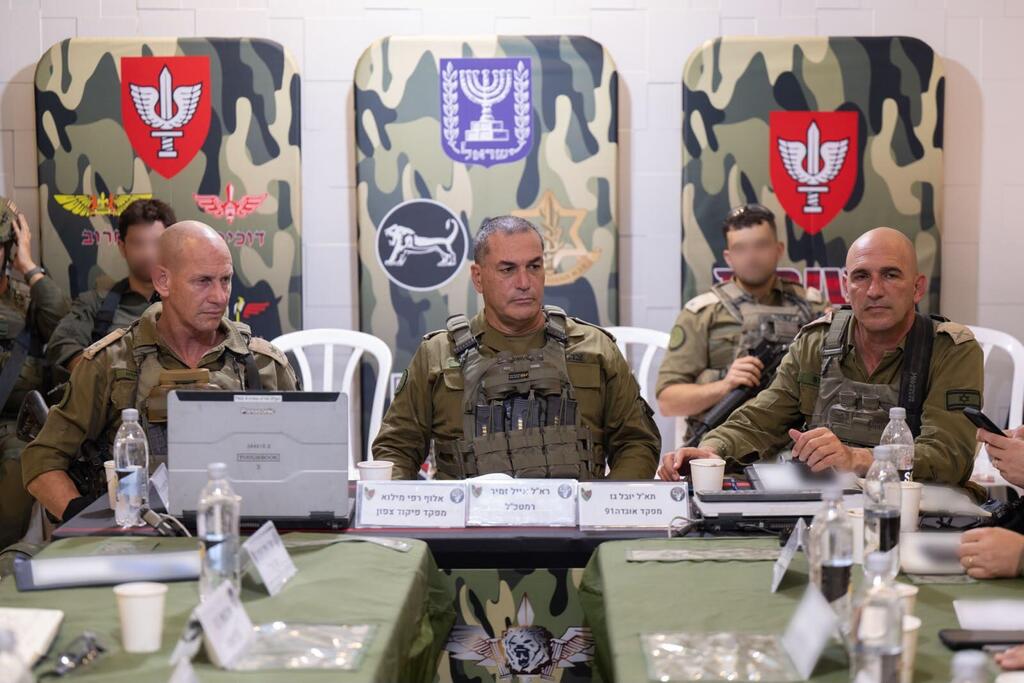
IDF Chief of Staff Lt. Gen. Eyal Zamir visited southern Lebanon
(Photo: IDF Spokesperson)
Meanwhile, activity along the Yellow Line continues as usual. Engineering, infantry and armored forces are continuing to demolish sites, scan areas and degrade Hezbollah’s capabilities. The IDF’s goal is that, by the end of the process, the entire area south of the Litani River will be demilitarized in one way or another.
On Tuesday, IDF Chief of Staff Lt. Gen. Eyal Zamir visited southern Lebanon along with Northern Command chief Maj. Gen. Rafi Milo, 91st Division commander Brig. Gen. Yuval Gaz and other commanders. “We are prepared for any change in the situation and ready for a wide range of scenarios,” Zamir said. He also referred to Israel’s military achievements in Iran, saying: “If required, we will know how to deepen those achievements.”
Zamir did not directly address in his remarks the intention to respond to the drone launched at the IDF engineering vehicle, but that possibility is the reason he spoke about the army’s ability to quickly return to combat.
First published: 20:42, 07.30.26