

Lebanon’s Prime Minister Nawaf Salam said this evening (Friday), shortly after the signing of the agreement in Washington, that the framework reached with Israel aims to achieve a full Israeli withdrawal from all Lebanese territory and to restore state sovereignty.
In the meantime, U.S. Secretary of State Marco Rubio issued a statement after the signing, announcing that the United States will transfer $130 million to Lebanon. “The United States commends the courage of the two sovereign governments for taking this step to break the cycle of violence once and for all. The United States will remain fully engaged and commit significant resources, including an immediate $100 million in humanitarian assistance in coordination with the U.N.”
The moment of signing the framework agreement between Lebanon and Israel
(Photo: Reuters)


He added that “the United States also reaffirms its intent to improve the capability and capacity of the Lebanese Armed Forces (LAF) to more effectively establish sovereignty throughout Lebanese territory. To that end, the Department of War is prepared to reimburse the LAF with more than $30 million under existing authorities and appropriations to support the President’s vision for an enduring peace in Lebanon.”
According to our commentator Ron Ben-Yishai, one of the agreement’s key advantages is the economic incentive provided by the United States to Lebanon. In Lebanese terms—where reconstruction is urgently needed—this is not insignificant funding, even though the actual need amounts to billions. Still, Lebanon now has not only a diplomatic and security interest in the agreement, but also an economic one.
Under the new framework, a trilateral military coordination mechanism—Israel, Lebanon, and the United States—will be established to enable implementation. As Rubio also announced, the U.S. is renewing military aid to Lebanon. According to him, the agreement sets out a clear and structured process for restoring Lebanese sovereignty, dismantling Hezbollah’s weapons and terrorist infrastructure, and allowing Israel to return to its borders once the threat to its citizens has been removed. For Lebanon, the framework provides a real path out of a prolonged crisis. For Israel, it creates an enforceable pathway to removing the ongoing threat on its northern border.
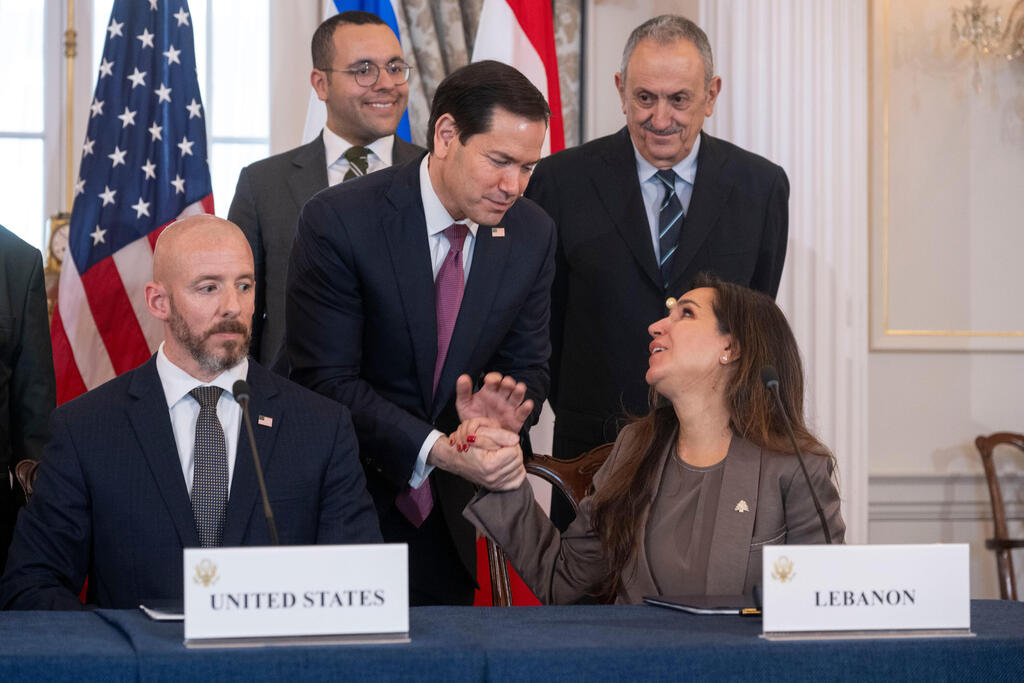
The signing of the agreement in Washington
(Photo: AP Photo/Kevin Wolf)
This is not the first time an international mechanism has attempted to demilitarize southern Lebanon, and once again no one is under any illusion that the Lebanese Army will act against Hezbollah. Even with strengthened U.S. support, the Lebanese military remains weak, and its commander is not interested in confrontation with the terrorist organization.
On the face of it, this appears to be a stronger agreement than the previous one, in the sense that it includes firmer American commitments. On the other hand, it seems Rubio was eager to present an achievement, and once again the Americans have not truly gone into the details. Against the backdrop of negotiations with Iran, Washington may be trying to present a framework agreement that signals to Tehran that it is seeking to preserve the ceasefire in Lebanon.
Hezbollah has already declared that it is not bound by the agreement, and those likely to pay the price are IDF soldiers, whose operational restrictions are expected to tighten further. Prime Minister Benjamin Netanyahu will now have to bring the agreement for approval by the cabinet. In the previous ceasefire discussions, Netanyahu said there was no agreement because Hezbollah had not accepted it, and that if one were reached, he would bring it for approval. Now, Israel has signed a formal document with the governments of Lebanon and the United States, and it will be required to bring it for approval by the cabinet or the government.