

Security officials say the Houthi rebel movement in Yemen has made significant advances in recent months, developing longer-range missiles and explosive drones and moving much of its production and storage underground — a shift that has prompted Israel to intensify operations against Houthi infrastructure far from its borders.
The warning, issued by military and intelligence officials, came after Thursday’s large-scale Israeli air raid on Sanaa that the military said dropped more than 65 munitions on Houthi command and weapons-storage sites in Operation Moving Package. The strikes followed a drone strike on the southern resort city of Eilat that wounded more than 20 people.
Israeli strikes in Yemen


Officials say the pattern in Yemen mirrors an Iranian model adopted by Tehran’s regional allies: establish fortified, indigenous weapons industries — often dug into mountains or deserts — so groups are not dependent on foreign shipments. The model, officials say, aims to produce heavier, more accurate missiles and low-flying, hard-to-detect explosive drones.
“The threat is evolving: the Houthis are not only launching rockets and drones, they are building resilient production and storage capabilities,” a senior military official said, speaking on condition of anonymity under military rules.
Israeli intelligence has also been watching what it describes as a Houthi plan to train militias for a large-scale incursion modeled on Hamas’s Oct. 7 attack on Israel. The program, nicknamed in some reports “Tuffan al-Aqsa” or “Jerusalem Flood,” allegedly includes local militia recruitment and courses to practice mass-infiltration tactics that could originate from neighboring countries, officials said.
Analysts say the training takes place in Yemen, but they assess that any actual operation would likely be launched from Jordan or Syria to obscure its origins. “This is an idea beyond anything they have attempted before,” a military official said.
The assessments have prompted stepped-up Israeli intelligence collection and new task forces focused on Yemen. Military intelligence (AMAN) has created teams of analysts directed at locating Houthi command centers and weapons production sites, officials said. Those units have already produced what the military called “initial successes” in mapping Houthi infrastructure.
The strikes on Sanaa came about a month after an earlier Israeli operation targeting Houthi infrastructure and followed an attack on a Houthi cabinet meeting in Sanaa that Israeli intelligence assessed had failed to eliminate two principal targets — the Houthi chief of staff and defense minister — even as several lesser ministers and the government’s head were killed, according to Israeli assessments shared with media.
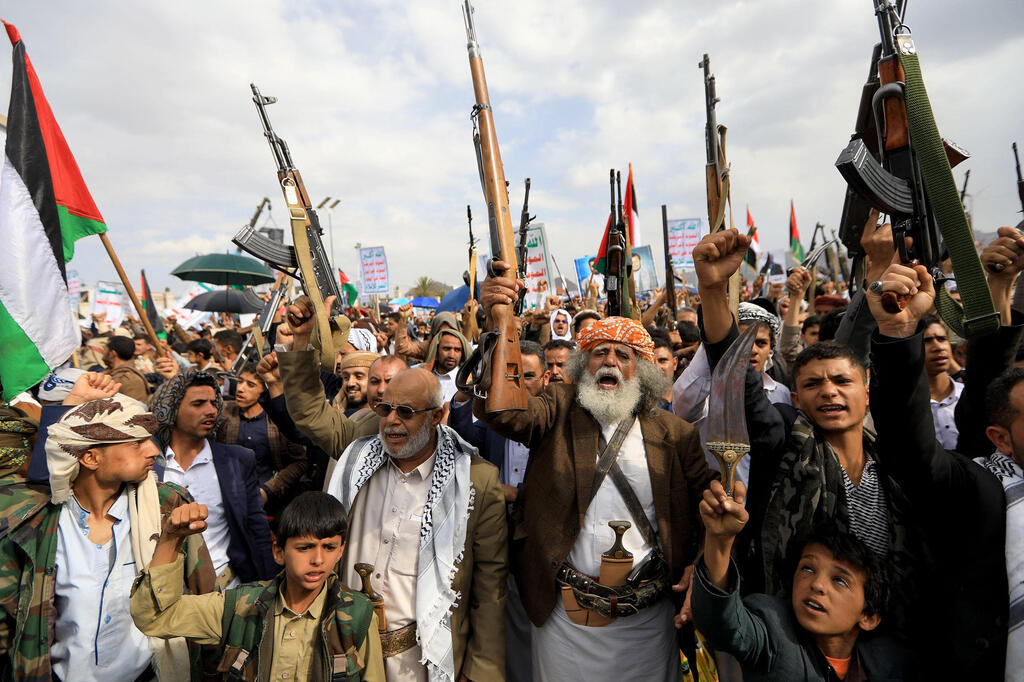
(Photo: MOHAMMED HUWAIS / AFP)
U.S. and international pressure on Houthi financing and arms transfers has continued. The U.S. Treasury this month sanctioned more than two dozen entities accused of channeling funds to the Houthis. Israeli officials said those steps, together with targeted strikes and internal Houthi developments, could help weaken the group over time.
IDF officials have said the operations are designed to prevent a future in which the Houthis possess thousands of accurate, long-range missiles that could threaten Israel and regional stability. “We do not want the Houthis to become a strategic, long-range missile threat,” one senior military official said. “That is why we are acting now to disrupt their centers of gravity.”
The Houthi movement, which is backed by Iran, has launched waves of drones and missiles toward Israel and shipping lanes in the Red Sea since the Gaza war began. Israel says its strikes in Yemen are intended to stop those attacks and to protect Israeli and international maritime traffic.
Analysts caution that degrading Houthi capabilities is difficult. Iran-style indigenization of weapons programs — tunneling production facilities into mountains and deserts and training local engineers — makes strikes and interdictions more complicated, they say. Israeli forces have in recent years carried out operations in Syria and elsewhere to try to halt similar efforts by Tehran and its proxies.
Israeli leaders argue a sustained campaign against the Houthi threat is necessary even if a ceasefire in Gaza is reached, saying the group’s stated goal of destroying Israel makes it an enduring security risk despite its geographic distance.
“We will not accept a situation in which the Houthis one day field thousands of precise missiles,” an Israeli official said, summarizing the government’s rationale for continuing operations.
However, another cautioned, “The more we hit their ports and stop weapons from Iran, the more they expand independent production."