


Efforts by Spain, Ireland, and Slovenia to push the European Union to take action against Israel over alleged human rights violations fell short once again, as EU foreign ministers failed to reach a consensus following a meeting in Brussels. No decision was made to suspend or alter the 1995 Association Agreement between Israel and the EU.
Despite proposals raised by EU foreign policy chief Kaja Kallas—including a partial or full suspension of the agreement; individual sanctions targeting Israeli ministers, military officials or extremist settlers; arms embargoes; trade-related measures; and freezing scientific cooperation such as participation in the Horizon Europe research program—none received the required support from EU member states.
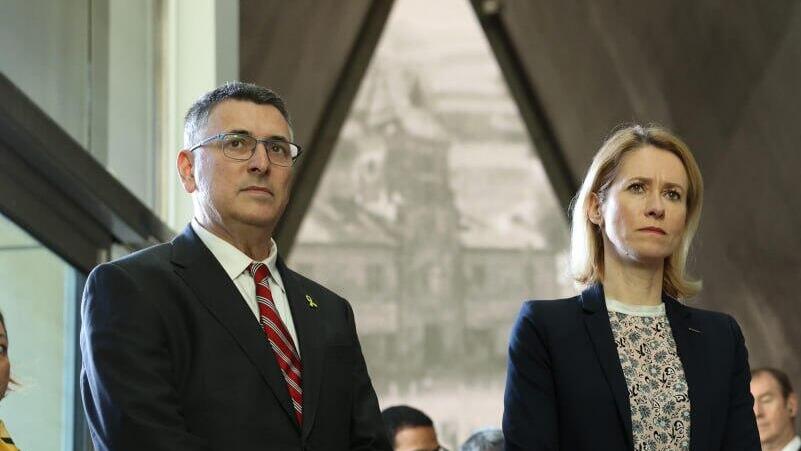
Gideon Sa'ar next to Kaja Kallas
(Photo: GPO)
Kallas said afterward that “Israel needs to take more concrete steps to improve the humanitarian situation in Gaza,” warning that “all options remain on the table” if Israel fails to meet its obligations.
The outcome marked a significant setback for Spain, Ireland and Slovenia, which have been leading anti-Israel efforts within the bloc. Slovenian Foreign Minister Tanja Fajon, one of the initiative’s main backers, posted on social media: “It is disappointing that there is no EU consensus to act on the June determination that Israel is violating Article 2 of the association agreement, concerning human rights. A general agreement on humanitarian aid cannot excuse inaction. We all have a responsibility to protect civilians.”
Fajon referred to a new understanding reached between Israel and the EU in recent weeks to boost humanitarian aid to Gaza—a move that took shape just ahead of the ministerial meeting. Kallas said last week that the agreement includes opening more crossings, expanding aid channels, and increasing the number of trucks entering the territory, “with a shared understanding that the aid must reach the civilian population directly and steps must be taken to prevent its diversion to Hamas.”
In the two weeks leading up to the meeting, Israeli Foreign Minister Gideon Saar launched a diplomatic campaign to block potential punitive steps. He held a series of meetings and phone calls with European leaders, including 11 diplomatic meetings in the Baltics and Austria. He also met with the presidents of Austria and Latvia and the prime minister of Estonia.
Saar’s talks focused on strengthening Israel-EU relations and countering efforts by Spain, Slovenia and Ireland to suspend or curtail the association agreement. When that initiative proved unviable, those states pushed alternative measures aimed at harming Israel’s standing, including trade restrictions and excluding Israel from programs like Horizon Europe.
Get the Ynetnews app on your smartphone: Google Play: https://bit.ly/4eJ37pE | Apple App Store: https://bit.ly/3ZL7iNv
Countries that opposed suspending the agreement or any retaliatory measures included Germany, Italy, Austria, the Czech Republic, Hungary and Croatia—several of which wield considerable influence within the EU. Under EU rules, passing such measures requires a “qualified majority,” meaning support from at least 65% of the EU’s population. The opposition of large member states effectively blocked any action.
The Association Agreement, signed in 1995, forms the legal framework for relations between the EU and Israel, covering economic, trade, diplomatic, cultural, health and social cooperation. Kallas decided to raise the possibility of action against Israel after the EU agreed in May to review the agreement “in light of Israeli military actions in Gaza and the West Bank, including restrictions on food, fuel, water and basic medical supplies to the besieged population.”
Three weeks ago, Israel also managed to block a separate EU initiative in Brussels to impose sanctions over the war in Gaza, as several key EU members voiced opposition. Spain, Ireland and Slovenia had again led the push, but were met with firm resistance from Germany, Italy, Austria, Hungary, Croatia, Romania, Lithuania, Greece and other states.