

The High Court of Justice heard arguments Thursday on petitions seeking the establishment of a state commission of inquiry into the failures surrounding Hamas’ Oct. 7 attack, as judges barred the public from the hearing out of concern over possible disturbances.
At the start of the hearing, Deputy Chief Justice Noam Sohlberg pressed government representative Michael Rabelo on the government’s position.
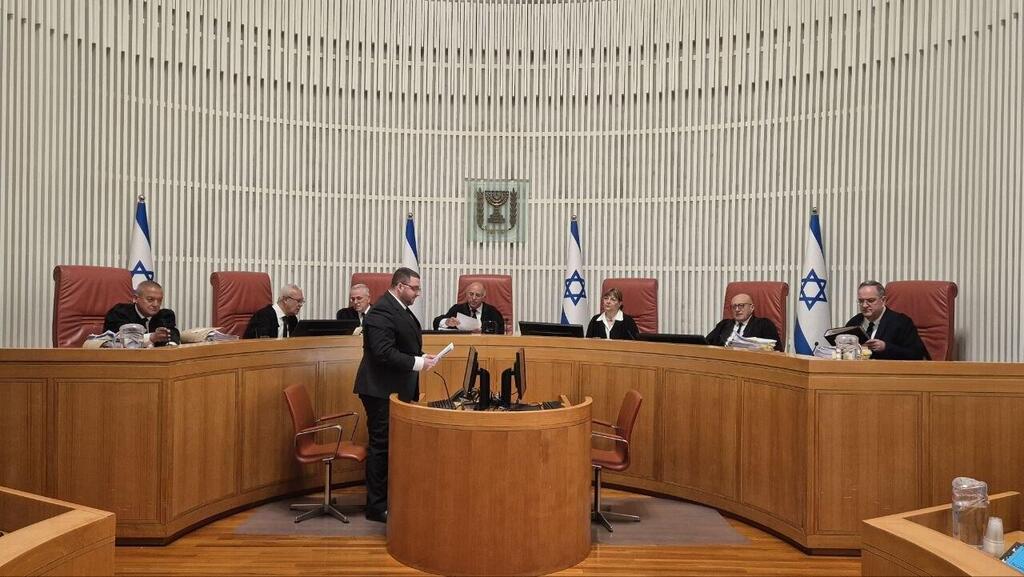
“You are saying no to a state commission of inquiry, according to your approach,” Sohlberg said. “So what yes? We have not seen anything.”
Rabelo replied that “in any case, the court has no authority to compel the government to establish a commission of inquiry. That does not exist in any court in the world.”
According to the government’s position, the petitioners are seeking an unprecedented step in Israel and abroad because the establishment of a commission of inquiry falls within the executive branch’s core authority.
“At the time, the government was instructed to discuss the issue, the government discussed it and decided not to establish a commission of inquiry,” Rabelo said. “So what are the petitioners asking, that your honors stand in the place of the government?”
Before the hearing, families belonging to the October Council, which has called for a state commission of inquiry, had been expected to deliver a statement. They struggled to do so after a confrontation with other bereaved families, including members of the Gvura and Tikva forums, who oppose such a commission.
“It is not appropriate to let the High Court create an inquiry commission,” said the father of Golani Brigade soldier Yishay Fitusi, who was killed on Oct. 7.
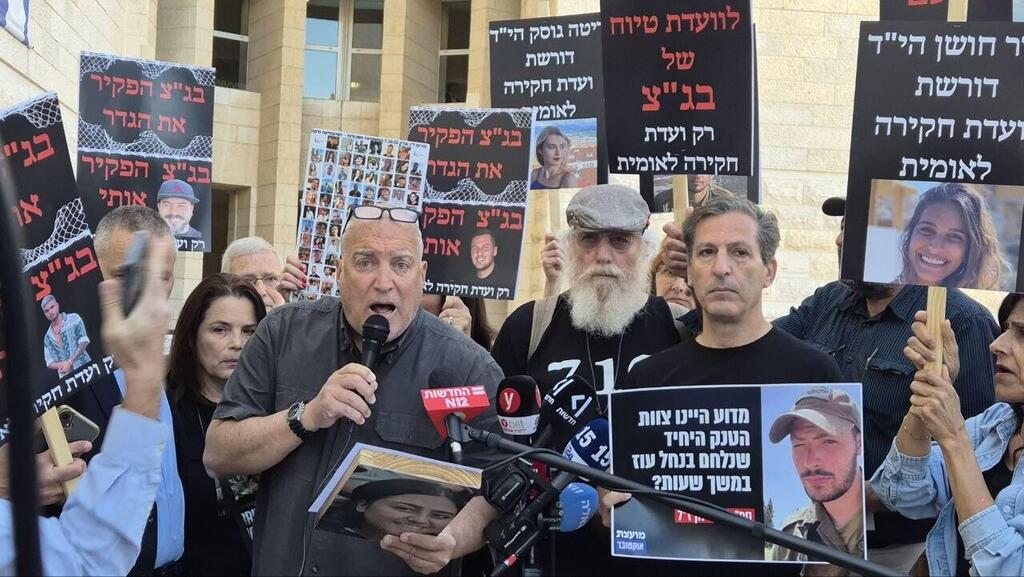
Bereaved families outside the High Court of Justice in Jerusalem demanding state commission of inquiry into the failures that led to the Oct 7. massacre
(Photo: Alex Kolomoisky)
Together with others, the group chanted, “There will be no commission of [Chief Justice] Yitzhak Amit,” and prevented the parents of Staff Sgt. Itay Chen — who was killed on Oct. 7, taken into Gaza and later returned for burial — from speaking.
Amid the attacks directed at them, Chen’s mother, Hagit, said: “You cannot bury our children together with the truth.”
His father, Ruby Chen, added: “We see what has been happening here since our demand for a state commission of inquiry — pressure, threats, wild incitement. We say to the judges: Do not be deterred, do not surrender.”
Eyal Eshel, the father of lookout soldier Roni Eshel, who was killed on the day of the attack, said: “The prime minister is choosing the path of division, the path of civil war, and that is what it looks like around me. The time has come for a historic ruling.”
Former minister Izhar Shay, whose son Yaron, a Nahal Brigade soldier, was killed on Oct. 7, appealed to parents opposing a state commission of inquiry.
“I wanted to tell you — there is a father here who was willing to speak with me and I heard his pain,” Shay said. “I am Yaron’s father and your pain and mine are the same pain. Why are we fighting one another?”
High Court Chief Justice Yitzhak Amit announced in February that, “for the sake of a clear mind,” he was transferring the decision on the judicial panel for the hearing to his deputy, Sohlberg. A day later, Sohlberg said the expanded panel — which he said was determined “taking into account recusals of some of the justices” — would include himself and Justices David Mintz, Alex Stein, Yael Willner, Yechiel Kasher, Khaled Kabub and Ofer Grosskopf.
In November, the High Court issued a conditional order in petitions seeking a state commission of inquiry into the failures of Oct. 7, while at the same time a ministerial committee was established to discuss the mandate of the government review panel it intended to set up.
The ministerial committee has met only once since it was formed. In any case, the court’s order directed the government to respond to the petitions demanding an explanation for why a state commission of inquiry would not be established to conduct an “independent, professional and impartial” investigation into the full range of events connected to the Oct. 7 attack.
In January, the government filed its response with the court, writing that “there is no legal basis whatsoever” to make the conditional order absolute and that the court should dismiss the petitions outright. Referring to the possibility that the court could order the establishment of a state commission of inquiry into the massacre, the government called such a step “an extreme and unprecedented act.”