

It can already be said that the attempted attack on the flydubai flight occurred because the field was left completely unprotected. The evidence: all the bodies involved in vetting foreign crew members on flights to Israel are already blaming one another. Either way, the incident must be treated as a successful terrorist attack - with all that implies, and the division of responsibility for screening foreign crew members landing in Israel must be urgently redefined, after Omani pilot Hamam al-Hamami boarded a plane bound for Ben-Gurion Airport.
Formally, responsibility for the screening lies with the Transportation Ministry’s security division, the Aviation Security Operations Center, or ASOC. It is supposed to provide security approval for foreign airlines arriving in Israel. At the same time, the Shin Bet is responsible for securing Israeli airlines. But the Transportation Ministry says it is not an intelligence agency and did not have the intelligence tools needed to examine the names of pilots and crew members on flights arriving in Israel.
Gallery
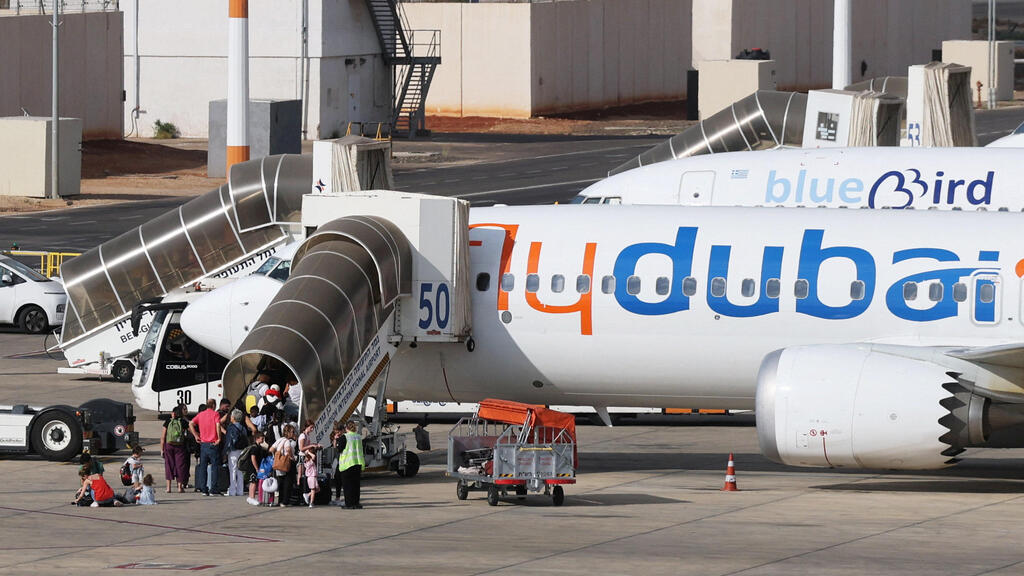
Israeli passengers board a flydubai airplane at Ben Gurion airport a day before the terror incident
(Photo: Ammar Awad/Reuters)
A law passed by the Knesset in 2023 requires all airlines to transfer to Israel the details of their passengers and crew members, as part of arrangements connected to the U.S. Visa Waiver Program. That database is transferred to the National Passenger Data Analysis Center, which operates under the Tax Authority — but the Mossad, Shin Bet and police insisted that they too have access to it for counterterrorism purposes, and the information is also available to the Transportation Ministry. The data provided on crew members includes identification details, citizenship and travel document information.
According to its official mandate, the Transportation Ministry’s security division is responsible for aviation security, and its duties explicitly include the “security assessment of foreign flights crossing or arriving in Israel.” The division also operates the Aviation Security Operations Center, which deals with coordinating the security aspects of aircraft arriving in Israel.
The Transportation Ministry is the body that grants seasonal approvals to airlines that commit to complying with all security regulations. Flydubai, an Emirati state-owned airline, pledged to Israel that it would comply with all the rules and send only pilots from countries that maintain diplomatic relations with Israel. That commitment was violated, but that does not absolve Israeli authorities of responsibility for the failure.
Although Flydubai sent an Omani pilot to Israel in violation of its commitments, the Transportation Ministry says it did not receive the passenger and crew list from the Tax Authority, while the Mossad also says it did not receive the list, even though it was available.

The Omani flydubai pilot who had a terrorist agenda
Transportation Minister Miri Regev placed responsibility on the Mossad, which did not obtain the list. The only Israeli body that actually received the list was the Tax Authority, but its focus is on identifying criminals and money launderers, not terrorists. The conduct of all the bodies involved and the incident as a whole suggest that Israel had not considered foreign pilots to be a potential source of danger and had not taken into account a scenario such as the September 11 attacks.
It later emerged that the state comptroller had indeed warned in the past of failures in the field, and nothing was done. In May 2024, State Comptroller Matanyahu Englman published a report on the security of international civil aviation to and from Israel. The audit examined outbound aviation from Ben-Gurion Airport, the security of Israeli aviation abroad and the security of foreign and private civilian aircraft entering Israeli airspace.
The comptroller recommended that the National Security Council conduct a staff review together with the Transportation Ministry, Finance Ministry, Israel Airports Authority, Shin Bet and police, and examine international aviation security in Israel “in all its aspects” — including foreign aviation entering the country. Despite the recommendation to regulate the division of responsibility among the bodies, the National Security Council, which was supposed to deal with the issue, did not do its job and no one took responsibility.
The Transportation Ministry’s Aviation Security Operations Center knows, for example, how to rigorously inspect private flights arriving in Israel. Why could the same center not inspect commercial airlines in the same way? On the face of it, the explanation is that it lacks both intelligence capabilities and the manpower needed to examine the large number of pilots and crew members arriving in Israel.
Either way, the state will have to establish a commission of inquiry and quickly bring order to the field — before a major disaster occurs that cannot be prevented at the last moment, as happened on the flydubai flight.
'Transportation Ministry did not pull the data for two years'
What can be said with certainty is that the passenger and crew list for flydubai flight FZ 1073 was transferred to Israel before takeoff, including the details of the Omani pilot. The Tax Authority confirmed that the full list was sent and received in accordance with the mechanism established under the Passenger Data Law.
However, according to several senior officials, the Transportation Ministry did not retrieve or examine data on crew members arriving on foreign flights to Israel for about two years.
From inside the flydubai flight
(Video: Section 27A of the Copyright Law)


That means the current incident was not necessarily the first time a crew member from a country that does not maintain diplomatic relations with Israel arrived in the country without that information being flagged to the officials responsible for conducting the flight’s security assessment.
At the center of the examination is the Transportation Ministry’s security division, whose official responsibilities include, among other things, the “security assessment of foreign flights crossing or arriving in Israel,” issuing security directives to airlines and conducting security assessments of transportation professionals, including those in the aviation sector.
The Aviation Security Operations Center also operates under the division. The division is headed by Avraham Cohen, alongside deputy security division director Tamir Uri. The question now is where the failure occurred and who was responsible for disregarding critical information about the identity of the foreign airline’s pilot — information that could have determined the fate of everyone on the flight.
Officials familiar with the details say crew data was not retrieved from the database for examination by the relevant official at the Transportation Ministry. Nor did the security agencies systematically examine the data that had been transferred.
As a result, even though the co-pilot’s citizenship was included in the information transferred to Israel, it did not trigger further scrutiny.
That is significant because the co-pilot’s citizenship was not a detail that should have become known only after the incident. The law requires airlines to provide Israel with data on passengers and crew members on flights entering, leaving or passing through the country.
The information includes, among other things, name, date of birth, sex, citizenship, passport number and the country that issued it.
The mechanism was established under the Law on Powers for the Collection and Analysis of Passenger Data, approved by the Knesset in 2023 and entering into force in April of that year. The law established the National Passenger Data Analysis Center and defined the permitted uses of the information, including preventing and thwarting terrorism and securing civil aviation.
The law also defines how access is divided among the various bodies. The Transportation Ministry, Tax Authority, Population Authority and Health Ministry may approach the center and conduct a query or assessment of information in the database. The Shin Bet, Mossad and police are permitted to establish branches of the database within their own organizations.
In the case of the flydubai flight, the Tax Authority confirmed receipt of the list, including the details of all crew members. The Mossad also had access to the data but did not check the list in a way that would have flagged the co-pilot’s citizenship.
It is important to distinguish between a security agency having access to the database and being required to manually check every passenger and crew list. The law allows the Mossad to establish a branch of the database, but it does not stipulate that every list must be individually reviewed by the agency.
Regev: 'The Mossad is responsible for foreign flights'
The gap now exposed concerns not only the existence of the information, but the way the various bodies are supposed to use it. As part of the review, the relevant authorities will have to examine how responsibilities are divided among the Transportation Ministry, the passenger data center and the security agencies, what instructions were issued for checking flight crew data and how extensively the database has been used since the law took effect.
If it emerges that crew members from countries that do not have relations with Israel arrived during this period without that information being examined, authorities will have to investigate the scale of the phenomenon, not only the flydubai case.

Transportation MInistry chief Miri Regev placed responsibility for the failure on the Mossad
(Photo: Yariv Katz)
At the same time, the security establishment and Transportation Ministry will have to decide whether changes are needed in how crew data is checked and in which cases cross-checking or further examination is required.
Ultimately, the review will have to determine where the gap arose between the information transferred to Israel and the information that reached the body supposed to use it, and whether this was an isolated failure or a problem in the existing mechanism.
Regev already on Thursday night placed responsibility for the failure on the Mossad. In an interview with Kan News, she suggested waiting for the investigation in the UAE to be completed “to understand exactly what happened there and where the breach was,” but added: “The body responsible for centralizing the information is the Tax Authority, under a government decision made several years ago, and the list was indeed in its possession. The list was not transferred to us because the bodies that are supposed to carry out the identity checks on the crew are the intelligence agencies.
“Aviation security is a very complex issue. The entire intelligence field is divided between the Mossad and the Shin Bet. The Shin Bet is responsible for Israeli flights and charter flights, and the Mossad is responsible for foreign flights. Flydubai is a foreign company, it has nothing to do with the Shin Bet, it is connected to the Mossad. No security body said Israelis cannot fly on foreign airlines to Dubai. The bodies that are supposed to say what the threat level is and whether it is possible to fly to that destination are the security agencies.”
'There is no 100% in security'
At a briefing for reporters held several hours after Regev’s remarks, Transportation Ministry officials said the names had not been transferred to them in advance and that they “rely on a declaration by the foreign airline regarding security checks carried out on flight crew members.”
According to the ministry’s security division: “We are not an intelligence agency that checks the intelligence background of foreign individuals. We do not have forces abroad, and we do not have a team that checks every person there.”
Asked how many pilots from hostile countries had already landed in Israel and how passengers could be sure they were safe when boarding a foreign airline, the Civil Aviation Authority had no answer.
“We estimate there were none. But we have no certainty. There is no 100% in security. Only if we stop aviation entirely will everything be safe. We rely on local security,” it said.
Civil Aviation Authority director Shmuel Zakai stressed: “If there was a violation here, it will be investigated.”
Officials later said it was impossible to know with certainty who had landed in Israel in recent years and whether hostile individuals may have been among them.
Regarding the 2023 law requiring the transfer of data, Transportation Ministry officials said: “This is a center for collecting passenger data. It is a body that is not yet operational. The information is transferred to the Tax Authority, and from there it is supposed to be distributed to relevant parties — the police, Mossad and Shin Bet.”
However, they did not address claims that the ministry’s security division had not proactively retrieved the data.
This article includes videos and photographs used in accordance with Section 27A of the Copyright Law.